
Sandy Lake program keeps boats off other lakes
Advertisement
Read this article for free:
or
Already have an account? Log in here »
We need your support!
Local journalism needs your support!
As we navigate through unprecedented times, our journalists are working harder than ever to bring you the latest local updates to keep you safe and informed.
Now, more than ever, we need your support.
Starting at $15.99 plus taxes every four weeks you can access your Brandon Sun online and full access to all content as it appears on our website.
Subscribe Nowor call circulation directly at (204) 727-0527.
Your pledge helps to ensure we provide the news that matters most to your community!
To continue reading, please subscribe:
Add Brandon Sun access to your Free Press subscription for only an additional
$1 for the first 4 weeks*
- Enjoy unlimited reading on brandonsun.com
- Read the Brandon Sun E-Edition, our digital replica newspaper
*Your next Free Press subscription payment will increase by $1.00 and you will be charged $20.95 plus GST for four weeks. After four weeks, your payment will increase to $24.95 plus GST every four weeks.
Read unlimited articles for free today:
or
Already have an account? Log in here »
Hey there, time traveller!
This article was published 25/05/2024 (840 days ago), so information in it may no longer be current.
A group dedicated to protecting Sandy Lake has created a watercraft registration program to prevent the spread of aquatic invasive species in the wake of zebra mussels being detected in Clear Lake last year.
First reported by the Minnedosa Tribune, the Sandy Lake Water Protection Working Group is asking watercraft users to commit to using their power boats, kayaks, toys and other craft only on Sandy Lake this year.
“We’ve been inspecting watercraft for the past five years,” said group president Daryl Kines. “In particular (for) zebra mussels, but there are other aquatic invasive species as well and the measures we take protect us from those as well.
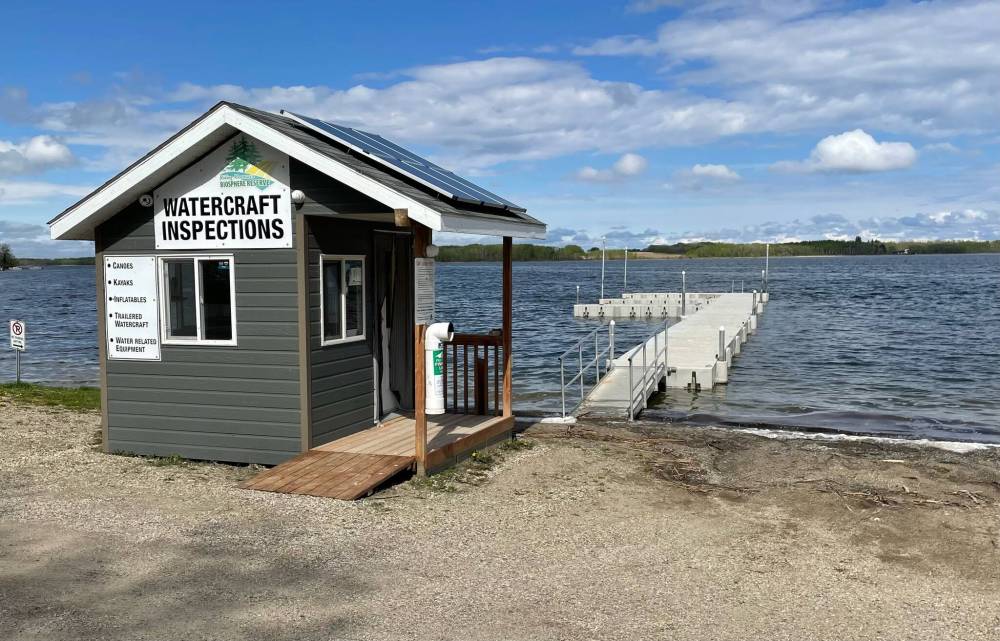
For the last five years, boats entering Sandy Lake have been inspected before launch at this station operated by the Sandy Lake Water Protection Working Group. After zebra mussels were detected in nearby Clear Lake last year, the group has instituted a program requiring boaters to commit to only using their watercraft in Sandy Lake and no other bodies of water this year. (Submitted)
“Certainly Riding Mountain National Park and the situation there has caused us to want to step up our measures.”
With Clear Lake off-limits to boats this year with only a few exceptions, Kines said the group has already received calls from boaters wondering if they can bring their watercraft down to Sandy Lake, situated about 100 kilometres north of Brandon in the Municipality of Harrison Park.
“We’re expecting a lot more people,” he said.
The group is trying to limit boaters to only launching their craft at the main launch at the south end of the lake near the intersection of Main and Lake streets.
Other official launches are being closed and property owners are being asked not to let boaters launch craft from their beaches.
Boaters who want to launch from that main point will be asked to sign an agreement that they will not use their craft in any other body of water this season.
Trailered watercraft will have a numbered steel tie placed over part of the trailer that prevents the attached craft from being launched.
When they come back to the lake, a boater with a tie will have it cut off and will be allowed to launch without inspection. When they’re done, they get the tie put back on.
Boaters will be required to have their watercraft inspected, with the inspection becoming more rigorous after June 10.
If the craft fails inspection, they must have their boat decontaminated at a provincial station before being allowed to launch in Sandy Lake.
According to Kines, the June 10 date is being set because that will be around when species like zebra mussels start to breed.
In the mussels’ case, their larva, known as veligers, will be released into bodies of water when the water warms up to around 10 C and are invisible to the eye while in their initial growth phases.
That’s why it’s important for inspectors to keep an eye out for leftover water in boats.
In the past few years of inspections, Kines said they’ve found boaters bringing in craft from out of province or coming from a control zone — an area where the presence of aquatic invasive species has been confirmed.
Typically, the station finds five to 10 craft per year that need to go for decontamination. While that’s not a lot, it only takes one boat to spread the species.
However, Kines said Riding Mountain National Park performs environmental DNA and sieve tests in area lakes each year and has yet to find any invasive species.
Sandy Lake used to have a substrate sampler to run tests that way, but Kines said someone stole it “for God knows what reason.”
Before 2022, the nearest provincial decontamination was in Headingley and so the group arranged a partnership with Riding Mountain National Park to send boats up there to be dealt with.
Now there’s a provincial station at the intersection of Highways 10 and 16, near Minnedosa.
Currently, Kines said, the group is working with the Municipality of Harrison Park to create a bylaw introducing fines for people caught violating their pledge.
Reeve Ian Drul said his council is investigating whether it has the authority to implement a bylaw.
“Currently, we’re only following the provincial rules … where if a boat is pulled over, and it’s come out of a control zone and it’s got water in its hold or water in its motor, that is a fine under the provincial act,” Drul said.
“We’re looking into a bylaw that all boats must be inspected at the Main Street launch before entering Sandy Lake, but there’s some paperwork involved with that, so we haven’t moved forward yet.”
Other lakes in the municipality have signage warning about zebra mussels and asking boaters to have their watercraft inspected at Sandy Lake, Drul said, though hopefully most boats coming from the south and east get inspected in Minnedosa.
Since the zebra mussel issue was made public, Drul said other municipalities have reached out to inquire about the local program as they look to create their own.
“What we’ve been trying to do is get the province on board with doing more inspection stations in the area and doing more decontamination to make sure that this doesn’t spread any further,” Drul said, adding that they’d like to see more testing done in nearby lakes and for the stream draining out of Clear Lake to be monitored more closely.
“We’re trying to do as much as possible, but we need the province to step up and help us.”
Ultimately, the group wants to spread the message that the best way to prevent the spread of aquatic invasive species is to only use watercraft in one body of water each season, whether it be a canoe, kayak, pontoon boat or trailered watercraft.
Beyond that, there is a fine for watercraft users who pass by a provincial inspection station without stopping for an inspection.
That’s a message Kines said he hopes the users of other lakes in the region will take to heart as well, as the spread of zebra mussels could affect not just the ecosystem, but infrastructure like water intakes along the Assiniboine River.
He’s also hoping that people using boats that can be launched from any point, like kayaks or canoes, will also follow the rules and have them inspected at the Main Street launch. On top of that, he hopes lake residents will encourage their visiting friends to use their boats instead of bringing their own.
In order to help pay for the program’s costs, as well as the costs of running the inspection station, users of trailered boats will be charged a $15 fee for the season, with other boat users getting charged a $5 fee.
» cslark@brandonsun.com
» X: @ColinSlark