
Dog owners face hurdles going to U.S.
Advertisement
Read this article for free:
or
Already have an account? Log in here »
We need your support!
Local journalism needs your support!
As we navigate through unprecedented times, our journalists are working harder than ever to bring you the latest local updates to keep you safe and informed.
Now, more than ever, we need your support.
Starting at $15.99 plus taxes every four weeks you can access your Brandon Sun online and full access to all content as it appears on our website.
Subscribe Nowor call circulation directly at (204) 727-0527.
Your pledge helps to ensure we provide the news that matters most to your community!
To continue reading, please subscribe:
Add Brandon Sun access to your Free Press subscription for only an additional
$1 for the first 4 weeks*
- Enjoy unlimited reading on brandonsun.com
- Read the Brandon Sun E-Edition, our digital replica newspaper
*Your next Free Press subscription payment will increase by $1.00 and you will be charged $20.95 plus GST for four weeks. After four weeks, your payment will increase to $24.95 plus GST every four weeks.
Read unlimited articles for free today:
or
Already have an account? Log in here »
Hey there, time traveller!
This article was published 01/06/2024 (878 days ago), so information in it may no longer be current.
New canine import regulations coming into force in the United States later this year are causing Westman dog owners, breeders and dog show competitors to rethink their travel plans south of the border.
Under new requirements announced by the U.S. Centers for Disease Control and Prevention last month, dogs entering the United States as of Aug. 1, 2024 will have to be at least six months old, appear healthy, have an implanted International Organization for Standardization (ISO)-compatible microchip, and have a completed CDC Dog Import form receipt.
As well, dog owners who have spent the last six months prior to crossing the border into the U.S. in only rabies-free or low-risk countries, such as Canada, will still need an additional form proving the dog is arriving from a DMRVV-free or low-risk country, and have it certified by their regular veterinarian as well as a veterinarian with the Canadian Food and Inspection Agency.
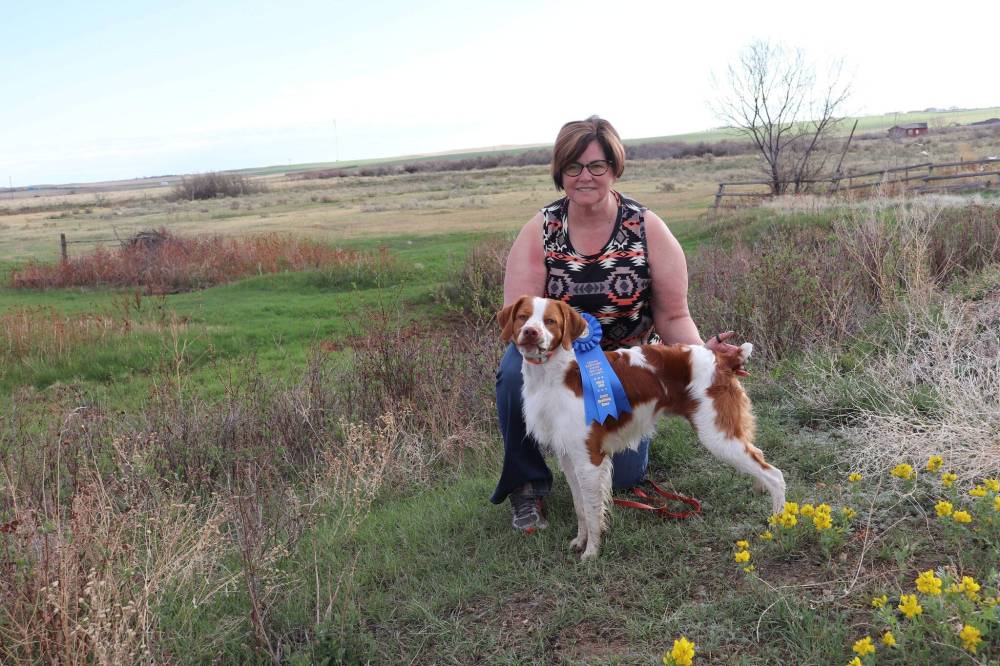
Brandon dog show competitor Julie Ross with her Brittany spaniel Fergus, after a dog field test trial in Alberta. (Courtesy Julie Ross)
Currently dog owners are only required to have an up-to-date rabies vaccination certification at the border crossing when travelling into the U.S.
The changes have caused confusion and frustration among dog owners who have been concerned about the impact these regulations will have on their ability to attend dog shows and trials south of the border, and for Canadian dog breeders who have U.S. customers.
But following talks with the CFIA and the Canadian Kennel Club, the CDC announced changes late this week to the pending regulations that may ease concerns of some dog owners who make several trips to the U.S. every year.
On May 29, the CDC announced a new option for a multiple entry import form, which was a change from the original plans that required dogs coming into the U.S. to have new signed paperwork for each time the animal crossed the border.
“So (now) you can have either a single entry that expires in 30 days, or you can have a multiple entry form that is good for the life of the rabies vaccine,” said Sarah McDowell, manager of government and stakeholder relations for the Canadian Kennel Club.
The CDC website now suggests that the form could be valid between one to three years, “if it contains information about rabies vaccination administered in a dog rabies free or low-risk country.”
McDowell said that in spite of the remaining issue of the required two signatures, having to go through the process every one to three years will be less of a burden. And there may be more changes in the coming weeks as well as groups like the CFIA and the CKC continue to work with their American counterparts.
“It’s like it’s ever-evolving day to day,” McDowell said. “And it’s probably because … as we work through the logistics of how this will actually, you know, take place, have these forms, these signatures, of the timing and the turnaround time … more stakeholders, you know, weigh in on the changes, it will continue to evolve … All of these stakeholders are working together to make it hopefully easier for all concerned travellers.”
That was good news for dog show competitor Julie Ross, who takes her Brittany spaniels across the border to Montana for spring and fall dog trials every year.
Until she learned on Friday that the regulations would allow for a multiple entry form, she had decided not to go at all this year because of the onerous and costly paperwork.
“Having it run the length of a rabies shot would certainly change my mind,” Ross told the Sun reporter who informed her of the change on Friday afternoon. “Then you only have to do it once. That’s much better. Besides, I don’t think the CFIA was ready to deal with the uptake on that.
“It doesn’t help the breeders though.”
McDowell agreed, calling the six-month minimum age requirement the “biggest hurdle” facing dog breeders in the country.
“It would be very costly on the breeder side,” McDowell said. “And also the socialization aspect. The ability to bond with that dog at younger ages is important for the socialization between the dog and the family. It’s critical for the development of the dog.”
At least a few southern Manitoba dog breeders who sell into the U.S. are facing the very real possibility of having to shut down their operations.
“It’s going to impact my breeding program,” said Brandon-based dog breeder Lynn White, who works as a conformation judge with the Canadian Kennel Club and also competes in dog shows and trials in the U.S.
“I breed Dobermans, and they are a crop to breed. And in Manitoba, as well as every other province but Ontario at this point in time, we cannot crop our dogs here. So I would say 90 per cent of us are going to the U.S. I’ve been going there for many years to have my dogs cropped.”
The cropping of a dog’s ears by a veterinarian is specific to certain dog breeds such as Dobermans, schnauzers, terriers, boxers and Great Danes. Ontario remains the only province where veterinarians will still perform cropping surgery, though the practice is more prevalent south of the Canadian border.

Doberman breeder Lynn White sits with her dog Berlin in this undated photo. (Submitted)
“With the new rules, your dog has to be six months old before it can cross the border,” White said. “We crop at seven weeks. And they insist that your dogs have to have rabies (shots), except you can’t give a puppy rabies shots until at least 12 weeks old … because they have the immunity of their mother until then. It compromises their immune system.”
White says her U.S.-based clients want “crop dogs,” and the regulations may prompt her to stop breeding altogether.
The pending dog import regulations have also prompted Rottweiler owner and dog show competitor Ayoka Bubar to reconsider her plans to become a breeder in the future. The Carberry resident said she hasn’t had a litter yet, and was “sitting on it” for the time being. She says keeping newborn puppies until they’re six months old not only prevents the creation of an early bond with a potential owner, it’s also cost prohibitive.
“Now everything seems to be up in the air,” Bubar said. “You know, if they really can’t go down until they’re six months old, as a breeder it’s really hard to keep puppies that long … And for a breeder, if a lot of your happy homes are coming from the U.S., I don’t know that they will breed anymore.”
The CDC says the new regulations are being adopted to prevent the re-introduction of dog rabies into the country, a disease that was eliminated in the U.S. in 2007.
According to the American Kennel Club website, the CDC witnessed a 54 per cent increase in the number of dogs that were ineligible for admission into the U.S. in 2020 due to falsified or fraudulent documentation.
Strengthening the regulations is also meant to help the U.S. more closely align with the World Organization for Animal Health’s standards for the international movement of dogs from countries with a high risk of dog rabies, and to address recent problems with international dog importations.
“The CDC’s new rule cited several cases of rabies-positive dogs being imported into the U.S. by, or on behalf of, animal rescue groups that presented with documentation for those dogs that had been falsified,” read an AKC press release dated May 17.
Ross says she understands the reasons why the CDC is changing the regulations, and agrees that it’s important for the U.S. and Canada to keep a zero-rabies designation.
“But, you know, at what cost?” Ross said. “It’s costing a lot of us that are responsible owners and breeders the ability to participate in our sport.”
The Brandon Sun contacted the Canadian Food and Inspection Agency on Friday for comment. In an emailed statement, a CFIA representative said the organization “is actively engaging with the United States (U.S.) to discuss and clarify the recent requirements for dogs entering the U.S.,” and noted that as soon as more information is available, updated guidance will be provided on the CFIA website.
When contacted by the Sun on Friday afternoon, a spokesperson for the U.S. Centers for Disease Control and Prevention was not available for comment at press time.
» mgoerzen@brandonsun.com
» X: @MattGoerzen