
Cultural hub conceptual designs unveiled
Advertisement
Read this article for free:
or
Already have an account? Log in here »
We need your support!
Local journalism needs your support!
As we navigate through unprecedented times, our journalists are working harder than ever to bring you the latest local updates to keep you safe and informed.
Now, more than ever, we need your support.
Starting at $15.99 plus taxes every four weeks you can access your Brandon Sun online and full access to all content as it appears on our website.
Subscribe Nowor call circulation directly at (204) 727-0527.
Your pledge helps to ensure we provide the news that matters most to your community!
To continue reading, please subscribe:
Add Brandon Sun access to your Free Press subscription for only an additional
$1 for the first 4 weeks*
- Enjoy unlimited reading on brandonsun.com
- Read the Brandon Sun E-Edition, our digital replica newspaper
*Your next Free Press subscription payment will increase by $1.00 and you will be charged $20.95 plus GST for four weeks. After four weeks, your payment will increase to $24.95 plus GST every four weeks.
Read unlimited articles for free today:
or
Already have an account? Log in here »
Hey there, time traveller!
This article was published 14/06/2024 (707 days ago), so information in it may no longer be current.
City staff unveiled two possible routes forward for a new cultural hub for Brandon at a special meeting held Monday.
Building a new cultural hub could cost between $25 to $28 million, while renovating the existing Library/Arts Building could cost between $15 to $18 million.
Work with the library and art gallery to reimagine their spaces as a new cultural hub for the city has been ongoing since 2020, Ryan Nickel, Brandon’s director of planning and buildings, said at the meeting.
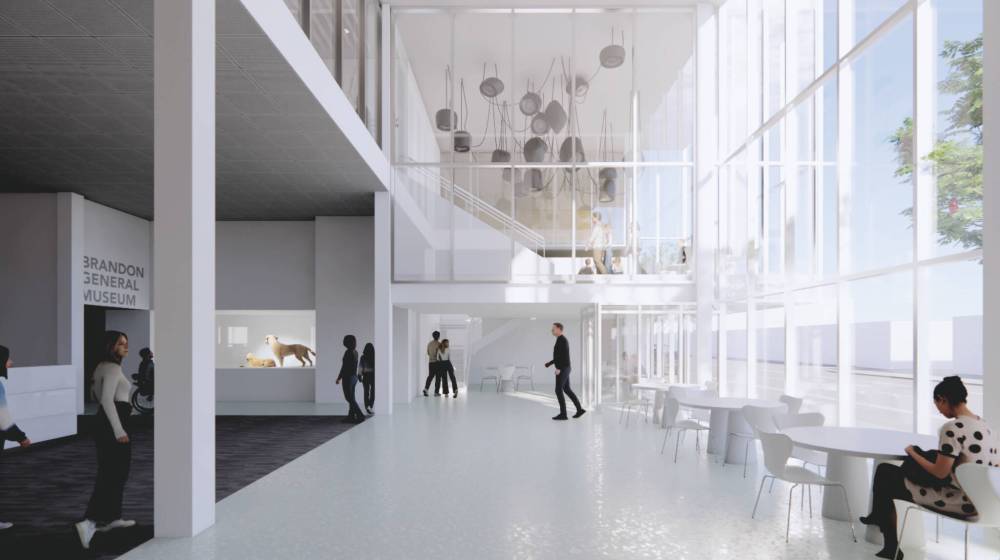
In March, council approved a $13,000 expense to revise conceptual designs for the project that would either see the existing Library/Arts Building at 701 Rosser Ave. renovated or an entirely new facility built at 901 Princess Ave.
Nickel presented the updated designs to council on Monday, saying he hoped it would provide them with enough information to choose a path forward at their next regular meeting on June 17.
“There were some pros and cons for each, including the new build,” Nickel said. “You’re getting a new building. Being purpose-built, it’s going to have greater functionality. Some of the advantages of the existing space is that there’s a lot of square footage there, including a full basement, that you wouldn’t get if we were going to the new build option.”
For both major directions the city can take, Nickel presented two options for each. One budgets for a base level of work, while the other is a “sustainability” option that includes more features, including improved energy efficiency equipment that would align with the city’s climate-change goals.
Beyond that, Nickel said the sustainability options are required to qualify for federal grant programs.
For a new building, with an estimated lifespan of 50 or more years, the base option is estimated to cost around $25 million, with $50,000 per year in utility costs. The sustainable option is estimated to cost $28 million, plus $32,000 in annual utility costs.
The renovation options would be considerably cheaper, but utility costs would be higher.
The base option is estimated to cost $15 million plus $80,000 a year in utilities, while the sustainable option would cost an estimated $18.5 million with $50,000 per year in utilities.
The catch with the renovation options is that the base scenario would also require an additional $2 million in deferred maintenance or $300,000 in deferred maintenance for the sustainable option.
The deferred maintenance estimates are based on a 2018 building condition assessment.
“That includes roof repairs, HVAC, windows and some of that we haven’t proceeded with we’re trying to get clarity around a decision,” Nickel said. “Some of that deferred maintenance is incorporated into the sustainability quote.”
Assisting with Nickel’s presentation were Jordan Demer and Brock Klassen of f-BLOK Architecture, the firm that worked on the conceptual designs.
They said the design for a hypothetical new building would be three stories tall, with a parking lot to the north of the building off of Ninth Street and an entrance plaza and drop-off area to the south off of Princess Avenue.
The first floor would host the library and a shared loading area, the second floor would be shared by the museum and art gallery and the third, smallest floor would feature studios for the art gallery.
A glass atrium would contain shared multipurpose rooms, washrooms and an elevator. Another elevator for freight would be at the rear of the building.
The third floor would be around 6,600 square feet, the second floor 15,650 square feet and the first floor 15,900 square feet.
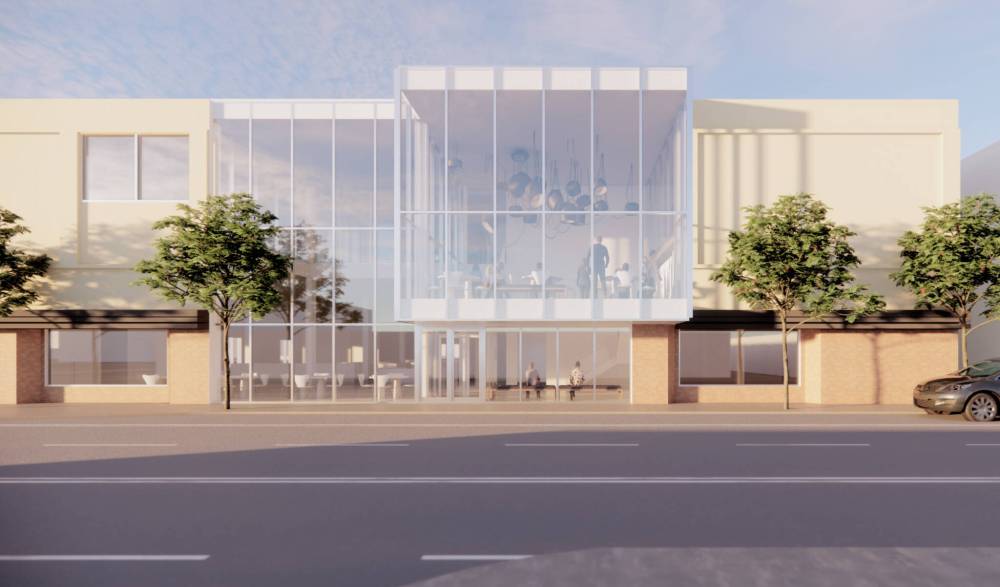
The design for the hypothetical renovation of the existing Library/Arts Building, which is connected to but not a part of The Town Centre mall, would change it so that patrons can enter from Rosser Avenue instead of through the mall as they currently do.
With the sale of the mall last year, Nickel said at a March council meeting that the city had started to consider whether the future of the cultural hub should lie elsewhere because the future of The Town Centre is uncertain.
In this option, the library would remain on the first floor of the building and would be joined by the museum. The art gallery would be mostly on the second floor and have a ceramics studio on the smaller third floor.
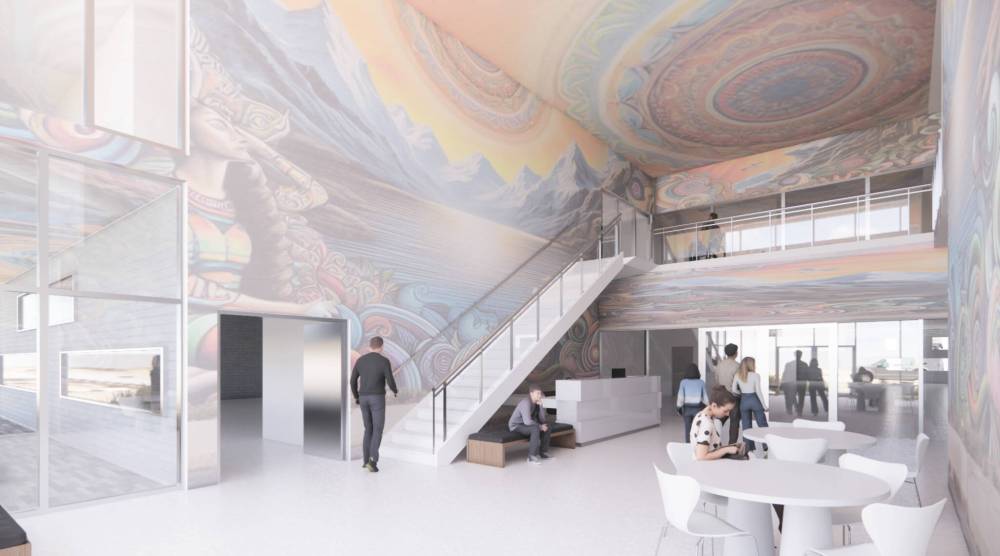
Like in the other option, a new atrium would include both washrooms and a multipurpose room. The first floor would be 22,400 square feet, the second floor 21,400 square feet and the third floor 5,400 square feet.
The renovations could be phased to allow the building’s occupants to continue to operate and to spread costs out over multiple years.
Phases 1, 2 and 3 would cost $5 million, $3.5 million and $6.5 million, respectively, for the baseline options and $6 million, $6.5 million and $6 million for the sustainable option.
If that approach is taken, phase one would see the new entrance built on Rosser Avenue along with a mezzanine and multipurpose room. The art gallery’s reception desk would be moved to face Rosser Avenue.
The f-BLOK representatives said phase two would address the potential demolition of The Town Centre, turning the shared wall between the Library/Arts Building and the mall into a new exterior wall. It would also re-adjust the layout of the art gallery further.
Phase three would rearrange the main floor and build a space for the museum.
Overall, the longer it takes to do the phases, the more expensive the architects said the project would be.
“The reason why, I think, from a staff perspective we prefer the renovation option is because we understand our financial reality right now and it provides us some flexibility around phasing,” Nickel said.
He said staff would recommend the sustainable option, particularly because of the federal grant options.
“Federally, the big grant for funding this type of program is the Infrastructure Canada Green and Inclusive Communities Building Fund,” Nickel said.
“That’s a fund for large-scale construction that could fund up to $25 million. We can’t assume we’ll get that, it’s a highly competitive national process, but that would be the big ticket grant for these types of large-scale cultural programs, and it’s closed right now.”
Other federal grants, he said, wouldn’t be at the level that would allow all the phases to be built at once.
In Manitoba, the Arts, Culture and Sport in Community Fund could provide 50 per cent of costs up to a maximum of $5 million. Nickel said a previous unsuccessful application had been made to the fund.
“We could phase improvements to see what we could do for $10 million, apply for $5 million and figure out how we can do some of these smaller incentives to close the gap even further, especially the ones around energy efficiency.”
A representative from the library said the extra space in the renovated building would be appreciated, while the new build would be laid out more efficiently for them.
A representative for the museum said either option would provide them with roughly the same amount of space for exhibits and the addition of shared spaces like multipurpose rooms would be a gain. The renovation option, they said, would give them a lot more storage space.
Coun. Bruce Luebke (Ward 6) pointed out that previous designs had incorporated revenue-generating features like a coffee shop and asked if they were still under consideration. Nickel said those options can be investigated more as the shared space aspects are fleshed out.
Coun. Kris Desjarlais (Ward 2) asked whether there was consideration given to putting in a policing element to the renovated building should The Town Centre be demolished. Currently, Brandon Police Service has a small satellite office in the mall.
According to Nickel, it hasn’t been contemplated but could be further explored.
Coun. Shawn Berry (Ward 7) said the city doesn’t know the future of The Town Centre and whether the owner of the property would want the Library/Arts Building as part of a future development.
“How are we going to approach that with trying to making a commitment as to what we want to do and not really knowing what’s going to happen with The Town Centre as a property?” Berry asked.
Nickel said no groups have expressed interest in the Library/Arts Building to this point, but acknowledged that downtown Brandon is currently a buyer’s market. However, he noted that there has been interest in the Princess site.
» cslark@brandonsun.com
» X: @ColinSlark