
Ray St. Germain dead at 83
Advertisement
Read this article for free:
or
Already have an account? Log in here »
We need your support!
Local journalism needs your support!
As we navigate through unprecedented times, our journalists are working harder than ever to bring you the latest local updates to keep you safe and informed.
Now, more than ever, we need your support.
Starting at $15.99 plus taxes every four weeks you can access your Brandon Sun online and full access to all content as it appears on our website.
Subscribe Nowor call circulation directly at (204) 727-0527.
Your pledge helps to ensure we provide the news that matters most to your community!
To continue reading, please subscribe:
Add Brandon Sun access to your Free Press subscription for only an additional
$1 for the first 4 weeks*
*Your next subscription payment will increase by $1.00 and you will be charged $20.00 plus GST for four weeks. After four weeks, your payment will increase to $24.00 plus GST every four weeks.
Read unlimited articles for free today:
or
Already have an account? Log in here »
Hey there, time traveller!
This article was published 27/06/2024 (677 days ago), so information in it may no longer be current.
WINNIPEG — Ray St. Germain, a Manitoba music legend who rose to fame as a teenager for performances reminiscent of Elvis Presley and who became fiercely proud of his Métis roots, died Tuesday at the age of 83.
His wife, Glory St. Germain, announced the Canadian Country Music Hall of Famer’s death on her Facebook page. For several years, St. Germain — who also spent more than 50 years as a television presenter and radio host — had been living with Parkinson’s disease.
“Our nation is mourning, there’s no question about it,” says Manitoba Métis Federation president David Chartrand, a longtime friend and colleague of St. Germain’s. “We lost our legend. We lost our hero, but he’s not gone. His music still carries on.”
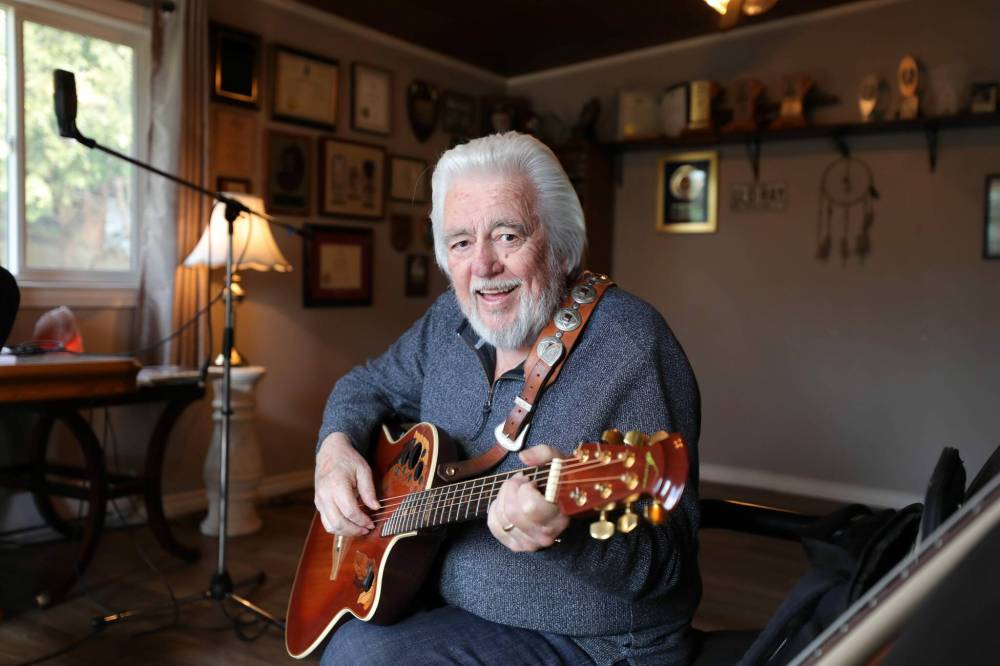
Ray St. Germain sits with his guitar in his home trophy room in a 2020 photo. The legendary Métis musician died Tuesday at the age of 83. (Winnipeg Free Press)
Across more than a dozen albums, hundreds of television broadcasts and thousands of live performances, St. Germain carved out a singular career.
In 1958, St. Germain recorded “She’s a Square” for Toronto’s Chateau Records, the first rock record produced by a Winnipegger to hit the national charts. He performed regularly into his late 70s, and in his last public appearance — earlier this month at a street-naming in his honour in his native St. Vital — he stunned the crowd with a resonant vibrato on his rendition of Presley’s “It’s Now or Never.”
“I wanted to be Elvis when I was younger,” St. Germain wrote in the epilogue to his entertaining autobiography, self-published in 2004. “But I wouldn’t trade my life for his. Besides, he never got to stay at the Harwood Hotel in Moose Jaw.”
Born July 29, 1940, St. Germain’s life in music began at 14 years old when he joined a country band called the Rhythm Ranch Boys, for which he played the accordion. When his bandmate Roy DeLaRonde heard St. Germain’s pitch-perfect impression of Presley, he taught St. Germain the basics of rhythm guitar.
“He said I would probably hurt myself jumping and shaking all over the stage with an accordion on,” St. Germain wrote in his book, “I Wanted to Be Elvis, So What Was I Doing in Moose Jaw?”
The young band had a gig playing 20-minute sets at the Beacon Theatre — on the current site of the Manitoba Museum — between movie screenings, remembers Ron Halldorson, who played steel guitar for the group as a 13-year-old.
Halldorson, who later served as St. Germain’s bandleader on his long-running, Izzy Asper-produced CKND country program “Big Sky Country,” recalls the way St. Germain controlled the room.
“He had studied Elvis and the way he moved, and all the girls at the Beacon were eating it up. That was how he began to build his fame in Winnipeg.”
But through intense work ethic and desire for self-improvement, St. Germain eclipsed impersonation to become a well-rounded performer, an artist to whom others would eventually pay tribute, Halldorson says.
“He didn’t start out with a fabulous voice, but he made himself into what he became, which was one of the finest singers this city has ever seen. This country, actually,” says Halldorson, echoing sentiments expressed by St. Germain himself.
A teenage St. Germain competed weekly on the “CJOB Western Hour,” a radio show broadcast live every Saturday from the Dominion Theatre. On the show, amateur western singers — the term country wasn’t yet used — would perform, with the top three selected to compete against the reigning champion, known as the King or the Queen of the Saddle.
“I never won, but the experience I was getting every week performing before a live audience was invaluable,” St. Germain wrote.
St. Germain’s big break came in 1956 when he had a weekend gig singing for the crowd at a downtown venue called the Rainbow Dance Gardens.
One evening, the audience included Betty Cody, Hal Lone Pine (Harold Breau) and their son Lone Pine Jr. (the jazz guitarist Lenny Breau). Lone Pine and Cody were established country stars, while Lone Pine hosted the “West Virginia Jamboree” and “Louisiana Hayride” radio programs.
In Winnipeg to establish a home base at CKY Radio, the trio performed live on air six mornings a week to promote their shows around the province.
A written request was delivered to the band before the show began, with Lone Pine asking to hear St. Germain sing an Elvis song. He launched into “Hound Dog,” visiting the guests at their booth once the set finished.
“I reached his table and felt like I was going to faint. I had never met a real singing radio star before,” St. Germain wrote in his autobiography. “I blurted out, ‘Hi Mr. Lone.’ He said, “Just call me Pine. Sit down and join us.”
Lone Pine was so impressed that he asked the 16-year-old to join his travelling radio show, offering him $15 per night, plus room and board.
St. Germain dropped out of Woodlawn High School the following week, showing up to CKY’s Main Street studios on Monday morning with his Martin D18 guitar. The band would record five 30-minute shows to be played every weekday morning at 7:30.
Every night, except Sunday and Monday, they performed in community halls and theatres in small towns across the Prairies, opening for travelling Opry stars such as Johnny Cash, Johnny Horton, Porter Wagoner and George Jones.
By 1958, St. Germain had taken his talents to television, winning the local spot on the CBC national singing competition “Talent Caravan,” making connections during the championship round in Ottawa that would lead him to move the following year to Toronto, where he befriended a young Gordon Lightfoot.
“(My mother’s) biggest worry was how I was going to have clean laundry when I had to travel so much,” St. Germain wrote about his leaving with the Lone Pine show. “I told her not to worry — I would be home every Sunday and bring it with me.”
In Toronto, St. Germain, who was married to his first wife, Barbara Neville, cut records, but struggled to attain lasting success, working for a stretch at an automotive shop as a control operator.

Ray St. Germain is shown with his wife Glory during the honorary renaming of St. Michael Road in St. Vital to Big Sky Country Way earlier this month. (Mike Deal/Winnipeg Free Press)
His wife, with whom St. Germain would raise two daughters, briefly joined him in Toronto after the singer pawned his guitar to buy her a plane ticket.
“As we drove back to the third-floor walk-up single-room suite I was staying in, I was trying to figure out a way to tell her I had failed. Fortunately, she understood and we lived there until we couldn’t take it anymore and decided to return to Winnipeg,” St. Germain wrote.
For five years, St. Germain put his showbiz dreams on hold, working downtown at the Grain Exchange to provide for his family as it resettled in St. Vital.
“I grew a moustache and a goatee, had two beautiful daughters and a loving wife. I was actually thinking of building a white picket fence. I was becoming one of them!” he wrote.
Television came calling again in 1964 when St. Germain, 24, was hired as one of the regional singing hosts of the CBC’s “Music Hop Hootenanny,” producing 39 episodes per year. Other hosts included future “Jeopardy!” host Alex Trebek in Toronto.
McCabe Grain gave St. Germain an ultimatum in 1965: grain inspector or television performer.
The choice was obvious.
Over the ensuing decade, St. Germain shared the stage at Studio 4 on Yonge Street in Toronto with artists such as Lightfoot, Ian and Sylvia, and an emergent Anne Murray and recorded his first full-length albums, a self-titled 1968 record released through RCA and 1969’s “Time for Livin’” on Capitol Records.
In the 1970s, while hosting “Big Sky Country” from Winnipeg, he began to explore, in both his personal life and his music, his Métis heritage, discovering his ancestral ties dating back to the Red River Rebellion.
As a child, he believed his father and uncles had brown skin “because they worked outside all year round, and they were well-tanned.”
“My mom and dad decided not to tell us to protect us from the prejudice that existed back then, and in some cases, still exists today,” St. Germain wrote.
Some of St. Germain’s most beloved and lasting songs — 1973’s “I’m Mighty Proud I’m Métis,” 1976’s swaggering epic “The Métis,” and “Whatcha Gonna Call Me”— are defiant anthems of his own reclamation and pride.
“Ray’s inspired generations of up-and-coming artists, not just through his music, but through his actions, be it performing at Métis gatherings or releasing music that inspires Métis people to look at and appreciate the contributions of leaders like Louis Riel,” said NCI FM programming director David McLeod, who was St. Germain’s supervisor when he started co-hosting the still-running “Métis Hour X2.”
That show came about at the urging of Chartrand and then-lieutenant governor Yvon Dumont, growing over nearly 30 years into a weekly institution on the airwaves.
“Ray was not only an incredibly talented artist but also a kind and generous soul,” his longtime co-host Naomi Clarke said in a release Wednesday.
“He was a mentor to many, and his passion for his Métis heritage was truly inspiring. We have lost a dear friend and a true champion of Métis culture.”
St. Germain’s contributions to music and his community are vast, with his five children and several grandchildren following the troubadour into a career in the recording industry.
“Music was his life,” his wife Glory said Wednesday. “And I’m so honoured his music will continue to inspire people to sing, to praise their heritage and to move forward with love and compassion.”
» Winnipeg Free Press