
City, bee lover team up for hive rescue
Advertisement
Read this article for free:
or
Already have an account? Log in here »
We need your support!
Local journalism needs your support!
As we navigate through unprecedented times, our journalists are working harder than ever to bring you the latest local updates to keep you safe and informed.
Now, more than ever, we need your support.
Starting at $15.99 plus taxes every four weeks you can access your Brandon Sun online and full access to all content as it appears on our website.
Subscribe Nowor call circulation directly at (204) 727-0527.
Your pledge helps to ensure we provide the news that matters most to your community!
To continue reading, please subscribe:
Add Brandon Sun access to your Free Press subscription for only an additional
$1 for the first 4 weeks*
- Enjoy unlimited reading on brandonsun.com
- Read the Brandon Sun E-Edition, our digital replica newspaper
*Your next Free Press subscription payment will increase by $1.00 and you will be charged $20.95 plus GST for four weeks. After four weeks, your payment will increase to $24.95 plus GST every four weeks.
Read unlimited articles for free today:
or
Already have an account? Log in here »
Hey there, time traveller!
This article was published 13/07/2024 (703 days ago), so information in it may no longer be current.
Instead of destroying a honeybee hive that was torn in two last month during a big thunderstorm, the City of Brandon’s parks and recreation department made an effort to save it.
A call for help on social media put city staff in touch with a hobbyist beekeeper who was able to adopt the hive after a multi-day effort.
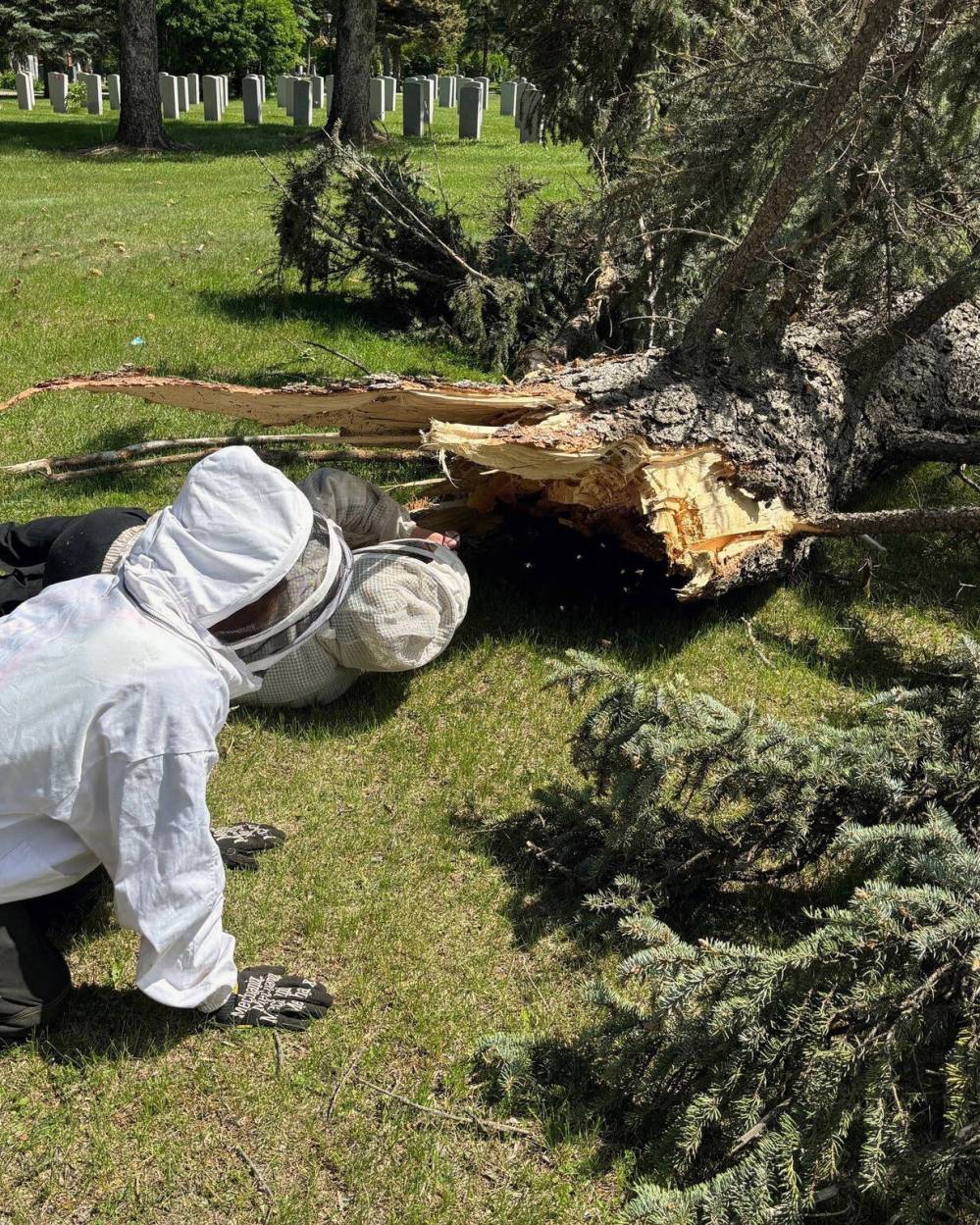
Two days after the June 15 storm, city arbourist Ché Orridge said she and a colleague were surveying the damage at the Brandon Municipal Cemetery when they came across a tree that had previously separated into two major branches before one of them snapped off in the wind.
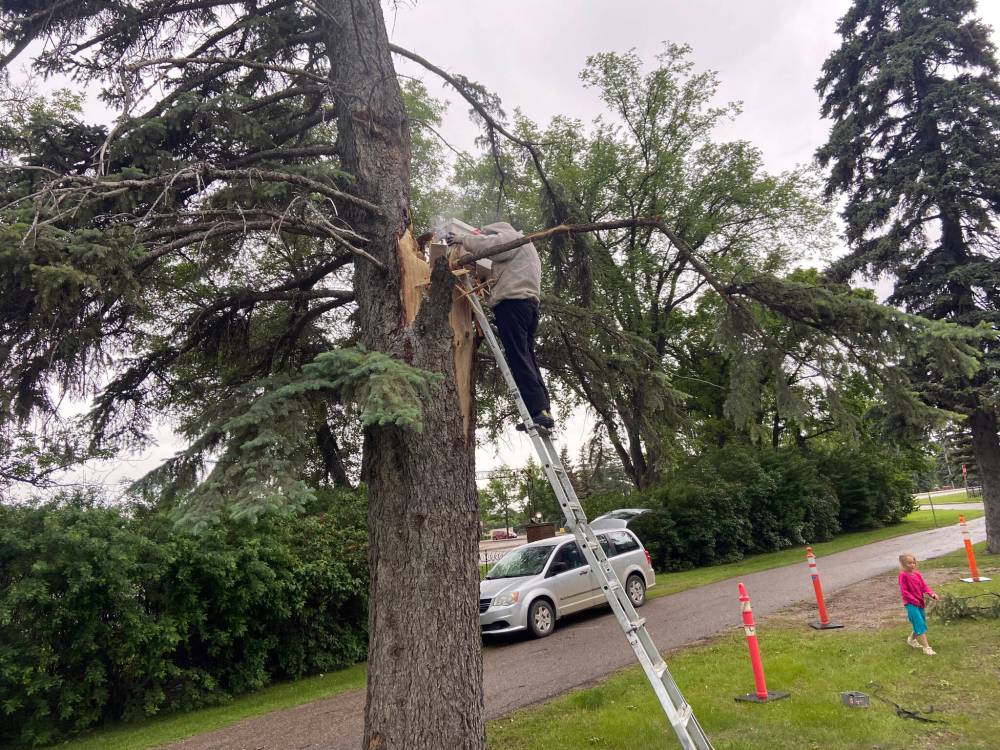
Golden-Greenwood secures a nucleus box on a broken tree at Brandon Municipal Cemetery last month in hopes of luring the bees inside after they were disrupted by a thunderstorm. (Submitted)
“There were thousands of bees on the one half of the tree that remains standing and on the part that had fallen down,” Orridge said. “We knew we couldn’t leave it there forever, so we had to clean it up. In order to clean it up, we would have had to disturb half of the hive or destroy it.”
Orridge turned to the People of Brandon Facebook group, asking if anyone knew someone who could help. Through that post, Orridge was given the phone number of Suzette Golden-Greenwood.
A family lawyer by trade, Golden-Greenwood has loved bees since she was a girl.
She told the Sun she fell in love with the critters after watching the members of a beehive on a fence go about their business.
For the last six years, she has kept bees in an insulated shed on her family’s five-acre property east of Brandon. Sometimes they take honey from the hives and make mead, while other years she just enjoys watching the bees in action.
Unfortunately, the cold winter and especially the late May snowstorm killed off her existing hives. Heading into the summer, Golden-Greenwood figured she would be without any this year.
However, early in the season, one of her children came into their home and excitedly announced that the bees had somehow come back. What had happened was that a swarm took over one of the boxes in the shed that she had yet to clean out.
Then, two days before the cemetery rescue, she went out and helped collect a swarm looking for a home on a friend’s property.
When a hive gets full, Golden-Greenwood said a bunch of the worker bees gorge themselves on honey and head out with the existing queen in search of a new place to make a hive. They do this after laying an egg that will become the old hive’s new queen.
The bees are dopey in this state and clump together in a swarm that protects their queen as they search for the right place to build.
In this case, Golden-Greenwood went out with her nine-year-old son, Basil, and put out a box that she encouraged the swarm to go into.
“I lay a sheet out underneath to make it easier for them,” she said.
“Whatever branch or object they’re on, I shake them so that they fall onto the sheet and then the workers are all in a panic, like ‘Oh my gosh! What just happened?’ And then some of them say, ‘Oh my gosh, there’s a box here,’ and they gather around the outside of it, start fluttering their wings and release a pheromone. It smells a little bit like lemongrass.”
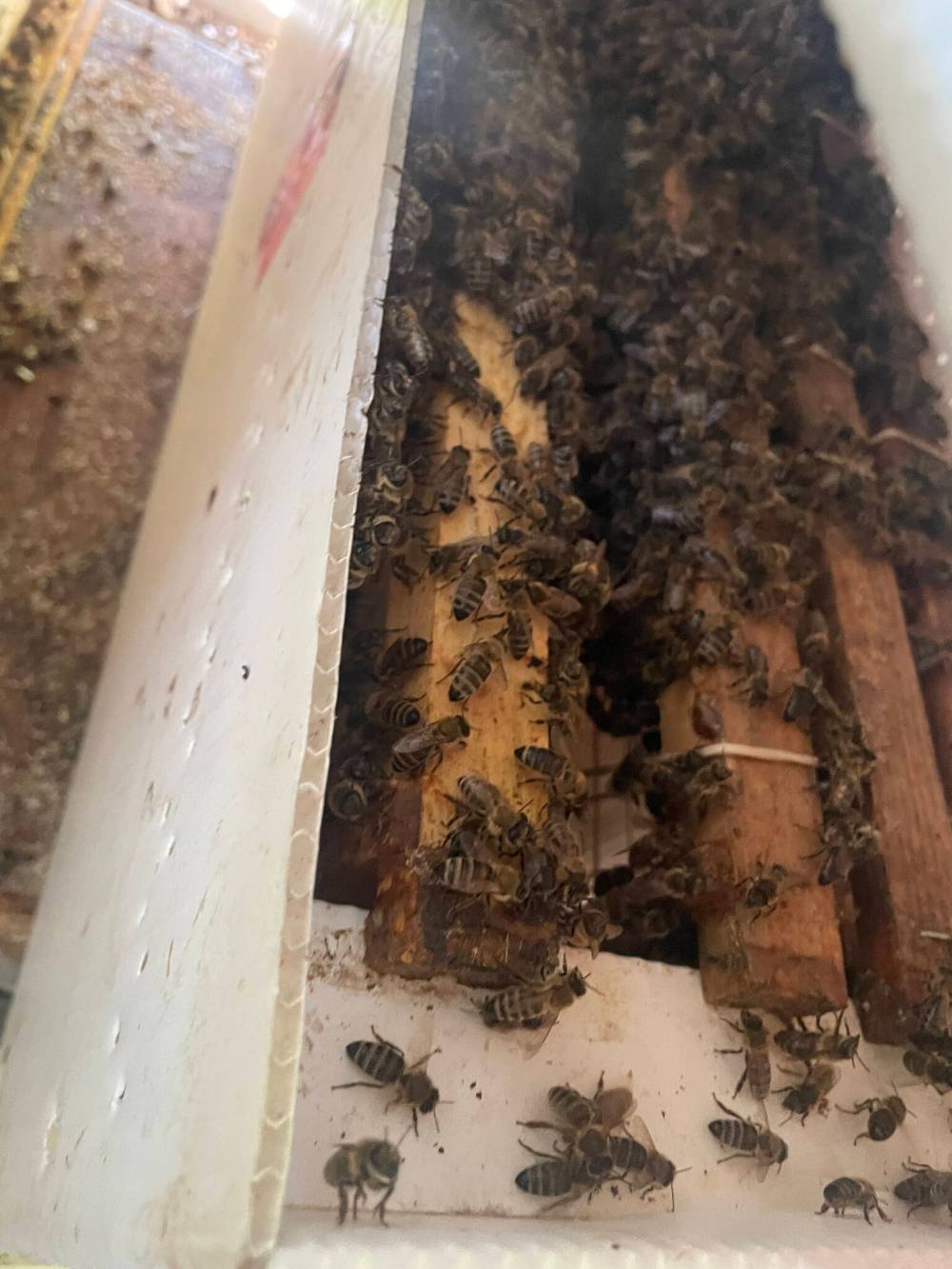
Bees are shown inside of one of hobbyist beekeeper Suzette Golden-Greenwood’s boxes. (Submitted)
That signal tells the others to make a beeline for the box, which can take a few hours depending on the colony size.
Once they were inside, she transported them back to her property and introduced them to her shed.
Before she volunteered at the cemetery, she said she had only ever moved bees in the swarm phase. The cemetery rescue was the first time she tried to move an active hive.
When Golden-Greenwood first got the call from Orridge, she headed over to the cemetery within 15 minutes with her swarm kit containing the box, sheet and protective jackets.
On the scene, they developed a plan to take effect the next morning when the bees were less active. At that point, there were more bees on the ground than in the tree.
They turned over a part of the fallen part of the tree so that Golden-Greenwood could extract a chunk of honeycomb and secure it to a frame inside one of the boxes with rubber bands to get the bees to start to venture inside.
Later that day, the weather looked like it would turn to rain again. Golden-Greenwood said she was worried that the exposed part of the hive in the tree would leave the bees without protection from the wind, rain and cold.
That evening, she told her husband, Jesse, that they were going out to the cemetery with a ladder. When they arrived, the bulk of bees had moved to the tree.
She ascended the ladder with a box and strapped it to the tree. Using one of her kids’ sand shovels, she gently scooped some of the comb out of the tree and into a frame inside the box. She then moved on to scooping the bees themselves.
The bees started to do the same fluttering behaviour they do when swarming, which gave Golden-Greenwood hope that her plan would work.
“I know this sounds crazy, but I talked to them,” she said. “‘Hey ladies, my name is Suzanne. I keep bees. I don’t want to upset you, but a bad thing happened to you here. I have this really nice box. I have a nice building where you could live, but the weather’s not good … Just think about it.’”
During this process, she was stung twice through the back of the gloves she was wearing. She said one of the stings “swelled up like a pitcher’s mound,” but she doesn’t blame the bees for protecting themselves.
A day later, Golden-Greenwood returned with a ladder and saw that the bees were forming chains. She scooped out the last of the comb and hoped that the bees would stay put so she could move them.
Bees go about their business inside of one of hobbyist beekeeper Suzette Golden-Greenwood’s boxes. (Submitted)
On June 19, she returned and saw only 50 or so bees outside of the box. She did her best to put as many as possible inside before taping it shut.
One of the biggest challenges of the whole affair was descending the latter with both hands gripping a box full of bees, but she managed it.
She still had to work that day, so the box of bees ended up spending some time in the shade near some maple trees at her office before she headed home and introduced the hive to her shed.
Her family left town for a couple of weeks and came back to find that the hive is laying eggs, building comb and creating nectar.
For each of her three hives, the bees have a different colour. One has blacker bees, another has brown ones and the last has yellow bees. That means she can easily tell which hive an individual bee comes from.
After the whole ordeal, Golden-Greenwood said she’s glad Orridge and the city’s parks department decided to try to save the bees instead of taking the easy way out.
Since the parks department posted an item about the rescue on its own Facebook page, she said she has had a couple of people ask if they could help her with some bumblebee nests.
“I just need to find some time to go, take a look and see if I can help,” she said. “Maybe there’s other people out there that will go ‘Look, I can do this too, this is fun.’”
» cslark@brandonsun.com
» X: @ColinSlark