
Buried bones set stage for forensic fieldwork
Advertisement
Read this article for free:
or
Already have an account? Log in here »
We need your support!
Local journalism needs your support!
As we navigate through unprecedented times, our journalists are working harder than ever to bring you the latest local updates to keep you safe and informed.
Now, more than ever, we need your support.
Starting at $15.99 plus taxes every four weeks you can access your Brandon Sun online and full access to all content as it appears on our website.
Subscribe Nowor call circulation directly at (204) 727-0527.
Your pledge helps to ensure we provide the news that matters most to your community!
To continue reading, please subscribe:
Add Brandon Sun access to your Free Press subscription for only an additional
$1 for the first 4 weeks*
*Your next subscription payment will increase by $1.00 and you will be charged $20.00 plus GST for four weeks. After four weeks, your payment will increase to $24.00 plus GST every four weeks.
Read unlimited articles for free today:
or
Already have an account? Log in here »
Hey there, time traveller!
This article was published 20/07/2024 (652 days ago), so information in it may no longer be current.
Brandon University has set the stage for its students to have hands-on experience in forensic anthropology this summer with fieldwork at the Brandon Hills Wildlife Management Area Trailhead.
Associate professor of anthropology Emily Holland buried pig bones with soft tissues attached in graves in the hills on Friday. The field school kicks off with reconnaissance on July 30, followed by the actual search commencing on Aug. 5.
Holland told the Sun the bones simulate human remains, providing students with realistic, hands-on experience.
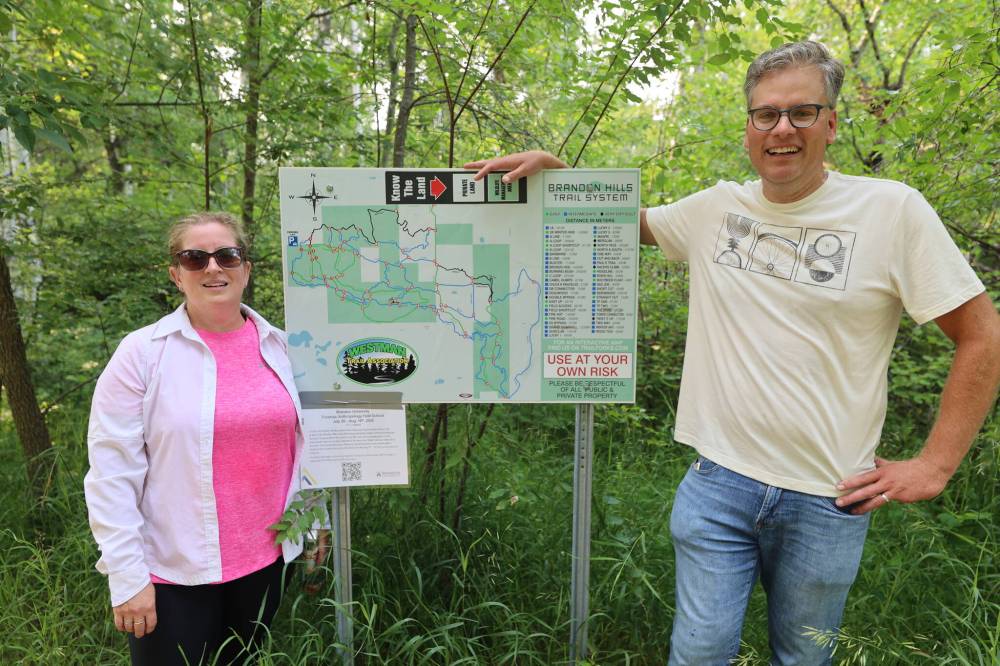
Brandon University associate professor of anthropology Emily Holland and marketing and communications director Grant Hamilton stand by one of the trail map display boards at the Brandon Hills Wildlife Management Area Trailhead on Friday. (Abiola Odutola/The Brandon Sun)
“It’s important to mimic real life because there’s going to be a smell as the bones and soft tissue start to decompose,” she said. “This is an important part of the training process for students. I designed the course to train students about how to locate, recover and document a crime scene or human remains in an outdoor area.”
The exercise, she said, is open to students who have completed the second-year Introduction to Forensic Anthropology course, ensuring they are well-prepared for the rigorous demands of the fieldwork.
The work takes place over three weeks.
“In the first week, students learn how to identify a grave or an area where someone might discard or place a body and they learn mapping and excavation techniques,” Holland said.
“They come to the area to look for signs of a grave or anything out of the ordinary that can help them identify what we call an area of interest or a point of interest. Then they design a search plan on how they’re going to search that area, recover evidence and excavate a grave.”
Students are required to manage themselves throughout the process, which Holland emphasizes is a critical part of their training.
They have to design work plans and schedules setting out who’s going to do what and when.
“They’re learning about managing personnel, leadership and teamwork, and they have five days to complete their search, mapping, excavation and cleanup.”
The tight timeline is intentional, mirroring the constraints often faced in real-life forensic investigations, she added.
Regarding the challenges faced, the associate professor highlighted the logistical challenges involved in setting up the field school.
“The logistics can be a little bit difficult because I can only put graves on Brandon University property in the Brandon Hills,” she said. “We have health and safety plans and an evacuation plan in case a student gets injured. There’s a lot of background logistics that has to happen.”
Despite the challenges, she added, the field school is designed to be a rigorous and rewarding experience.
“The biggest issue is that they doubt their own knowledge. But they do know what they’re doing, and they just have to get out of their way and do it.”
» aodutola@brandonsun.com
» X: @AbiolaOdutola