
Zebra mussels ‘building a presence’ in Clear Lake
Advertisement
Read this article for free:
or
Already have an account? Log in here »
We need your support!
Local journalism needs your support!
As we navigate through unprecedented times, our journalists are working harder than ever to bring you the latest local updates to keep you safe and informed.
Now, more than ever, we need your support.
Starting at $15.99 plus taxes every four weeks you can access your Brandon Sun online and full access to all content as it appears on our website.
Subscribe Nowor call circulation directly at (204) 727-0527.
Your pledge helps to ensure we provide the news that matters most to your community!
To continue reading, please subscribe:
Add Brandon Sun access to your Free Press subscription for only an additional
$1 for the first 4 weeks*
*Your next subscription payment will increase by $1.00 and you will be charged $20.00 plus GST for four weeks. After four weeks, your payment will increase to $24.00 plus GST every four weeks.
Read unlimited articles for free today:
or
Already have an account? Log in here »
Hey there, time traveller!
This article was published 20/07/2024 (577 days ago), so information in it may no longer be current.
New evidence from Clear Lake’s main boat cove shows zebra mussels “are building a presence” there, Parks Canada announced Friday.
Snorkelers found one live adult mussel and a partial shell near Boat Cove on Wednesday.
Making matters worse, Parks Canada said water samples in Boat Cove taken between June 19 and June 27 tested positive for zebra mussel environmental DNA.
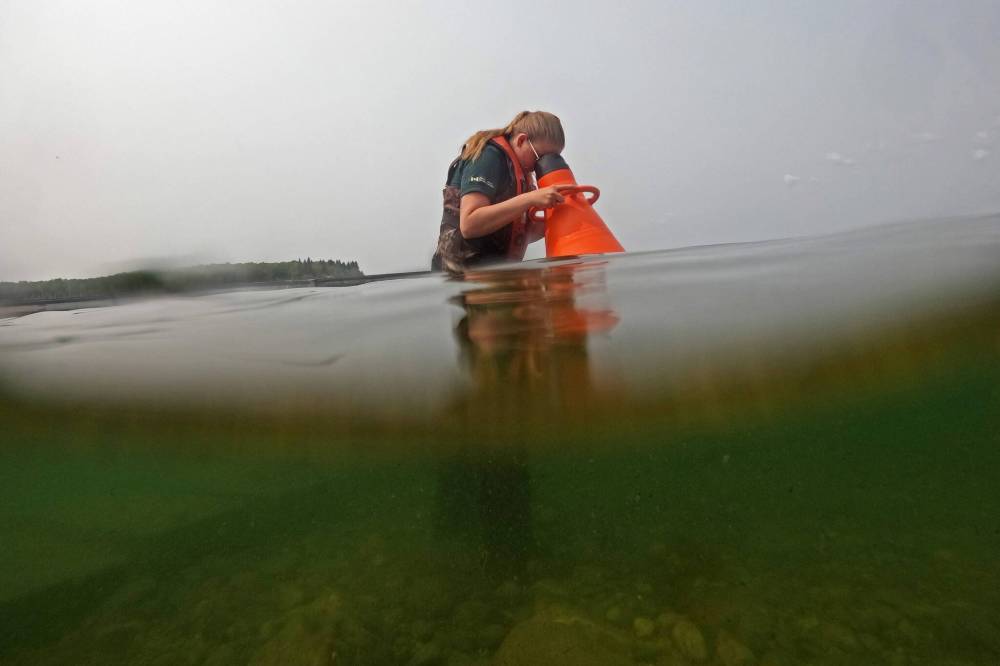
That “indicates that there’s probably a localized infestation in Boat Cove,” Winnipeg South Liberal MP and Canada’s Special Advisor on Water Terry Duguid told the Winnipeg Free Press on Friday.
Parks Canada is continuing with its plan to install containment curtains in the lake around Boat Cove to try to prevent the further spread of the mussels and their larvae, also known as veligers.
“It’s like an underwater fence that the larvae cannot penetrate,” Duguid said. “The water can flow, but the tiny larvae will not be able to make their way through the barrier.”
The agency is waiting for results from further visual surveys and water samples before deciding on whether to use potassium chloride, also known as potash, to kill mussels in the lake.
According to Duguid, the curtains will arrive on Monday and will also be used to contain the treatment areas if potash is used.
A statement issued by Parks Canada on Friday said the agency remains committed to working with Keeseekoowenin Ojibway First Nation to preserve the long-term health of the lake.
Since May, virtually all boats and watercraft have been banned from entering Clear Lake except for those operated by Parks Canada, the Martese tour boat and a boat operated by Keeseekoowenin.
The move came after Parks Canada first announced the discovery of live zebra mussels in Clear Lake last November. The invasive species can compete with native species for resources and can damage infrastructure like water intakes by blocking them.
Another release issued Friday announced two people have been charged under the National Parks Act for paddleboarding on Clear Lake in late June. Those charges could result in fines up to $25,000 each.
“A few months ago, when we instituted the watercraft restrictions, we took a prudent, cautious approach guided by science,” Duguid said. “If we had not taken some of these measures there would have been a wider infestation that we cannot contain.”
Manitoba Natural Resources Minister Jamie Moses told the Free Press he was “saddened and disappointed” by the development.
Moses said the province has heard from businesses that have been impacted by the boat ban. He has been advocating for further support from the federal government for those impacted by the watercraft restrictions.
“My message to Manitobans is that Clear Lake is still a beautiful spot to go and visit. There are a lot of great opportunities for people to visit and enjoy the region and make sure that we’re supporting our local businesses and tourism sector.”
The province recently released a strategy to manage aquatic invasive species, which Moses said goes hand-in-hand with the $500,000 increase to its aquatic invasive species budget.
“These both go to engaging the public, increasing our testing and monitoring as well as increasing the decontamination stations with an additional mobile unit — the newest testing station we’ve had open this summer.”
Moses said the mobile unit, which has been open for a few weeks, has been “very successful in educating the public and making sure the public do their part, which is to clean, drain, dry and when needed, decontaminate” their watercraft.
“The great thing about the mobile unit is that it is able to operate in a variety of locations around the province and address the needs as they arise. Our team is going to be continuing with the monitoring and increased testing we have in place to stop the spread of zebra mussels.”
Moses said the province will increase testing in the waterways downstream from Clear Lake.
“That’s really going to help us be able to stop the spread and take the necessary actions to keep all of our waterways as clean and as safe as possible. That’s what Manitobans are looking for. We enjoy our waterways and we know it’s a vital part of our community.”
Speaking with the Sun earlier in the day, Riding Mountain PC MLA Greg Nesbitt reiterated his previous call for the provincial government to test those streams leading out of Clear Lake and called for Moses to make the location of those mobile inspection units publicly known.
“All the streams that lead out of Clear Lake go into the Little Saskatchewan River and into the Assiniboine (River),” Nesbitt said. “For the past year, I’ve been calling on water testing and reporting to the public on the results of those tests. To date, I haven’t received any assurance from the minister that that’s being done.”
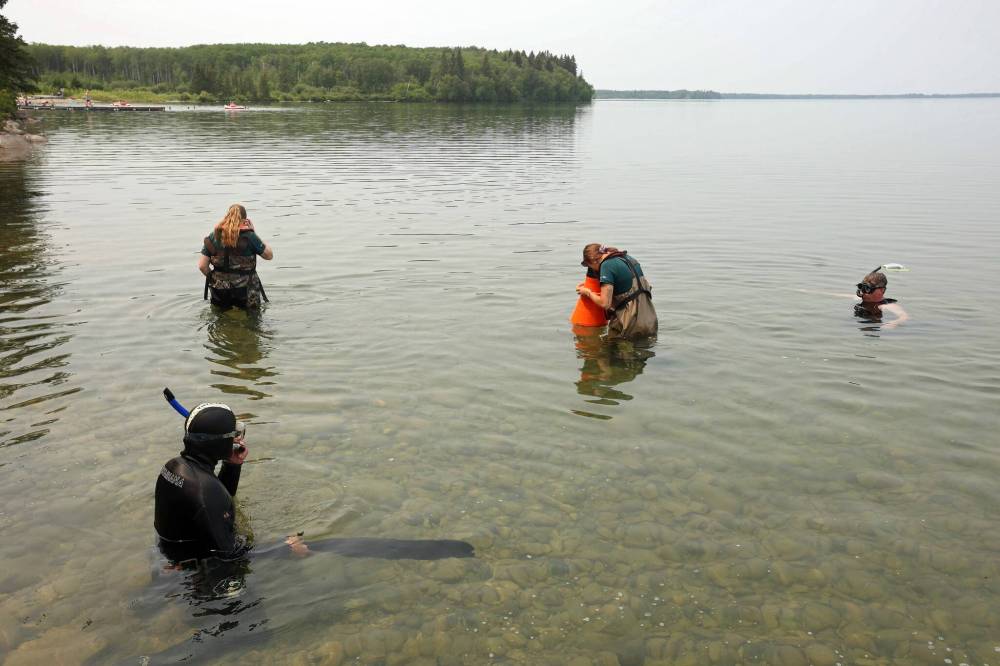
Parks Canada employees conduct visual inspections for signs of zebra mussels near Clear Lake’s main boat cove in Riding Mountain National Park on Friday. Parks Canada announced Friday that they had found evidence of localized zebra mussel infiltration at Boat Cove. (Photos by Tim Smith/The Brandon Sun)
Beyond that, Nesbitt said he would advocate for the province to support nearby businesses should they experience a decline in revenue this summer.
Nesbitt also pointed to a recent release from Fisheries and Oceans Canada stating roadside inspections at the Manitoba-Ontario border last month discovered five vehicles carrying zebra mussels.
“Last year, I advocated with the federal minister for more funding for support to do more inspections interprovincially at the borders,” Nesbitt said. “I’m glad to see the federal government took the lead on that.”
As for whether to use potash at Clear Lake, Nesbitt said a previous attempt using the substance to kill zebra mussels in harbours in Lake Winnipeg wasn’t successful, but perhaps an attempt in a smaller, contained body of water might be.
James Plewak, a former chief of Keeseekoowenin and a senior official with the Coalition of First Nations with Interests in Riding Mountain National Park, said his community was informed about the discovery earlier this week.
That coalition is comprised of Keeseekoowenin, Ebb and Flow First Nation, Waywayseecappo First Nation, Rolling River First Nation, Tootinaowaziibeeng First Nation, Gambler First Nation and Sandy Bay Ojibway First Nation.
Plewak said that as he had only had the chance to speak with current Keeseekoowenin Chief Dwayne Blackbird from the member First Nations about the development, he only wanted to speak as a member of his community and not on behalf of the entire coalition.
“We have our own aquatic biologist — his name is John Whitaker — that works for the First Nation and we have been working with the Riding Mountain technical staff on aquatic invasive species,” Plewak said. “We’ve been working with Parks (Canada), we’ve been well informed of the issue and how to go about addressing it.”
He said it was “kind of puzzling that there have been no veligers detected yet” and that the First Nations were expecting the installation of the curtain in preparation for using potash.
“My view is that I think Parks is doing the right thing,” Plewak said. “They’re addressing the issue before it gets too far out of hand. They’re erring on the side of caution.”
If the area can be contained, Plewak said he thinks there’s a good chance the mussels can be eradicated before they spread to the whole lake.
Ashley Smith, an Indigenous woman who owns and operates a camping business called Turtle Village in Wasagaming, echoed those thoughts about the lack of larvae.
“To my understanding, no veligers have been found yet,” Smith told the Sun. “Which is good news. Because if they haven’t made this their habitat or they’re not thriving here, I’m hopeful … they won’t make this a place that they want to stay.”
She said she was hopeful zebra mussels won’t stick around Clear Lake and has concerns about the potential ecological effects of potash use.
“My concern moving forward is the environmental impact assessment that we haven’t received from Parks (Canada) regarding what potash treatment might do … I’d be interested to see where that goes and if discussion will be opened up to the community, to the First Nations prior to them deciding on an action to move forward,” Smith said.
Over the long term, she said she doesn’t think access to the lake can remain shut down. However, she added, more emphasis needs to be placed on cleaning watercraft, opening more inspection stations and hiring people to staff those stations.
Since the boat ban, Smith said her business has seen a decrease in visitors and an increase in cancellations. She said she has heard from fellow businesses they are at 60 to 70 per cent capacity whereas they’d normally be around 90 per cent.
A lot of this comes from the misconception that the lake is entirely closed.
“That’s simply not true,” she said. “We can go swimming, we can go fishing, but you definitely can’t take your kayaks and your long boards and such out there, which is most of our clients. Our customers are not bringing the big motorized boats.”
George Hartlen, chief administrative officer for Friends of Riding Mountain National Park, said his organization is disappointed about the news.
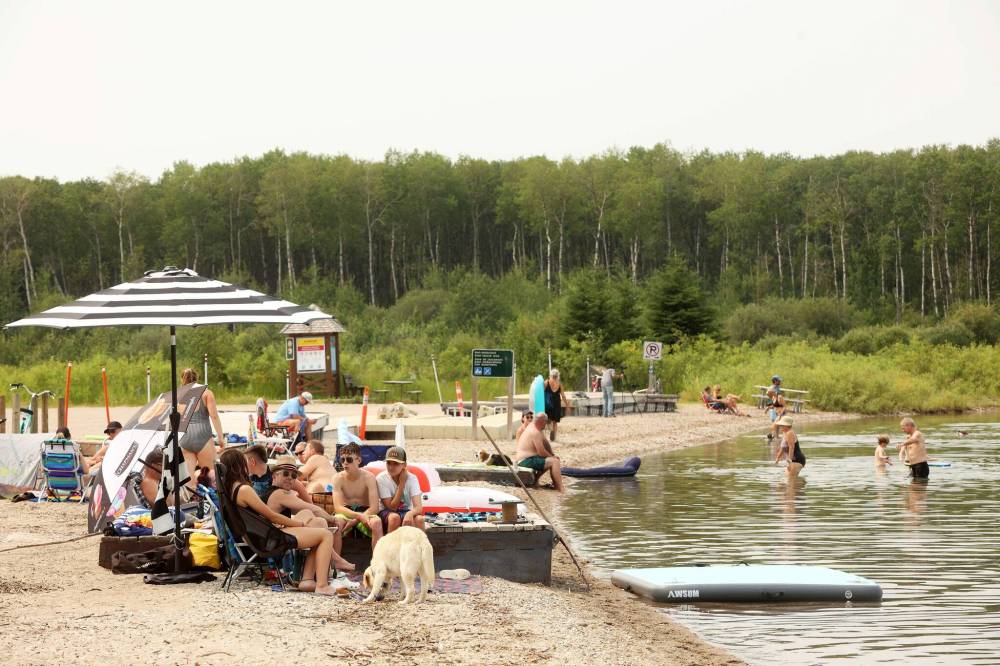
Beachgoers enjoy the hot weather and cool water at the Clear Lake boat cove in Riding Mountain National Park on Friday.
“We were hoping that maybe the discovery last fall was an isolated incident,” Hartlen said. “But you know, we’ve been very lucky over the years that nothing found its way into the waters.”
Like Smith, Hartlen is glad no larvae have been found.
“Definitely that adds to the mystery as to how we have a zebra mussel in the water without any veligers,” Hartlen said. “So far, it looks like we’ve missed a step. That is definitely somewhat of a comforting situation to be in, but it is still alarming.”
He said the news hadn’t really registered yet for people, but would likely become a talking point as the weekend progresses.
To this point in the season, he said the large majority of park users appreciated the preventive measures put in place and have been very supportive of decisions made to safeguard its future.
From what he has been told, Hartlen said potash would have a minimal effect on the overall health of the treated area but has only been shown to be effective in small, contained areas in previous uses.
Hartlen said he was happy with how the park has communicated and worked with stakeholders about the ongoing situation so far.
“It’s been such a weird spring-summer season so far, with all the weather systems that we’ve been experiencing,” he said. “It’s hard to say what impact anything is having on visitation right now. The streets are so busy, the beach is still packed, there’s cars all over the place … I think we’ll be able to get a better picture once the season has wrapped up.”
Karly McRae, president of Lakehouse Properties and the Clear Lake Country Destination Enrichment Organization, told the Free Press on Friday it is still too early to judge the recent findings.
“Despite this latest news, we want people to know that Wasagaming and Clear Lake are still open for business,” McRae said.
She said she encourages Parks Canada to hold public meetings to work with the public to find creative solutions to these problems.
“We need to fully understand what is happening and what the long-term plan is. Families and businesses in Clear Lake have borne an immense financial cost over the uncertainty this spring, with tourism bookings down 10-20 per cent in some cases.”
Another component of Parks Canada’s statement about the new zebra mussel discovery was an acknowledgment of the effect the situation has had on local businesses. The agency committed a “$100,000 contribution to enhance the visitor experience and tourism offer in the Riding Mountain community.”
By email, Dauphin-Swan River-Neepawa Conservative MP Dan Mazier said he was “carefully reviewing the recent developments from Parks Canada and will be meeting with a variety of stakeholders and officials to better understand the situation.”
He added: “As the MP for the region, the health of Clear Lake and the local economy remains a priority for me.”
» cslark@brandonsun.com, with files from Julia-Simone Rutgers
» X: @ColinSlark