
Seniors provide homestead for monarchs
Advertisement
Read this article for free:
or
Already have an account? Log in here »
We need your support!
Local journalism needs your support!
As we navigate through unprecedented times, our journalists are working harder than ever to bring you the latest local updates to keep you safe and informed.
Now, more than ever, we need your support.
Starting at $15.99 plus taxes every four weeks you can access your Brandon Sun online and full access to all content as it appears on our website.
Subscribe Nowor call circulation directly at (204) 727-0527.
Your pledge helps to ensure we provide the news that matters most to your community!
To continue reading, please subscribe:
Add Brandon Sun access to your Free Press subscription for only an additional
$1 for the first 4 weeks*
- Enjoy unlimited reading on brandonsun.com
- Read the Brandon Sun E-Edition, our digital replica newspaper
*Your next Free Press subscription payment will increase by $1.00 and you will be charged $20.95 plus GST for four weeks. After four weeks, your payment will increase to $24.95 plus GST every four weeks.
Read unlimited articles for free today:
or
Already have an account? Log in here »
Hey there, time traveller!
This article was published 05/09/2024 (660 days ago), so information in it may no longer be current.
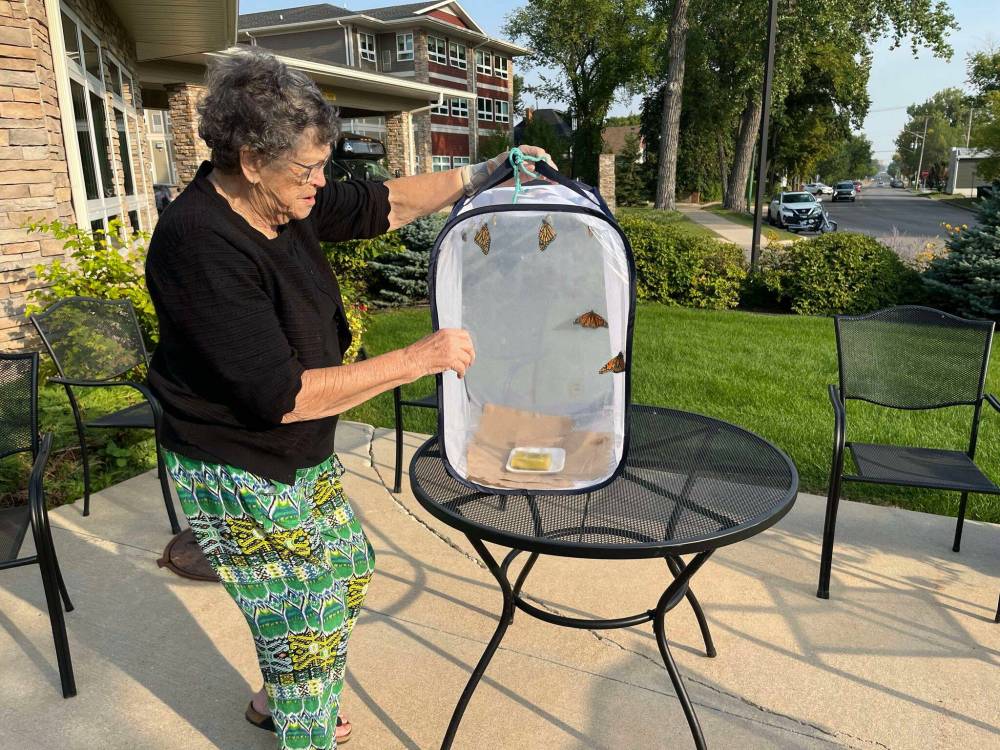
Brandon’s Pam Stacy carries a butterfly habitat cage with care, places it on an outdoor patio table, unzips the door and releases the monarch butterflies into the garden area of Rotary Villas at Crocus Gardens in Brandon.
The retirement living facility has been part of a pilot project since 2019 with a for-profit social enterprise called Monarch Homestead in Melita. The goal is to increase the butterfly population in Manitoba.
“This summer alone, we have released about 25 butterflies, and that’s in two batches,” Stacy said. “The success rate when we do it like this can be 100 per cent or a pretty high success rate, and in the wild, it’s only about 20 per cent.”
Monarch Homestead’s monarch lodge program is best suited for places where people can care for and check on the monarchs once a day, including retirement communities, correctional institutes and youth programs, according to the homestead’s website.
The organization provides butterfly eggs, milkweed leaves and instructions on how to nurture the monarchs into adulthood, said Stacy.
“We get them when the eggs are laid on the milkweed leaves, and then we have the tiniest caterpillars you’ve ever seen,” she said. “They eat ferociously, and then they go up into these chrysalises for about a week or 10 days, and then we have these beautiful butterflies.”
Placed beside the monarch lodge is a record book in which Stacy meticulously keeps track of each stage of growth, the date they become butterflies and when they’re released. So far this week, three were released on Tuesday and three on Wednesday.
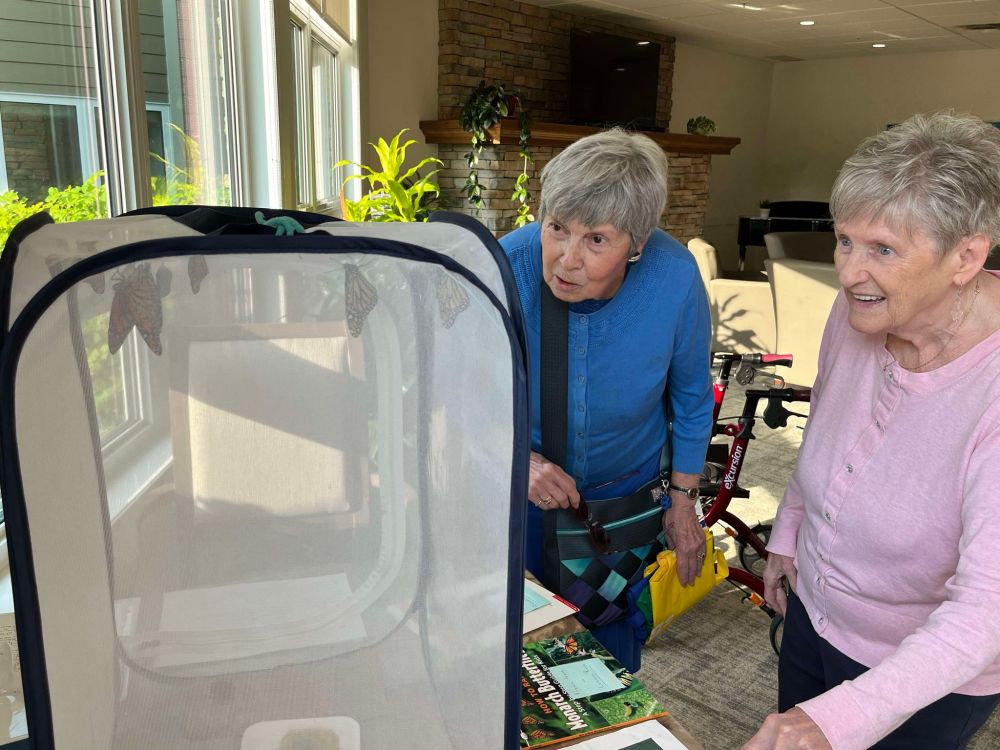
Myrna Barkley said it’s “marvellous to watch the transformation,” adding that the little white butterfly cage that sits next to the window in the lounge area catches “everybody’s eye.”
“Oh, it’s wonderful,” Barkley said. “Even when my daughter comes to visit, she just loves to have a look at the different stages, because this is something you don’t ever see in nature or any other place.”
As another Rotary Villas resident, Sylvia Barr, joined Barkley to watch one of the butterflies dry off its wings, she said, “It’s just amazing to see nature up close like this.”
Stacy said she waits a full day after the monarch “becomes a butterfly” before releasing it, “so they can get their strength,” and she places a sponge with honey and water at the bottom of the cage to give it nourishment.

The four stages of the monarch butterfly life cycle are the egg, the larvae (caterpillar), the pupa (chrysalis) and the adult butterfly.
In the caterpillar stage, it crawls to the top of the mesh cage and suspends itself. It will hang upside down and form itself into a shape that resembles the letter J.
Stacy said it will stay like that for “the better part of a week, and then it turns black, and once it’s black, you can often see the little bits of orange. It’s really very exciting.”
“I knew nothing about monarchs or butterflies when I started, so it’s been very, very interesting,” she said as she looked at another monarch making a move, “Look — there’s another one just about to come out of its chrysalis shell. Oh my goodness.”
The monarch population has lost more than 80 per cent of its population in the last 20 years, according to Monarch Homestead’s website, citing habitat loss as one of the biggest factors, followed by chemical use in agriculture and environmental changes.
The organization offers a free milkweed seed giveaway, education and resources. Also included on its website is a petition asking the Manitoba government to take milkweed off the noxious weed list.
Milkweed is the caterpillar’s sole source of food and has been considered a noxious weed by the Manitoba government since 2012.
Barr said she remembers when the pilot project started, how they “fostered the monarch butterflies,” and what it felt like when she released the very first one.
“This is such a great program and to know that you’re helping the monarch population is so important.”
» mmcdougall@brandonsun.com
» X: @enviromichele