
Radio doctor talks Manitoba health care
Advertisement
Read this article for free:
or
Already have an account? Log in here »
We need your support!
Local journalism needs your support!
As we navigate through unprecedented times, our journalists are working harder than ever to bring you the latest local updates to keep you safe and informed.
Now, more than ever, we need your support.
Starting at $15.99 plus taxes every four weeks you can access your Brandon Sun online and full access to all content as it appears on our website.
Subscribe Nowor call circulation directly at (204) 727-0527.
Your pledge helps to ensure we provide the news that matters most to your community!
To continue reading, please subscribe:
Add Brandon Sun access to your Free Press subscription for only an additional
$1 for the first 4 weeks*
*Your next subscription payment will increase by $1.00 and you will be charged $20.00 plus GST for four weeks. After four weeks, your payment will increase to $24.00 plus GST every four weeks.
Read unlimited articles for free today:
or
Already have an account? Log in here »
Hey there, time traveller!
This article was published 16/09/2024 (542 days ago), so information in it may no longer be current.
With Brandon University promised to eventually get a medical school, a well-known emergency room physician has some ideas on other successful models in Canada that could serve as examples to follow.
Dr. Brian Goldman gave a talk on the state of Canadian health care at the Lorne Watson Recital Hall at the university Saturday afternoon as part of the J.R.C. Lectureship.
Toronto-based Goldman is the host of CBC Radio’s “White Coat, Black Art” and “The Dose.” Goldman said he researched health care in Westman for his BU talk and an upcoming episode of “White Coat, Black Art” focused on Carberry’s efforts to find a doctor to reopen that community’s emergency department.
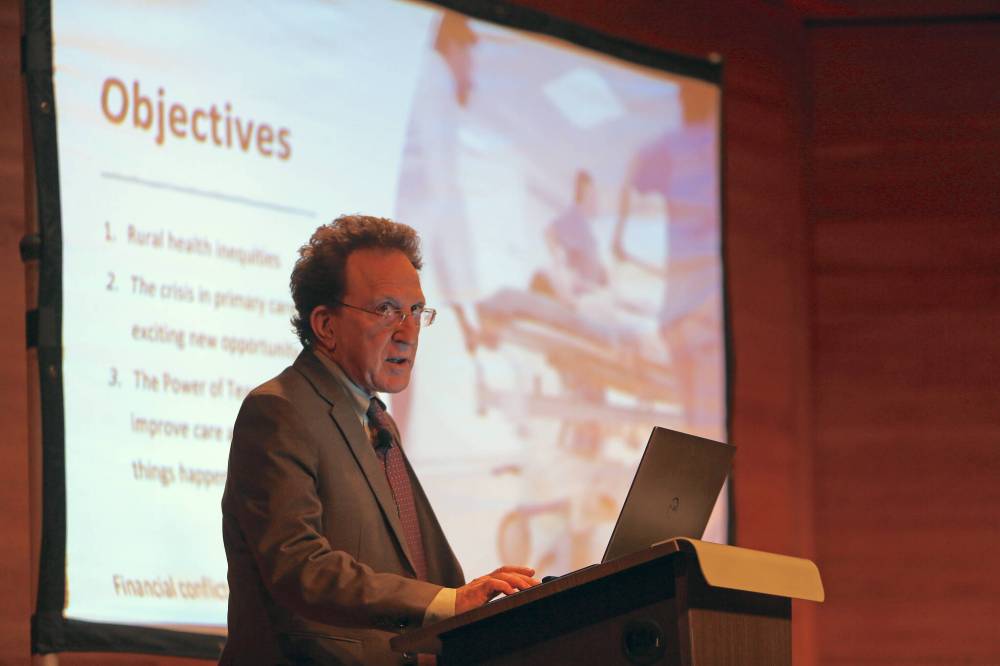
CBC Radio host Dr. Brian Goldman gives a talk about rural health care as part of Brandon University’s J.R.C. Evans Lectureship on Saturday at the Lorne Watson Recital Hall. (Colin Slark/The Brandon Sun)
This year’s provincial budget made reference to building a new annex at BU that will eventually house a medical school in partnership with the University of Manitoba.
“If you want people to practise here, you should recruit them from here because they’re more likely to come back than people who are coming from other regions,” Goldman said.
He said that bringing a full, four-year medical education program is the next step towards doing just that.
The University of Manitoba, he said, has accreditation for third- and fourth-year students and BU would need to get accredited for first- and second-year students.
The eventual plan in Brandon is to get 10 to 16 students per year. When students are taking classes in all four years of studies, that would lead to a total of 40 to 64 going through the program at any one time.
As Brandon University sets up its school and its model, Goldman referenced other efforts to recruit rural doctors through schooling elsewhere in Canada.
The first is the Northern Medical Program in Prince George, B.C., a partnership between the University of British Columbia (UBC) and the University of Northern British Columbia (UNBC).
“The two, UBC and UNBC, are in partnership with each other and that’s why it makes sense to have BU and University of Manitoba in partnership with one another,” Goldman said. “They have 40 students per class and they’re training up students preferentially from and for northern and rural communities.”
The other model Goldman brought up was the Queen’s-Lakeridge Health MD Family Medicine Program.
Based out of Kingston, Ont., the six-year program is the only one in Canada aimed specifically at training family doctors.
“They don’t know if they’ve got the screening process right, but in theory, what they’re doing is attracting people who want to be family doctors and not specialists,” Goldman said. “They’re looking for people who think holistically, who try to fit the pieces together, who understand that they have to work in a greater teamwork model.”
However, the doctor also noted that these days doctors can typically specialize in anything.
Much of Goldman’s talk revolved around access to health care. He said that Manitoba has the second-lowest rate of family doctors in the country and statistics show that 6 1/2 million Canadians don’t have access to primary care, family doctors or nurse practitioners.
Sometimes, this leads to people going into emergency rooms to arrange for things like cancer treatment. It also means that walk-in clinics and emergency departments are frequently busy dealing with minor illnesses like strep throat or urinary infections.
Patients unattached to family doctors frequently attend walk-in clinics, virtual medicine or emergency departments. Goldman said these unattached patients deserve the same level of medical care as everyone else.
Manitoba, he said, has seen the closure of a lot of walk-in clinics, urgent care centres.
Many family physicians suffer from burnout because they have high standards, but they don’t have enough time to deal with their patients, they’re inundated with paperwork for which they’re frequently not compensated for, and they aren’t properly compensated in general.
According to Goldman, British Columbia has seen some success in the past few years by trying to properly remunerate family physicians for dealing with paperwork and complex problems like dementia, osteoporosis, chronic kidney disease and more.
“It’s early, but I can tell you that the initial indications right now are that family physicians are coming back, signing on enthusiastically so far,” Goldman said.
After his talk, Goldman and Dr. Barbara MacKalski of the Brandon Clinic had a brief chat before turning the floor over to audience questions.
Among the spectators for Saturday’s event were Prairie Mountain Health CEO Treena Slate and Dr. Nichelle Desilets, a Neepawa-based family doctor who will become the next president of Doctors Manitoba this spring.
After the talk, Desilets told the Sun that the new physician services agreement between Doctors Manitoba and the provincial government covers similar ground to the compensation for family doctors in B.C. that Goldman referenced.
“Staff at Doctors Manitoba used the B.C. model when looking at what it would take to make Manitoba comparable,” Desilets said. “I can tell you that as a family doctor, that my deal in Manitoba is better than in B.C.”
However, as the elements of the agreement are still rolling out, Desilets said the full impact of that change isn’t known yet. On a personal level, she said that being compensated for that work makes her less frustrated about unpaid labour keeping her away from her family.
A part of Goldman’s talk that resonated with Desilets was teamwork and collaboration between not just doctors within the same facility, but in different parts of the health-care system.
Goldman referenced a triage system called CritiCall, a 24-7 phone service that connects hospital-based physicians with resources their hospital doesn’t have.
Desilets said that Manitoba recently introduced a similar system called VECTRS, but it’s not where it needs to be yet.
“Just this week, I had two colleagues with critically unwell patients in very small hospitals, hospitals that are small enough to not even have lab services overnight,” Desilets said.
“They were having a lot of difficulty transferring their patients out of those smaller facilities, up to the regional or tertiary care that they need because it’s so hard to know who to call.”
In one case, she said she and a colleague were assisting a very unwell patient. They called the closest intensive care unit, which said they couldn’t accommodate the patient and suggested they call Winnipeg.
The problem was, they didn’t know which hospital, department or person they should call.
“We’re making up the process every time,” Desilets said. “VECTRS, hopefully one day will be that one phone call that Dr. Goldman was talking about, where they are essential intake, they ask you a few key questions about your patient and they get the right person on the phone for you.”
» cslark@brandonsun.com
» X: @ColinSlark