
Brandon crash included in traffic safety report
Advertisement
Read this article for free:
or
Already have an account? Log in here »
We need your support!
Local journalism needs your support!
As we navigate through unprecedented times, our journalists are working harder than ever to bring you the latest local updates to keep you safe and informed.
Now, more than ever, we need your support.
Starting at $15.99 plus taxes every four weeks you can access your Brandon Sun online and full access to all content as it appears on our website.
Subscribe Nowor call circulation directly at (204) 727-0527.
Your pledge helps to ensure we provide the news that matters most to your community!
To continue reading, please subscribe:
Add Brandon Sun access to your Free Press subscription for only an additional
$1 for the first 4 weeks*
- Enjoy unlimited reading on brandonsun.com
- Read the Brandon Sun E-Edition, our digital replica newspaper
*Your next Free Press subscription payment will increase by $1.00 and you will be charged $20.95 plus GST for four weeks. After four weeks, your payment will increase to $24.95 plus GST every four weeks.
Read unlimited articles for free today:
or
Already have an account? Log in here »
Hey there, time traveller!
This article was published 16/10/2024 (582 days ago), so information in it may no longer be current.
Municipalities should establish formalized processes to study and react to serious vehicle collisions, according to a new report from a U.S.-based non-profit that included data from a Brandon crash.
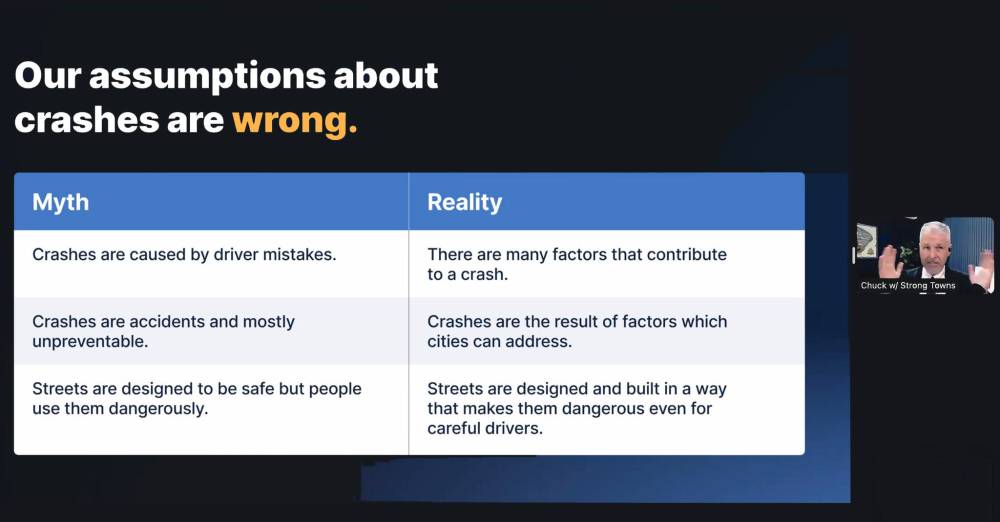
Released on Tuesday, “Beyond Blame: How Cities can Learn from Crashes to Create Safer Streets Today” by Strong Towns took the results of studies into the causes of 18 collisions in the U.S. and Canada and made a series of recommendations on how municipalities can run their own studies.
Most of the crashes studied were fatal ones in the U.S. and a single fatal Canadian crash in Ottawa.
The only non-fatal accident included was a 2022 collision near Rideau Park in Brandon, where local cycling advocate Grant Hamilton lost his pinky finger and suffered a separated shoulder after being struck by a car.
The report said that the default response to crashes is to assign blame for insurance purposes.
“The medical profession uses clinical mortality reviews to study and learn from adverse outcomes,” the report said. “The National Transportation Safety Board has a similar commitment to study each plane crash. Yet, despite the level of urgency, there is no institutional response to gain insight from automobile crashes.”
According to the report, this is because there is a lack of established practices for analyzing and learning from car crashes.
The 18 cases turned up five common contributing factors to collisions: high-speed road design in urban areas, design that inadequately accounts for pedestrians and cyclists, dangerous intersection design, visibility and lighting issues and deviation from the street or intersection designer’s intent.
Strong Towns representatives believe that Hamilton’s collision had three of those factors: dangerous intersection design, visibility and lighting issues and deviation from the designer’s intent.
Going forward, the organization recommends six courses of action:
• Make vehicle safety a core organizational responsibility by appointing a person empowered to speak up on traffic safety issues.
• Establish a crash response team to gather data after a crash.
• Create a crash analysis studio format to identity factors that cause a crash.
• Use temporary traffic control devices to respond quickly after a crash or to dangerous conditions.
• Update local street standards to prioritize safety over traffic speed.
• Hold biking and walking audits for all municipal projects so that insight and awareness isn’t just being provided from the perspectives of motorists.
During a Q&A session, Strong Towns’ community engagement co-ordinator Tony Harris said Brandon’s engagement with their crash analysis had “been higher than some of the other communities we worked with, and lower than a few others.”
Harris said Hamilton’s advocacy has helped sustain some local Vision Zero projects, and he applauded Brandon’s efforts to reduce speed limits in some neighbourhoods and a pilot project to install a mini-roundabout at the intersection of Princess Avenue East and Douglas Street.
Vision zero is a strategy that aims for zero serious injuries or traffic deaths in any given year. Brandon has established a Vision Zero Task Force, and the speed reductions and the mini roundabout pilot project have been part of the city’s efforts toward Vision Zero.
Brandon transportation planner Sam van Huizen, who watched Tuesday’s presentation, said even though most of the studied crashes were in the U.S., there were some similarities with Canada such as the shared management of roadways between municipal and state or provincial governments.
“For so long … the sad reality is that we as traffic engineers have kind of been planning roadways and for the vehicle. We need to shift away from that,” van Huizen said. “Road use is not just for vehicles, it’s for non-vehicle use as well: pedestrians, cyclists, people who use assistive devices.”
He said municipalities’ best ally in the fight for better traffic safety is the reduction of speed limits. However, getting motorists to comply with those reductions is a problem, especially when roadways were built with a higher speed limit in mind.
In the area around Rideau Park, where speed limits were dropped to 30 km/h, van Huizen said “there’s not as much compliance” as the city was hoping for.
Data collected this year shows that 85 per cent of drivers are going 47 km/h or slower, with the remaining 15 per cent driving faster. In response, van Huizen said the city is working with law enforcement to improve compliance during hours when traffic is heavier.
He added that traffic engineers aim for the 85th percentile speed to be closed to the posted speed limit as it typically shows good compliance from drivers on following road rules.
As the city ramps up for next spring, further calming measures like cushioning (speed bumps) are being considered in the area at intersections, rather than mid-block. They also want to continue providing parking on roads like Lorne Avenue, while still providing adequate space for cyclists.
Further speed reduction and traffic calming efforts are being planned for other parts of the city, but van Huizen said more data is needed before more information is released.
He did say that pedestrian-heavy areas like around Brandon University are being looked at, as well as areas near playgrounds.
Currently, the city is considering various designs for the rebuilding of 26th Street from Park to Victoria avenues, all of which would include some kind of protection for cyclists whether it’s a multi-use pathway, a raised cycle lane or buffered cycle lanes.
Van Huizen said Strong Towns’ recommendation that bike lane infrastructure be separate from pedestrian sidewalks or from street networks is something city staff can point to when residents ask about the necessity of the redesign.
“We see all these scenarios where either vulnerable road users, like pedestrians or cyclists, have been killed or injured severely,” he said. “If proper infrastructure was in place, perhaps that could have been avoided.”
Though Hamilton was unable to watch Tuesday’s presentation, he told the Sun that he had been provided with an embargoed copy of the report.
He said the similarities between his crash and those in the other communities show that Brandon doesn’t need to reinvent the wheel to address traffic safety. He also said he was impressed with the report’s urgency toward acting.
“We don’t necessarily need to analyze things, plan things,” he said. “We can go out there and make positive change with pylons, with paint, with some signage. Frankly, I’m happy that the City of Brandon has taken us in that direction with the mini roundabout that’s actually near the crash site in the east end.”
As a member of Brandon’s Vision Zero Task Force, Hamilton said the idea of a quick response team to analyze crashes really stood out to him.
On 26th Street, Hamilton expressed some disappointment that the discussion over the redevelopment took so long, but said he was glad that the city is talking with residents about what kind of street that neighbourhood needs.
“The cities that have found the most success with bike lane networks, the emphasis is on the network,” he said. “One bike lane that goes from Park Avenue to Victoria Avenue is not going to change cycling in Brandon. We need 15 bike lanes on 15 different streets, and we need the kind of transformation in how people can get around the city to make it worthwhile.”
» cslark@brandonsun.com
» X: @ColinSlark
History
Updated on Wednesday, October 16, 2024 11:47 AM CDT: Corrected and clarified information about observed traffic speeds near Rideau Park.