
‘We don’t want to forget the past’
RCA Museum a link to Canada’s war history
Advertisement
Read this article for free:
or
Already have an account? Log in here »
We need your support!
Local journalism needs your support!
As we navigate through unprecedented times, our journalists are working harder than ever to bring you the latest local updates to keep you safe and informed.
Now, more than ever, we need your support.
Starting at $15.99 plus taxes every four weeks you can access your Brandon Sun online and full access to all content as it appears on our website.
Subscribe Nowor call circulation directly at (204) 727-0527.
Your pledge helps to ensure we provide the news that matters most to your community!
To continue reading, please subscribe:
Add Brandon Sun access to your Free Press subscription for only an additional
$1 for the first 4 weeks*
- Enjoy unlimited reading on brandonsun.com
- Read the Brandon Sun E-Edition, our digital replica newspaper
*Your next Free Press subscription payment will increase by $1.00 and you will be charged $20.95 plus GST for four weeks. After four weeks, your payment will increase to $24.95 plus GST every four weeks.
Read unlimited articles for free today:
or
Already have an account? Log in here »
Hey there, time traveller!
This article was published 09/11/2024 (572 days ago), so information in it may no longer be current.
CFB SHILO — The guns have long fallen silent from their wartime service in the first and second World Wars. And the stories of the men and women who served our country — so many of them giving their lives on the battlefield — are now part of our shared history.
And yet so often that history can feel a lifetime removed from our own memories, even as we gather on Remembrance Day this coming Monday to grieve for the fallen and pray for lasting peace in the world. So many of us never fought on a battlefield, and will never know the courage and horror of war. While we can be thankful of that reality, there remains a need to understand Canada’s war history as we raise the next generation of Canadians.
“We don’t want to forget the past,” Royal Canadian Artillery Museum director Andrew Oakden told the Sun during a tour of the facility at CFB Shilo. “And certainly not the service of these men that fought and died in these past wars.”
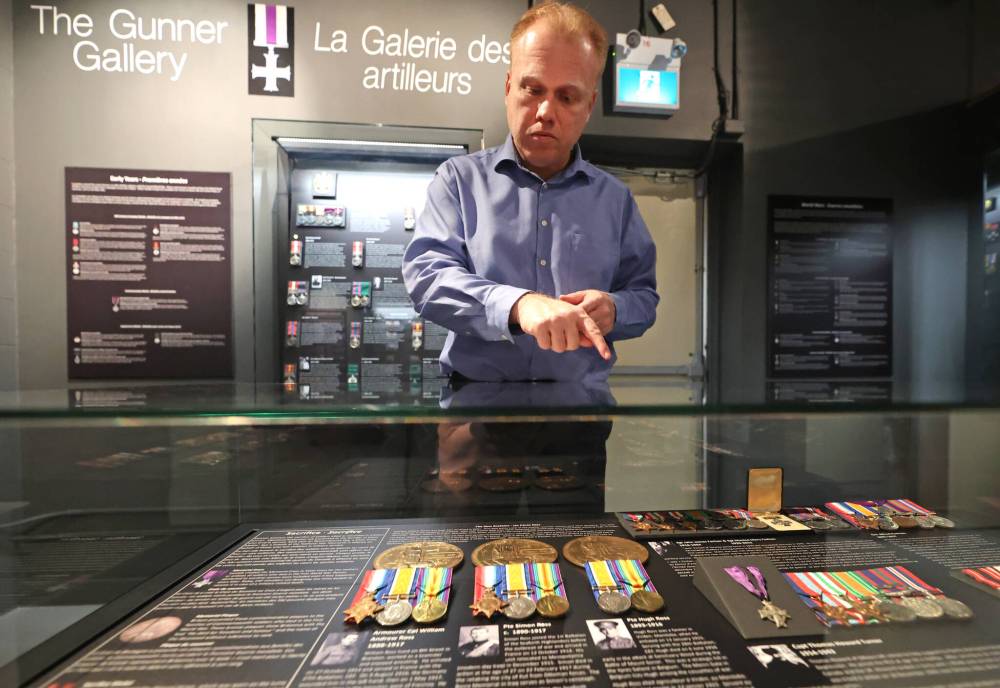
Royal Canadian Artillery Museum director Andrew Oakden explains a display of medals that were given to Hugh Ross, Simon Ross and William Ross, three brothers with ties to Virden who all served and died during the First World War for Canada. Their medals, and the memorial plaques — or “death pennies” — that were given to their families upon their deaths, are on display as part of the museum’s vast collection of war memorabilia. (Photos by Matt Goerzen/The Brandon Sun)
This year marks the 110th anniversary of the First World War, which started in 1914. More than 60,000 Canadians died in that conflict, many of them local men and women from Brandon and western Manitoba. While they are no longer with us, many of their stories live on in the archives and displays at the RCA Museum.
In this anniversary year, the museum opened a new temporary exhibit to mark the start of the First World War. The exhibit, called “Over the Top: Canada and the First World War,” was originally set to finish in August, but has been continued into 2025. That means Manitobans who have yet to take in the exhibit and are interested in learning more about Canada’s involvement in the Great War and of the stories of our local veterans still have time to visit.
“We have a number of the medals of soldiers who died in World War I on display in our Gunner gallery, including the Ross brothers,” Oakden said. “They were three brothers who died during World War I within less than a year of each other. We have their dead men’s pennies and their medal sets and photos on display with their bios of each of the three soldiers.”
The three brothers were the sons of Hugh Ross from the Highlands of Scotland, who immigrated to Canada in 1907 and settled in Virden. As stated on the RCA Museum website, Hugh Ross brought two sons to Canada, Hugh and William, a daughter Mary, and a second wife Jane. The middle son, Simon, did not immigrate to Canada. All three brothers would die in service.
The stories of many more servicemen and women are told at the RCA Museum, which holds thousands of artifacts, medals, guns and vehicles from the first and second World Wars — many of which are on display for visitors.
Also on display is a printing plate of John McCrae’s famous wartime poem “In Flanders Fields,” which was created more than 100 years ago and has been on base at CFB Shilo since the 1920s.
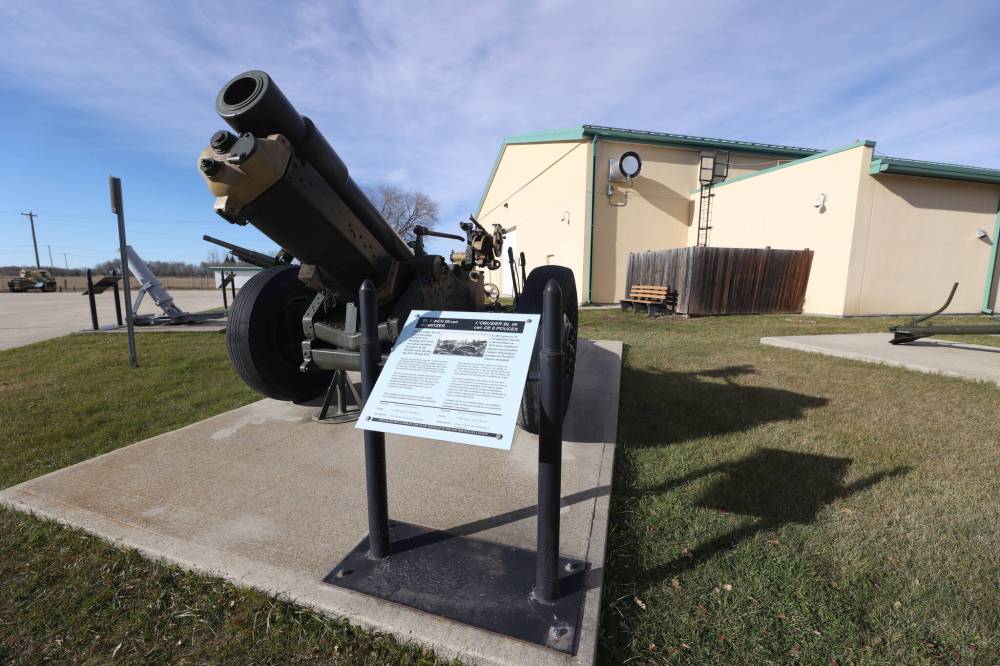
A BL 6 Inch 26 cwt howitzer, first introduced in 1915 to replace medium howitzers in the British Army during the First World War, stands outside the RCA Museum at CFB Shilo. It’s one of several such guns on display on the museum grounds.
“General Morrison, who led the artillery in World War I had it done up after the war. He did it up to I guess sell copies of the poem. So it just stayed in this area and stayed in 1RCHA hands throughout. And then it probably went to the mess, then it went to the school, and then the museum in the early ’60s.”
Beyond the special First World War anniversary exhibit, the museum has much more on offer to draw in visitors, including artifacts from Canada’s various peacekeeping and military roles during the Korean and Afghanistan wars.
During the tour on Wednesday, Oakden made sure to point out one display in particular. He said he had asked his staff to find stories and artifacts from Indigenous soldiers within their archives that could help bring their stories to the public. As a result, the museum now displays the uniform of Gunner Paul Gladu, an Indigenous Canadian who fought in the Second World War and spent part of his tour of duty in France and Holland. A wooden gunner’s RCA emblem he carved and painted with his own hands is part of the display.
“We also have a letter from the ’60s when he couldn’t get his benefits and he wasn’t doing well,” Oakden said. “He obviously enjoyed being with the Canadian Artillery, did his service, and 20 years later he never got his benefits because benefits went through Indian Affairs. So it is with that history of Canada not supporting all the veterans.”
Perhaps one of the most intriguing rooms in the facility is the archive room where so much of the artifacts in their care are held in storage.

A metal box that once held Christmas chocolate for soldiers as part of their rations in 1914 is one of the many artifacts in storage and on display at the RCA Museum in CFB Shilo. Oakden says many soldiers would have stored their cigarettes in the box after the chocolate was gone.
As we walk into the space, Oakden picks out a dark green service jacket out of a long line of similar uniforms with the word Canada emblazoned on the shoulder. It belonged to Lt-Gen. Guy Simonds, who led the campaign in northwestern Europe as part of the Canadian armed forces during the Second World War.
“He went back and became the commander of the Canadian army after the war, and helped develop the army in the ’50s and ’60s, right before he retired.”
The jacket — called a battle dress — in Oakden’s hands, was made with a bright red inner material, which he says was not standard.
“He was certainly very sharp and creative. He’s known for being very dignified and very official. Like in this case, I know his uniform was British. I know it has the maker’s mark on it. So in this case that is not standard issue, to be red. So he had it specially done. It’s supposed to be green, but he’s a general — he can do what he wants.”
There are also several other items in storage at the RCA Museum, including photos, paintings, uniforms, hats and helmets, as well as mementos brought home by Canadian soldiers during their time overseas.
Oakden pulls out a cabinet drawer full of those kinds of mementos, including a military chocolate ration box, cutlery and various pins. He says the museum even has enemy flags in their care, though he notes they’re not artifacts that can be tastefully displayed.
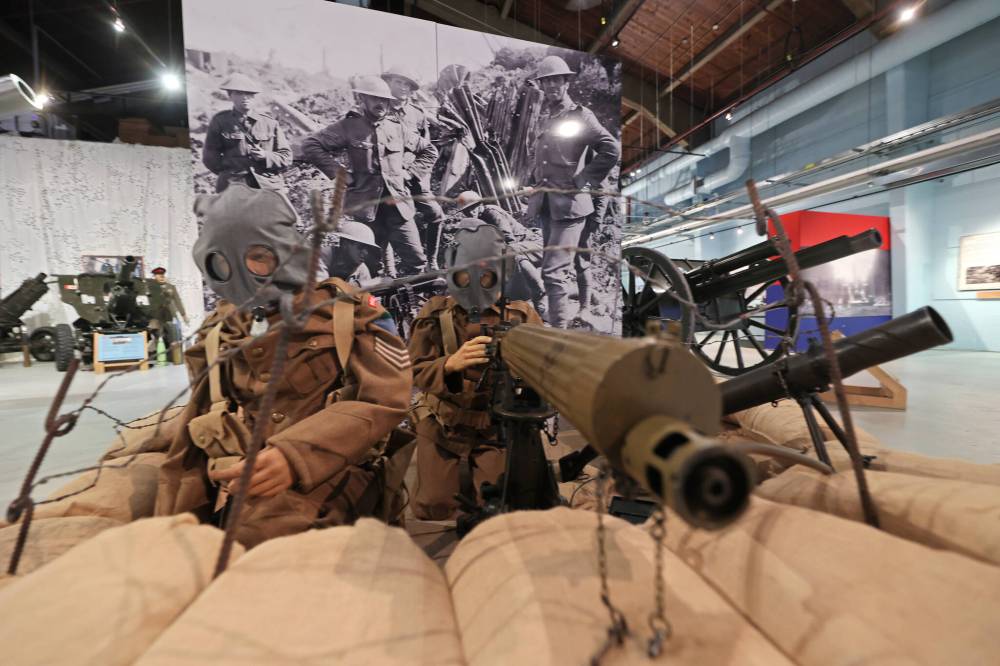
Mannequins of Canadian soldiers wearing gas masks man a Vickers machine gun as part of a temporary First World War exhibit at the RCA Museum in CFB Shilo dedicated to the early years of the Great War. This year marks the 110th anniversary of the start of the First World War.
“We have, I think, 11 large Nazi flags. What do you do with them? You can’t really show them. They have good provenance, so we know where they came from and who took it. But, you know …”
While the many artifacts of war are certainly of interest, Oakden says the point of visiting the museum, particularly on Remembrance Day, is to help the public understand what Canadians have done in service of their country.
“We want people to remember, you know,” Oakden said. “We want them to think more so of the soldier than themselves, and the sacrifice that they made.”
For anyone looking to walk back in time for a few hours on Remembrance Day, the RCA Museum will be open on Monday at 11:30 a.m. until 4 p.m.
Lest we forget.
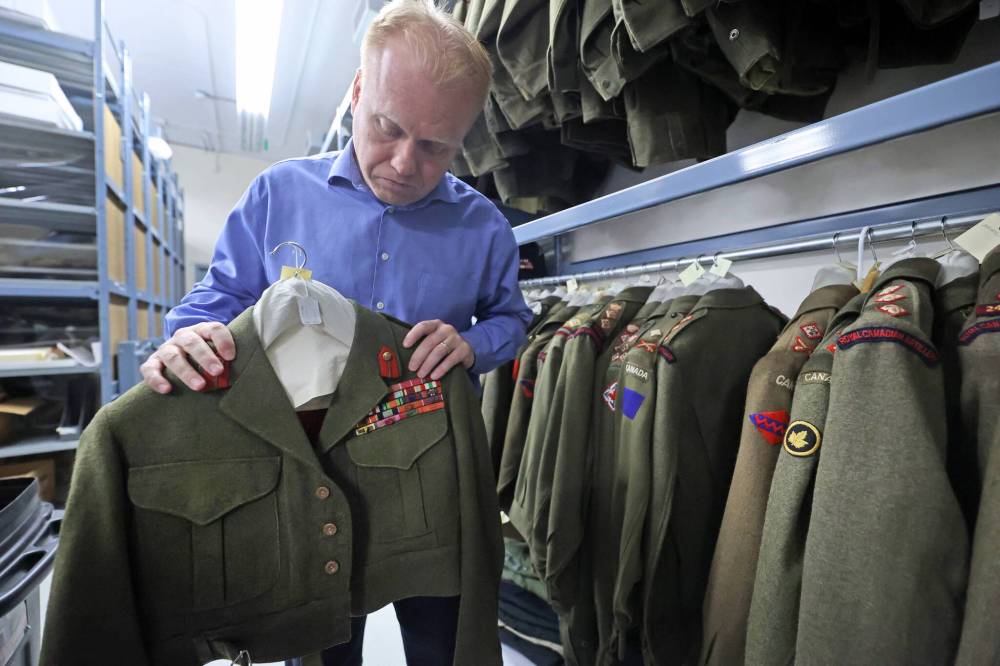
Oakden holds a uniform that once belonged to Lt.-General Guy G. Simonds, a famous Canadian officer who led the Canadian military campaign in northwestern Europe during the Second World War. His uniform, and those of many other Canadian soldiers, are stored in the archive room of the RCA Museum.
» mgoerzen@brandonsun.com
» Bluesky: @mattgoerzen.bsky.social