
Province plans new bison statue
Advertisement
Read this article for free:
or
Already have an account? Log in here »
We need your support!
Local journalism needs your support!
As we navigate through unprecedented times, our journalists are working harder than ever to bring you the latest local updates to keep you safe and informed.
Now, more than ever, we need your support.
Starting at $15.99 plus taxes every four weeks you can access your Brandon Sun online and full access to all content as it appears on our website.
Subscribe Nowor call circulation directly at (204) 727-0527.
Your pledge helps to ensure we provide the news that matters most to your community!
To continue reading, please subscribe:
Add Brandon Sun access to your Free Press subscription for only an additional
$1 for the first 4 weeks*
*Your next subscription payment will increase by $1.00 and you will be charged $20.00 plus GST for four weeks. After four weeks, your payment will increase to $24.00 plus GST every four weeks.
Read unlimited articles for free today:
or
Already have an account? Log in here »
Hey there, time traveller!
This article was published 22/11/2024 (456 days ago), so information in it may no longer be current.
WINNIPEG — As the province makes plans for a statue to “serve as a reminder of the sacred bonds of family that were harmed in the residential school era,” it is also discussing the future of the toppled and beheaded Queen Victoria monument it’s replacing at the legislature.
“I think there’s an opportunity here to send a values message about who we are as Manitobans,” Premier Wab Kinew said Tuesday ahead of the statue’s announcement in Tuesday’s throne speech.
“The bison is our provincial symbol. The legislature is the peoples’ building. I think that having a bison mother and child on the front of the legislature is a way to invite people down. Yes, people will come for the selfies and the photo-ops. At the same time, when we reflect on part of the recent history — it also evokes and acknowledges the history of residential schools.”
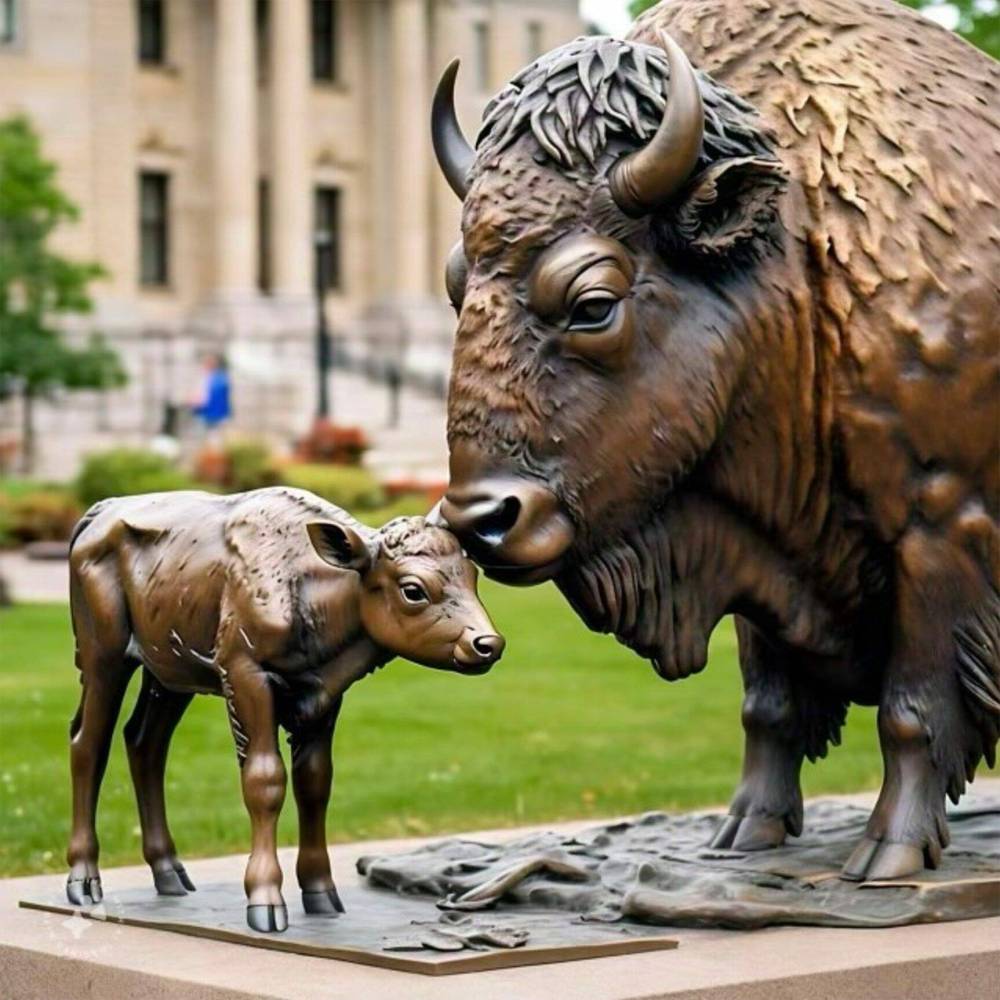
An AI image posted on Instagram by Premier Wab Kinew shows what a newly commissioned statue could look like. The bison statue is set to find a home on the Manitoba Legislative Building’s front lawn. (Submitted)
The premier said he hopes public input will be included in the design. He expects the process will take a year.
“I think it’s a wonderful, wonderful idea,” said Mary Courchene, an elder from Sagkeeng First Nation who attended Fort Alexander residential school. The retired Indigenous educator said she likes the concept of a young bison and its mother.
“It will be an excellent teaching.”
Courchene drew a parallel from what happened to the bison that once roamed freely and sustained Indigenous people to the experiences of First Nations people since colonization.
The animal that symbolizes respect in Indigenous culture was practically wiped out and can only be seen behind fences today, she said.
“I always compare it to the way we were gathered or stolen away from our families … we were not treated so kindly,” she said. “That changed a lot of us. Many of us didn’t get that family bonding and the result was many people were in jails, many of our people were homeless and many lost contact with families and were placed in the child welfare system.”
A mother and baby bison is a hopeful and challenging image for Manitoba, she said.
“What kind of future do they have — are they going to be annihilated down the line or are we going to resurrect what they had and what we had?” Courchene asked.
“Are we going to build our families and hopefully in the future we will revive our values and mores of long ago where we had the sacred teaching? That’s what we’re working for. We have kind of a long way to go.”
Courchene quoted former Manitoba judge and senator Murray Sinclair, who chaired the Truth and Reconciliation Commission of Canada: “Education is what got us into this mess and education is key to getting us out of it,” Sinclair, who died earlier this month, said in 2022.
Gordon Goldsborough, the Manitoba Historical Society’s head researcher, is less enthusiastic about more bisons at the legislature, noting there are already two massive statues on either side of the grand staircase inside the building.
“It seems redundant, somehow,” he said, adding a monument commemorating Indigenous people on the grounds is long overdue.
Meanwhile, the province is also considering what to do with the Queen Victoria statue that was damaged beyond repair by protesters on Canada Day 2021 following reports of potential unmarked graves at former residential school sites.
“I think it’s important that we preserve the statue and what took place in the living memory of our province,” Kinew said, noting there are questions concerning protocol, curatorship and caring for the statue that need to be addressed.
“I want this to be presented in an historically relevant context, which means talk about the statue of the queen, who she was and what it represents.”
He said it means talking about what was taking place in Canada at the time of the protest.
“I would want future generations of Manitobans to be able to learn from this and to reflect on what took place,” he said, adding the provincial government is talking to museums about exhibiting the damaged statue.
Manitoba Museum CEO Dorota Blumczyńska said she has been consulted about the statue.
“We certainly appreciate the tremendous historic significance that this statue has to the province and to the nation,” she told the Winnipeg Free Press Thursday.
“I think our role would be — if it were to be here — to prepare visitors in advance of coming upon the statue, to understand what its current state symbolizes and what it means, and how it got there.”
She said exhibiting the statue at the museum would happen only after consultations with consultations and a shared decision with the facility’s Indigenous advisory circle and “our broader communities.”
“We would not be prepared to make this decision on our own because the Manitoba Museum is for all Manitobans and we respect and truly treasure and are grateful for the relationships we have with First Nations, Inuit and Métis communities,” she said.
“They’d have to agree that the educational value of the broken, vandalized statue outweighed any risk of its exhibition.”
Blumczyńska said the statue represents a complicated figure in history.
“The monarchy, as we know, represents colonialism, tremendous harm to First Nations, Inuit and Métis communities, the attempted erasure of their cultures, the attempted genocide,” she said.
» Winnipeg Free Press