
BU prof’s new book examines social media’s role in policing
Advertisement
Read this article for free:
or
Already have an account? Log in here »
We need your support!
Local journalism needs your support!
As we navigate through unprecedented times, our journalists are working harder than ever to bring you the latest local updates to keep you safe and informed.
Now, more than ever, we need your support.
Starting at $15.99 plus taxes every four weeks you can access your Brandon Sun online and full access to all content as it appears on our website.
Subscribe Nowor call circulation directly at (204) 727-0527.
Your pledge helps to ensure we provide the news that matters most to your community!
To continue reading, please subscribe:
Add Brandon Sun access to your Free Press subscription for only an additional
$1 for the first 4 weeks*
- Enjoy unlimited reading on brandonsun.com
- Read the Brandon Sun E-Edition, our digital replica newspaper
*Your next Free Press subscription payment will increase by $1.00 and you will be charged $20.95 plus GST for four weeks. After four weeks, your payment will increase to $24.95 plus GST every four weeks.
Read unlimited articles for free today:
or
Already have an account? Log in here »
Hey there, time traveller!
This article was published 05/12/2024 (691 days ago), so information in it may no longer be current.
A Brandon University sociology professor has taken a deep dive into how police departments are using social media as an additional tool for law enforcement, and how this is being perceived by the public.
Chris Schneider’s latest book — his eighth — is called, “Policing and Social Media: Social Control in an Era of Digital Media.”
“The book doesn’t make recommendations,” Schneider said. “What it does is largely explore how policing has incorporated social media into its front line police strategies. Social media is a primary strategy that police services engage in, and this book explores how this develops.”
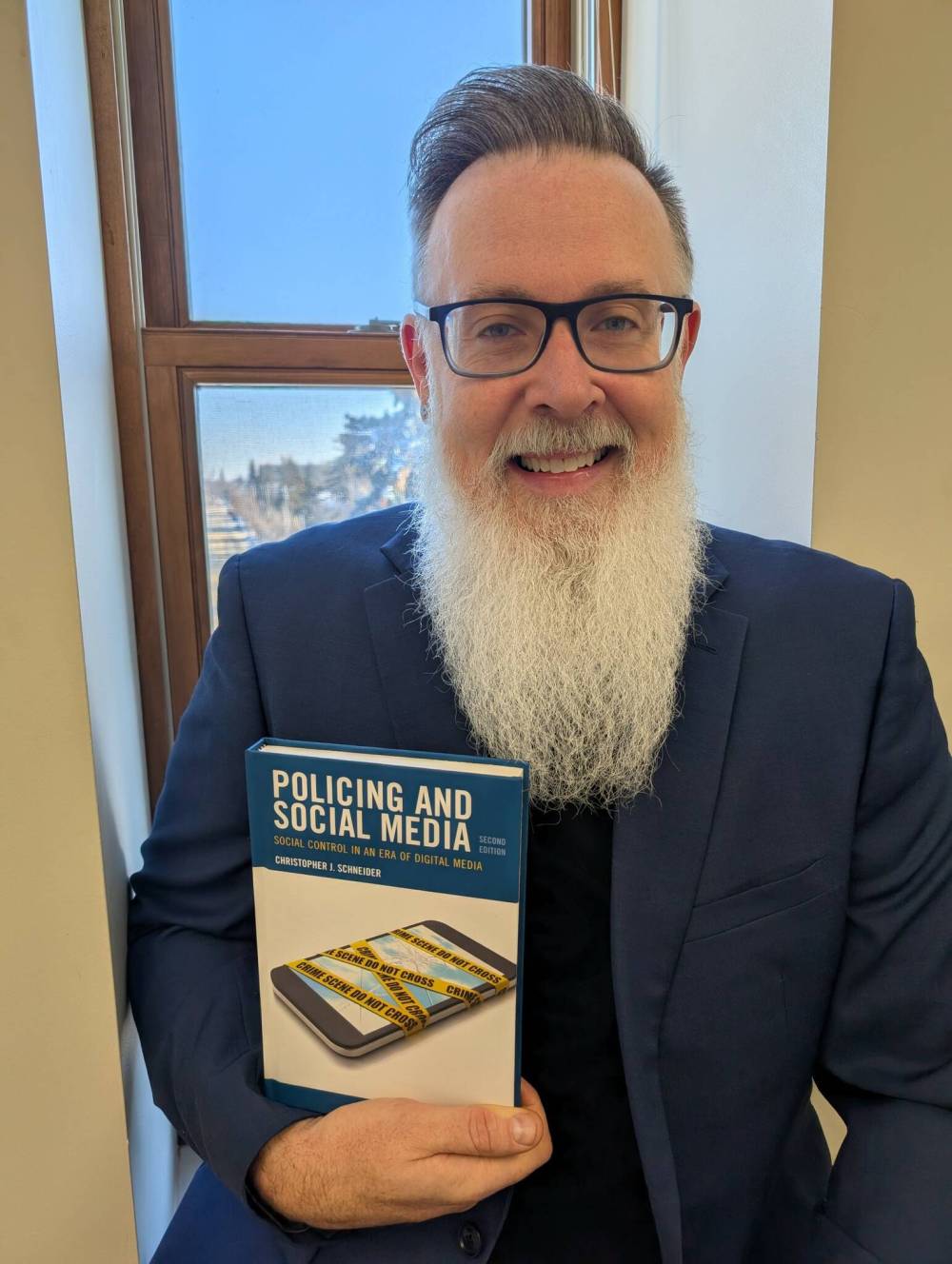
Christopher Schneider, Brandon University sociology professor and author has completed a second edition of his book titled, “Policing and Social Media: Social Control in an Era of Digital Media.” (Submittted)
Schneider’s book is an updated version of the first release, which was originally published in 2016. It now includes TikTok, which he said is one of the fastest growing social media platforms for young people.
He started by investigating the Toronto Police Service’s use of TikTok. The organization was the first police service in Canada to develop and launch a social media strategy in July of 2011, including its implementation at its police college, with more than 100 officers opening Twitter accounts at one point under the initiative.
“I was looking to see how and in what ways police were engaging primarily young persons to restore trust and confidence in policing,” said Schneider.
“This was important to look at, because other police services across the country followed in the footsteps of what the Toronto Police Service was doing.”
While using TikTok can be an advantage for reaching and connecting with citizens, Schneider said in some instances social media posts have nothing to do with police work.
He cited the instance of Saskatoon police, whose members went viral in 2018 for their lip-syncing video of the Backstreet Boys song, “I Want It That Way,” which racked up more than 3.7 million views on Facebook.
“What in the world does police lip syncing to popular music have to do with apprehending criminals? I’m not so sure,” Schneider said.
“But this personalizes the police, right? They’re trying to show officers as more than just the badge, showing officers as being humorous, fun and engaging. But when we look at the research literature on policing, personalized policing never works,” Schneider said. “What it does is erode police legitimacy.”
The cornerstone of police legitimacy is impersonal policing, Schneider explained. Social media can be confusing to followers, who might see an officer on social media and think they are friends.
“Social media can show police as humorous and fun, but then when they have to get serious at an arrest, people might think, why are you arresting me? I thought we were friends. I thought we were cool. That could upset members of the public and make a bad impression,” Schneider said.
Social media can also hinder police investigations, Schneider added, now that more people are using their phones to take photos and videos of what they are seeing and instantly sharing them online.
“It’s actually complicated police work to a degree. If people are recording and live streaming, it’s going online, sometimes even before the police show up at a scene. So that means there’s now a crime narrative.
“People online are saying what it is that happened, and information is being put out there that the police don’t have control over.
“So, this is one of the key distinctions of how things have changed,” Schneider clarified.
The research for his book included collecting more than 100,000 tweets published by the Toronto Police Service, about 400 TikTok videos, and 8,000 posts on a YouTube video.
What really got him thinking about the impact of social media and policing was an event in Vancouver in 2011. Hockey fans who were upset that the Canucks had lost the Stanley Cup to the Boston Bruins started rioting.
It was one of the first “large-scale criminal events,” that had people taking photos and videos and posting them as the event was happening.
While Schneider said he hasn’t done research on police services in Westman, he has taken a “cursory look” at Brandon Police Service’s social media accounts.
“What Brandon police is doing is fairly consistent with what the research says other police services are doing on social media, in terms of providing traffic updates and those kinds of things.”
“And it looks to me that they’re doing a fairly decent job at that.”
Schneider’s book is available on Amazon. It can also be accessed by calling BU’s Research and Graduate Studies office at 204-571-8544.
» mmcdougall@brandonsun.com
» X: @enviromichele