
In remembering the past, the Dakota find reconciliation, healing
Advertisement
Read this article for free:
or
Already have an account? Log in here »
We need your support!
Local journalism needs your support!
As we navigate through unprecedented times, our journalists are working harder than ever to bring you the latest local updates to keep you safe and informed.
Now, more than ever, we need your support.
Starting at $15.99 plus taxes every four weeks you can access your Brandon Sun online and full access to all content as it appears on our website.
Subscribe Nowor call circulation directly at (204) 727-0527.
Your pledge helps to ensure we provide the news that matters most to your community!
To continue reading, please subscribe:
Add Brandon Sun access to your Free Press subscription for only an additional
$1 for the first 4 weeks*
*Your next subscription payment will increase by $1.00 and you will be charged $20.00 plus GST for four weeks. After four weeks, your payment will increase to $24.00 plus GST every four weeks.
Read unlimited articles for free today:
or
Already have an account? Log in here »
Hey there, time traveller!
This article was published 02/01/2025 (448 days ago), so information in it may no longer be current.
The terrain is mostly flat — flanked by bare oak and birch trees, undulating valleys and lakes. The weather, though, can be brutal. Temperatures reach -40 during some years, interspersed with snowy blizzards and fog that can reduce visibility to nearly naught.
But every year since 2005, a group of riders, runners and walkers have been making the annual trek to Mankato, Minn., to commemorate an event that is widely considered the largest mass execution in the history of the United States. It was ordered by President Abraham Lincoln in December of 1862.
Wilfred Keeble, 66, from the Crow Creek Indian Reservation in Fort Thompson, S.D., has spent nearly two decades riding for this cause now. He was part of the original group that set out to test uncharted territory during the nearly 330-mile-long inaugural ride in 2005 and spoke to the Sun in December while taking part in the 2024 ride.

Riders from various First Nation communities across the United States and Canada gather near the original site of the hanging of the Dakota 38 in Mankato, Minn., before the ride’s conclusion on Dec. 26. The commemoration ceremony takes place at the Dakota 38 Memorial at Reconciliation Park in Mankato, situated near the Minnesota River. Dedicated in 1997, the memorial marks the site of the largest mass execution in U.S. history where 38 Dakota Indians were hanged by the government during the U.S.-Dakota Conflict of 1862. (Source: U.S. Library of Congress) (Submitted)
“I didn’t really know what to expect. It was a horse ride. I had one horse. The horse did a good job. It was a long ride … couple of weeks on the road. The cause was good, and we got it done. Never done anything like that before,” Keeble said.
The idea for the “Dakota 38+2 Memorial Ride” was originally conceived by Vietnam war veteran and Dakota elder Jim Miller, who passed away in 2023. Miller admitted to having envisioned the ride in a dream where he saw his ancestors — the Dakota 38 — being hanged in a similar setting as the one that took place in 1862 in Mankato. He had never been to the city or heard about the event till then.
President Lincoln’s 1862 order came in the wake of a short-lived uprising by the Dakota Sioux tribes — based primarily in Minnesota at the time — who rebelled against settler encroachments on their land and because prior treaties signed with the Dakota, which included supplying food and other rations, were not honoured. A conflict, known as the U.S.-Dakota war, ensued, with thousands of Dakota men, women and children being driven off their lands and starved to death.
Hundreds were also placed in the Fort Snelling Concentration Camp in an enclosure built next to the banks of the Minnesota River, where starved of food and ridden with disease, most eventually perished.
According to the Minnesota Historical Society, “The concentration camp at Fort Snelling was not a death camp, and Dakota people were not systematically exterminated there. The camp was, however, a part of the genocidal policies pursued against Indigenous people throughout the U.S. Colonists and soldiers hunted down and killed Dakota people, abused them physically and mentally, imprisoned them, and subjected them to a campaign calculated to make them stop being Dakota.”
After the uprising ended, the remaining Dakota were exiled from Minnesota, loaded up in steamboats and transported down the Missouri river to a narrow stretch of land in what came to be later known as the Crow Creek Indian Reservation in South Dakota. From there, many fanned out to other U.S. states, including South and North Dakota, Nebraska, Colorado, Wyoming, Montana, Iowa and further north into provinces across Canada — primarily in the Prairies.
Miller’s ethereal experience and the subsequent inter-generational trauma endured by many of the direct descendants of the Dakota 38 has also been encapsulated in a 2012 documentary on the subject, entitled, “Dakota 38” made by Smooth Feather Films — a non-profit based in southern Maine.
The documentary follows Miller and the group of intrepid Dakota riders as they make their way down the great plains of South Dakota, starting on Dec. 10 each year from Lower Brule and ride for over 330 miles to conclude the ride with a commemoration ceremony on Dec. 26 at the Dakota 38 Memorial situated in the Reconciliation Park in Mankato — which is the original site where the hanging of the 38 Dakota men took place.
The “2” in “Dakota 38+2 Memorial Ride” refers to two other Dakota men — Shakpe and Medicine Bottle — who were kidnapped and hanged after the hanging of the Dakota 38 on the same charges.
Since it first began in 2005, the idea and concept of the ride has undergone several iterations. The original Dakota 38+2 Memorial Ride ended in 2022, following the COVID-19 pandemic and a year before the death of Miller. But given its popularity and success in generating more awareness about this important historical event, the ride has now evolved into more of a community-building event, drawing many more people, including non-Dakota, and many from among the younger generation of Dakota.
Elder Virgil Taken Alive on the Dakota uprising in the “Dakota 38” documentary “They were supposed to be given rations, given the treaty, but people get greedy, that’s why they called them Wasi’chu. They started skimming off the rations and pretty soon they were starving them. When they were starving them, that’s when this trader said, ‘Well, let them eat grass.’”
The original ride has now morphed into two separate rides. The first one is called the “Mankato Healing and Reconciliation Ride,” which starts at Fort Thompson, S.D., and is led by Wilfred Keeble.
The second ride is called, “The Dakota Exile Ride,” and starts in Santee, Neb.
Peter Lengkeek — the chief of the Great Crow Creek Sioux Tribe — is a direct descendant of Walks with Owl Tail (his great-great grandfather) and one of the Dakota 38 hanged on Dec. 26, 1862. He took part in the December 2024 ride as well.
“To be Dakota means to walk in peace and harmony with every living thing. This is our way,” Lengkeek says in the documentary.
“This ride came through a vision of a man by the name of Jim Miller. And in that vision, he saw riders going east. We were going home. That’s what we’re doing is we’re going home … and that’s the point. That’s what we’re trying to do here is we’re trying to reconcile, unite, make peace with everyone. Because that’s what it means to be Dakota.”
Mikey Peters, Medicine Bottle’s great-great grandson, was also a part of the documentary and says this about the annual ride. “You know, we’ll never be able to feel what he (Medicine Bottle) felt. But we understand he was a spiritual man, and he cared a lot about his people, and I think if he was alive, he would have done the same thing. He would have wanted to acknowledge the ancestors in a spiritual way.”
Peters and many other Dakota descendants also found inspiration for the ride in Miller’s vision. “When I heard about this dream that Jim Miller had, I wanted to be a part of it. There’s something about that ride that pulls you to it, and you want to get on a horse and help out. You feel the pain in your ribs, your back, your legs. You get cold, we’ve been through blizzards. A lot of time, if you don’t own a horse, you end up on the horse that nobody wants to ride, so that’s a sacrifice in itself.”
Travis Mazawasicuna, 58, who is part of the Sioux Valley Unity Riders and is from the Sioux Valley Dakota Nation in Manitoba, spoke with the Sun last month about his years-long participation in the Dakota 38+2 Memorial ride, and travelling to the States in December last year to be a part of “The Dakota Exile Ride,” along with his 19-year-old niece Cynthia Noel and Sioux Valley Dakota Nation Chief Vince Tacan, 63.
“I am looking forward to it. I have been going every year (since 2005), with the exception of two to three years,” Mazawasicuna told the Sun.
“It is also a family thing … we are all connected with the Dakota 38. And we share the same fate. A lot more people know about the ride now, our people know but, it’s also the non-Dakota who know more,” said Mazawasicuna, adding that the Sioux Valley Unity Riders take part in many other rides across the province, including for diabetes, cancer, the residential schools, etc.
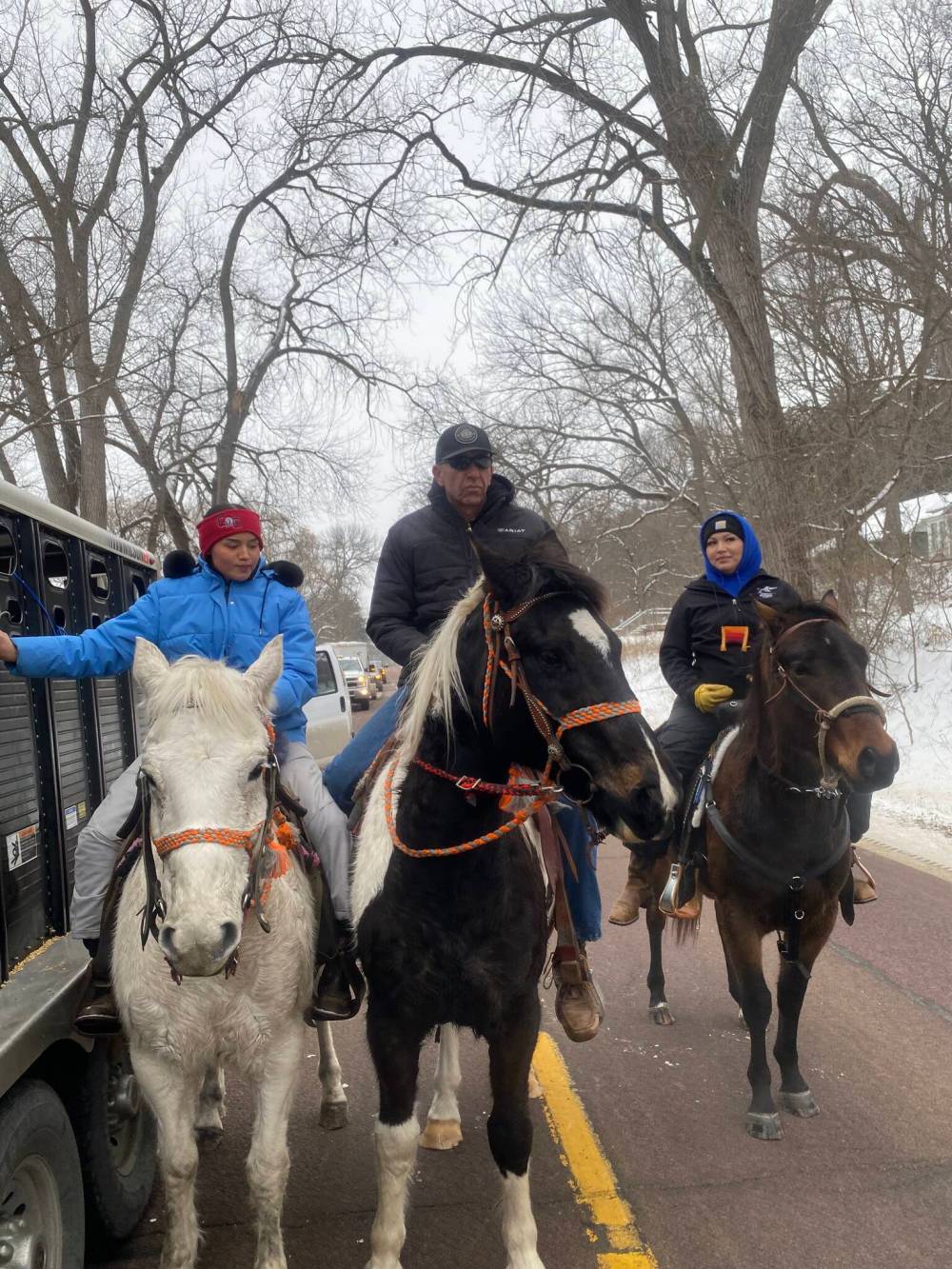
He also spoke about the importance of using horses for the ride, given their spiritual significance in Indigenous culture. “I am taking my horse named ‘Rock’ this year. And he has been there from the start of the ride.”
Mazawasicuna also pointed out that the 2024 ride drew about 20 participants from the Sioux Valley Dakota Nation, along with a group of five to six runners, one elder and two drivers from the neighboring Birdtail Sioux First Nation. The runners in the latter group were part of the annual run affiliated with the Dakota Exile Ride that takes place from Minneapolis to Mankato.
Betsy, 73, a relative of Mazawasicuna, conducts a “feeding the spirit” ceremony during the ride and joined him this year as well. His aunt Peps Columbus, who was nearing 80 and passed away last year, had been a regular participant in the ride until 2023. Chief Tacan told the Sun he took part in the ride for the first time in 2023. “I thought it was just a ride, but when I went last year, I saw all good work being done.”
He added that as a First Nations Safety officer, Mazawasicuna, who was accompanied by two other safety officers for the ride in December, has tried to involve more youth from the Sioux Valley in the ride to help build more awareness about the event and broader reconciliation and First Nations issues.
“I rode a bit (last year), but I spent more time driving and supporting the riders. And I was thinking of all our history and how all these people were displaced, and it was interesting to see all these areas where our people settled. People are really interested in the ride now. There are people who are not even Dakota who want to be on the ride — Cree, Ojibway and other First Nations,” stated Tacan.
The ride has helped many in the younger generation reconnect and rediscover the Dakota’s colourful history, including the buffalo and horse culture, and the ride is only one of many ways in which the Sioux Valley Dakota Nation is endeavouring to do so, Tacan pointed out.
“Some of the kids have lost their sense of identity so now they are slowly making their way back.”
The Sun also spoke with Noel after the end of the recent ride on Dec. 26. She said she had a great experience riding her horse Felix. Noel added she was sad to leave many of her contemporaries from other First Nation communities, who all came together to take part in the commemoration ceremonies held in Mankato at the end of the ride.
After nearly two decades, the ride has evolved into an annual event that now draws many from among the younger generation of Dakota and other First Nation communities, helping youth in these communities reconnect with their historical and cultural legacies, and develop a broader and deeper understanding of reconciliation issues.

Keeble said that after four years of riding, he wanted to stop. “I felt I had accomplished what I wanted.” However, he brought his grandchildren along on the ride during the fourth year.
“After we finished the ride, we were loading up and we were leaving the park and these grandkids are talking and I overhear their conversations, which are about the next year and what they want to do the next year,” said Keeble, adding that there has been no looking back since then.
“It’s a commitment to the ride. It helps a lot of people — spiritually, emotionally. It’s a healing ride. The message this ride carries is reconciliation and healing … The horse is a healer. It’s real simple.”
About a dozen of Keeble’s grandchildren joined him for the ride in December. “They are all accomplished men and women,” he said, pointing out that the group from Fort Thompson included 20 people and 18 horses.
When asked if he plans to return next year, Keeble said, “That’s the plan.”
For Darwin Strong, 67, from Red Lake, Minn., who lays claim to being a mix of Anishinaabe or Chippewa and Dakota, the annual ride is about remembrance. “… what I mean by that is that people in general need to remember that even though those 38 men were falsely accused (and hanged), their blood is still here today. It’s here today through their relatives. They are living on through us. Who they were — their blood and DNA — didn’t go anywhere. It’s still here.”
Strong, who has also been a part of the ride since 2005, led a group of 70 to 80 people from his community for December’s ride. The group included runners, walkers and riders, with the age demographic varying from grade school all the way up to many elders from his community joining in.
He added that his community is also trying to involve more youth in the ride and sees the experience of the ride as an integral part of passing on oral histories and teachings to the younger generation. “When we come together, we talk about our ancestry — what it means, the connection to this earth — the physical and the spiritual. Having our youth involved next to us is what creates that pride in them.”
Even as the ride has become a significant symbol of healing and reconciliation, Strong said he would still like to see more awareness about the historical wrongs and trauma endured by the Dakota and other First Nation communities.
“The awareness itself — we as Native people haven’t gone anywhere. We are still here. And to me, personally, it seems like even though we are here today, we are still almost like a myth to people. It’s crazy. We are in the year 2024. And who we are, our contributions, our history, our efforts — what we have done to impact the history of this country, people need to be aware of that and be educated on that.”

When quizzed about how the mythologizing and mystifying of First Nations and Indigenous culture over centuries had also contributed to alienating and othering Indigenous peoples from the mainstream, Strong agreed.
“From a historic standpoint, this country and even Canada. It just wasn’t created by the blood, sweat and tears of white people. It was the Native people. They wouldn’t have survived if it wasn’t for us.”
Strong told the Sun that even though the ride has generated more awareness about history, he would like to see more change by way of the education curriculum reflecting history and historical facts about Indigenous peoples more accurately. He is especially aware of this while taking part in the ride each year.
“Oh, definitely. There is a multitude of feelings that come into play during this time. It’s every day of my life and their life. We can’t change our pigment so the ignorance and the prejudices that we endure, we have to deal with, because of the mainstream’s close-mindedness.”
Interested readers can watch the “Dakota 38” documentary at https://www.youtube.com/watch?v=1pX6FBSUyQI
» ssharma@brandonsun.com