
Conservation officers boost presence at border
Advertisement
Read this article for free:
or
Already have an account? Log in here »
We need your support!
Local journalism needs your support!
As we navigate through unprecedented times, our journalists are working harder than ever to bring you the latest local updates to keep you safe and informed.
Now, more than ever, we need your support.
Starting at $15.99 plus taxes every four weeks you can access your Brandon Sun online and full access to all content as it appears on our website.
Subscribe Nowor call circulation directly at (204) 727-0527.
Your pledge helps to ensure we provide the news that matters most to your community!
To continue reading, please subscribe:
Add Brandon Sun access to your Free Press subscription for only an additional
$1 for the first 4 weeks*
- Enjoy unlimited reading on brandonsun.com
- Read the Brandon Sun E-Edition, our digital replica newspaper
*Your next Free Press subscription payment will increase by $1.00 and you will be charged $20.95 plus GST for four weeks. After four weeks, your payment will increase to $24.95 plus GST every four weeks.
Read unlimited articles for free today:
or
Already have an account? Log in here »
Hey there, time traveller!
This article was published 28/01/2025 (521 days ago), so information in it may no longer be current.
NEAR EMERSON — Nearly a dozen conservation officers are now patrolling along the Canada-United States border in hopes of increasing security and responding to threats from U.S. President Donald Trump.
Premier Wab Kinew announced Monday conservation officers stationed in Winnipeg, Steinbach, Manitou, Sprague, Boissevain and Virden are now patrolling between ports of entry, focusing on secondary roads and backcountry areas, and will provide “humanitarian” support should the border find more people attempting to cross from the U.S. into Canada, particularly in dangerous weather conditions.
“We’re asking for them to be deployed into areas to help us just be that additional set of eyes and ears,” Kinew told reporters at a news conference near Emerson.
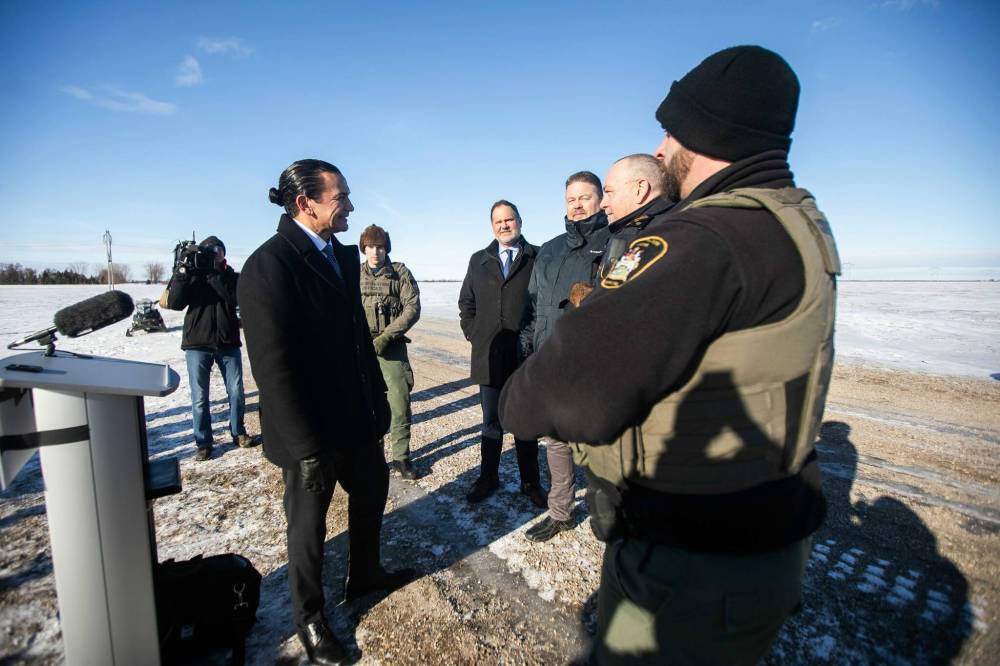
Premier Wab Kinew chats with conservation officers after making an announcement about conservation officers patrolling the border during a press conference near the Canada-U.S. border west of Emerson on Monday. (Mikaela MacKenzie/Winnipeg Free Press)
Trump has repeatedly threatened to impose a 25 per cent tariff on incoming goods unless Canada works to prevent illegal border crossings into the U.S. and to decrease the amount of drugs being smuggled across. Those tariffs could be implemented on Feb. 1, Trump has said.
Kinew said the conservation officers, who are typically tasked with enforcement regarding wildlife, will work with RCMP and the Canada Border Services Agency. The province is spending $360,000 to re-deploy the officers, along with funding for snowmobiles and other utility vehicles. Another $460,000 will go toward overtime for RCMP officers at the border.
Conservation officers will only intervene in cases when they don’t suspect further criminal activity, like drug trafficking. In those cases, officers will be asked to report to Border Services and RCMP.
“If you see somebody trying to cross an open plain like this without gloves and hats on, then that would be a situation where there’d be that direct intervention,” Kinew said.
The premier said the move was part of the province’s planned response to Trump “at a time like this, when Manitobans are looking for reassurance,” but was also a response to calls border communities have made for years.
“If we were to go to Gretna, or Altona, or Emerson, or any community in the area, people will tell you they want to have a secure border, but they’ll also tell you they have a humanitarian heart for some of those very, very difficult situations we’ve heard of,” Kinew said.
Six people were arrested trying to cross the border into Manitoba Jan. 14, days before the U.S. president was sworn into office. RCMP said the six weren’t dressed for the weather, which dipped below -20 C.
Emerson-Franklin Reeve David Carlson said any additional boots on the ground near the border would help put his community at ease.
“People get themselves into a really bad situation quite often, and we don’t want any more tragedies out here with regards to people either losing their lives or being injured by the weather,” he said.
The Manitoba Government and General Employees’ Union said no extra officers are being hired specifically for border duties, and no extra training has been offered to existing workers.
The union said about 20 per cent of conservation officer jobs are vacant, and officers are already busy with their regular tasks, so it’s unclear how much additional work they can take on.
“It sounds like (officers’) routines may change a little, to be a little more towards the border, but overall, from what we understand, they’re going to do as much of their regular role as possible,” union president Kyle Ross said.
Kinew said vacancy rates for conservation officers have dropped from 20 per cent to 10 per cent under his government, while acknowledging he’d like to hire more.
Progressive Conservative Leader Wayne Ewasko said the border has “never been weaker” under the provincial NDP and federal Liberals.
“Conservation officers have an important job protecting public safety and our fish, wildlife, and forest resources, but pulling them away from their core duties to patrol the border is not a permanent solution,” he said in an emailed statement.
Immigration lawyer Alastair Clarke said his office has been fielding calls from Americans who disagree with Trump’s policies trying to come to Canada, and people in the U.S. without citizenship who are fearful of being deported.
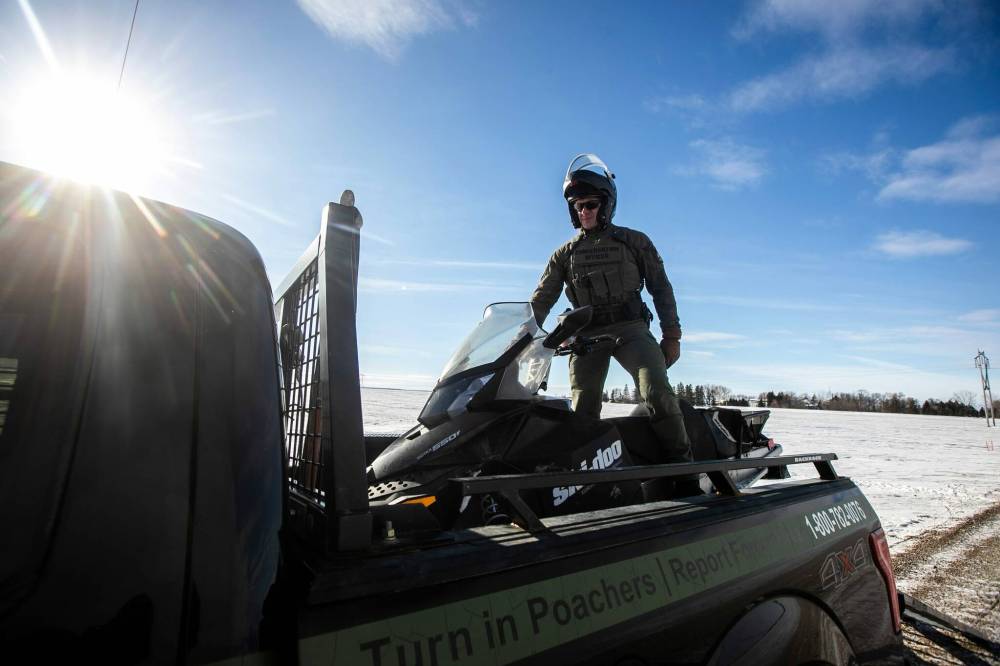
Conservation officer Nick Woroniuk drives a snowmobile back onto a truck after a press conference near the Canada-U.S. border west of Emerson on Monday. (Mikaela MacKenzie/Winnipeg Free Press)
Last week, Clarke said, a Venezuelan asylum seeker who had family in Manitoba called for help, saying he no longer felt safe in the U.S. He was turned back at the border.
If Trump’s 2016 presidency can provide any hindsight, he said, Manitoba will need additional help at the border.
“I don’t see it getting any better,” he said.
In 2022, a family from India froze to death while trying to cross the Manitoba-U.S. border. Two men were found guilty of human smuggling in November. They are set to be sentenced in March.
In 2016, two men from Ghana lost their fingers to frostbite while crossing the border. They became Canadian citizens in 2023.
“Those cases just break my heart,” Clarke said.
“When people are just trying to find safety, when they’re trying to be with their family members, when they are trying to find a better life. There is inherent risk in their journeys, but it is so sad when you hear about someone paying the ultimate price.”
Monday’s announcement comes one week after Black Hawk helicopters began patrolling the Manitoba-U.S. border. The chopper flights, along with drones, are part of the federal government’s $1.3-billion border security upgrade plan in response to Trump’s threats.
Kinew’s focus on the border — whether it be the conservation officers or recent announcement of a U.S. trade council and an office opening in Washington, D.C. — makes clear he isn’t waiting for Ottawa to lead on the issue, said Christopher Adams, an adjunct professor in political studies at the University of Manitoba.
“After Trump’s first inauguration, the federal government really did have one voice, and the premiers sort of were in lockstep with the federal government,” he said.
“This time around, there is a political vacuum in Ottawa … and so the premiers are all filling in with playing their own roles, representing their own interests in many ways, with dealing with the Trump threat of tariffs.”
» Winnipeg Free Press, with files from The Canadian Press