
Expert schools kids, parents about online safety
Advertisement
Read this article for free:
or
Already have an account? Log in here »
We need your support!
Local journalism needs your support!
As we navigate through unprecedented times, our journalists are working harder than ever to bring you the latest local updates to keep you safe and informed.
Now, more than ever, we need your support.
Starting at $15.99 plus taxes every four weeks you can access your Brandon Sun online and full access to all content as it appears on our website.
Subscribe Nowor call circulation directly at (204) 727-0527.
Your pledge helps to ensure we provide the news that matters most to your community!
To continue reading, please subscribe:
Add Brandon Sun access to your Free Press subscription for only an additional
$1 for the first 4 weeks*
*Your next subscription payment will increase by $1.00 and you will be charged $20.00 plus GST for four weeks. After four weeks, your payment will increase to $24.00 plus GST every four weeks.
Read unlimited articles for free today:
or
Already have an account? Log in here »
Hey there, time traveller!
This article was published 20/03/2025 (408 days ago), so information in it may no longer be current.
What age should kids be when they get their first cellphone?
That is a question that online safety expert Val Caldwell says she gets from parents all the time. When it came to her own children, Caldwell said she waited until they were old enough to drive.
“I see kids in Grade 3 who have cellphones, so it’s a difficult question, because I can answer from my own beliefs and values. And every parent is going to feel differently, but my recommendation would be to hold off as long as possible,” she said.
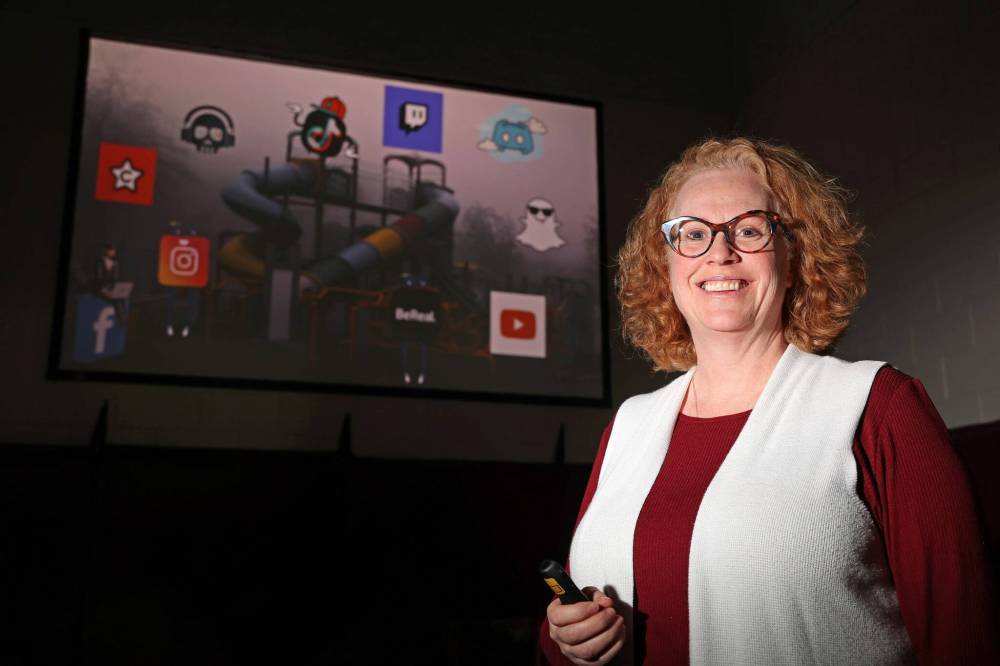
Val Caldwell, an online safety expert with a focus on mental health, spoke to students from Grades 3 to 8 at Valleyview Centennial School on Wednesday, as well as to parents of students the same evening. Caldwell’s evening presentation was organized by the Valleyview Centennial School Parent Council. (Tim Smith/The Brandon Sun)
Even more difficult, but more important, Caldwell added, is for parents to learn how to say no to their kids if it’s believed they are too young.
“Rather than just taking the ‘because I said so’ approach, I think we need to talk more with kids about the honest reasons why we want to hold them off,” she said.
“I am concerned about connections online and the ‘friends’ kids make, and I’m saying the word ‘friends’ in quotations,” said Caldwell.
“Kids are constantly talking about friends that they meet online. But who is this person? I can be a 53-year-old woman who can become a 12-year-old boy on Roblox. So, I’m concerned about the connections they make when they don’t know who the person is,” she said.
As an online safety expert with a significant focus on mental health, Caldwell speaks to 8,000 to 10,000 school kids a year within the city of Brandon and rural school divisions.
Caldwell began her career in Westman as a program facilitator with Child and Family Services more than 15 years ago.
But when social media stressors started to take up more time in conversations she was having with parents, Caldwell started developing presentations geared toward adults as well as students from kindergarten to Grade 12 and is now a full-time public speaker.
Yesterday morning and afternoon, she spoke to students from Grade 3 to Grade 8 at Valleyview Centennial School, followed by an evening presentation in the gymnasium organized by the school parent council.
If parents are going to provide their children with devices, there need to be significant rules, said Caldwell. An Apple device can be programmed to turn off at 8 p.m., and access to certain apps can be limited.
“Parents, caregivers and trusted adults should always have the passwords to kids’ devices,” Caldwell said.
“They should monitor them, but not in a punitive way,” she added.
“I don’t think that adults need to grab the phones and check them 24-7, but they should be able to access them if they are concerned that there’s something wrong.
“So, we explain that to kids, and we don’t do that in secret. You say, ‘I am providing you this device at a young age, and these are the rules around it,’” she said.
When Caldwell speaks to kids in Grades 3 and 4, the conversation is geared toward talking to strangers and what that definition means online, and what to do when people send them messages.
With older students, she broaches the subject of what happens when a mistake is made, such as an embarrassing photo that goes public.
“Sextortion is a huge issue that we’re seeing with kids — the youngest I have seen was an eight-year-old,” Caldwell said.
“So, maybe we can’t stop the picture from being sent, but we can teach them that it’s a mistake, it is not a death sentence. We don’t want to lose kids over this.”
Boys and girls are at equal risk to be targeted online, added Caldwell.
“It’s not about boys or girls, it’s about keeping them safe.”
Typically, boys are extorted for money and girls are extorted for more images, according to Cybertip.ca, which is Canada’s tipline for reporting the online sexual abuse and exploitation of children.
Additionally, the platforms Instagram and Snapchat have the highest number of sextortion incidents, and when the genders were known, 83 per cent of sextortion victims were male between the ages of 11 and 17.
Caldwell also talks with kids and parents about mental health and maintaining a balance with how much time people are spending on their devices.
“There are a lot of good things about technology, and I focus on that as well,” she said. “It’s wonderful to keep in contact with friends and family.
“You can get such great information, so there’s lots of positives with it, but it’s really about balancing those risks versus the rewards.”
For more information about Val Caldwell, find her on Facebook.
» mmcdougall@brandonsun.com
» enviromichele.bsky.social