
Ashlee Shingoose named as serial killer’s victim
Advertisement
Read this article for free:
or
Already have an account? Log in here »
We need your support!
Local journalism needs your support!
As we navigate through unprecedented times, our journalists are working harder than ever to bring you the latest local updates to keep you safe and informed.
Now, more than ever, we need your support.
Starting at $15.99 plus taxes every four weeks you can access your Brandon Sun online and full access to all content as it appears on our website.
Subscribe Nowor call circulation directly at (204) 727-0527.
Your pledge helps to ensure we provide the news that matters most to your community!
To continue reading, please subscribe:
Add Brandon Sun access to your Free Press subscription for only an additional
$1 for the first 4 weeks*
*Your next subscription payment will increase by $1.00 and you will be charged $20.00 plus GST for four weeks. After four weeks, your payment will increase to $24.00 plus GST every four weeks.
Read unlimited articles for free today:
or
Already have an account? Log in here »
Hey there, time traveller!
This article was published 27/03/2025 (364 days ago), so information in it may no longer be current.
WINNIPEG — The first victim of a Winnipeg serial killer was finally given a name Wednesday — after two-plus years of being known only as Mashkode Bizhiki’ikwe (Buffalo Woman) — as police declared there is “no doubt” she is Ashlee Shingoose.
The breakthrough, based on a post-conviction interview with her killer, Jeremy Skibicki, and testing of DNA found on a pair of pants she wore, will bring a search of the Brady Road landfill for the remains of Shingoose, whose parents expressed gratitude to investigators and others following the heartbreaking update.
“There’s no doubt in our mind whatsoever that Buffalo Woman was Ashlee Shingoose,” Winnipeg Police Service deputy chief of investigations Cam Mackid said, referring to facts, physical evidence and new information from Skibicki that were used to confirm the identity of one of the killer’s four victims.
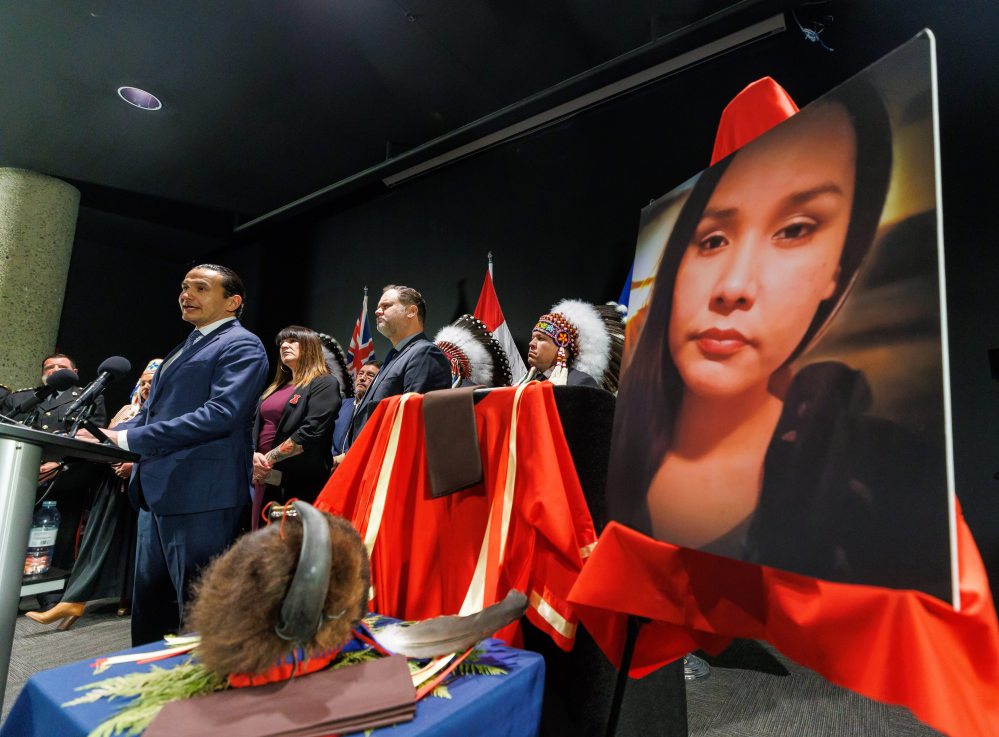
Shingoose, from St. Theresa Point First Nation, was 30 when she went missing, having been last seen near a downtown-area homeless shelter in March 2022.
After being killed, investigators believe her remains were placed in a garbage bin on Henderson Highway, based on details from Skibicki.
The bin’s contents were collected by a truck and deposited at the city-run Brady Road landfill. That wasn’t established as fact until investigators got a chance to ask more questions of Skibicki in a Dec. 17 interview, Mackid said.
DNA belonging to Shingoose and three other victims — Rebecca Contois, 24, Morgan Harris, 39, and Marcedes Myran, 24 — was found in Skibicki’s North Kildonan apartment.
Police initially thought Buffalo Woman was a different woman whose DNA was found on the cuff of a Baby Phat jacket that she and other people, including Shingoose, wore. The jacket ended up being a “dead end,” Mackid.
When homicide detectives interviewed Skibicki at a maximum security prison in December, he mentioned a pair of pants worn by Buffalo Woman.
Police sent the pants — one of more than 5,000 pieces of physical evidence collected in the case — to an RCMP lab for DNA testing. DNA from the pants match Shingoose’s DNA. The results came back Monday, confirming her family’s longheld fears.
The pants were not sent for testing earlier in the investigation because there was previously no indication they were relevant, Mackid said. He did not know if the pants were initially found in Skibicki’s apartment or a garbage bin.
Mackid said Skibicki talked about Shingoose, provided a description of Buffalo Woman that was similar to Shingoose, and was shown “many” photos of her in December.
“In addition to the DNA on the clothes, that identification was backed up by an identification based on photos that were shown to him,” Mackid told reporters after a news conference in Winnipeg.
Mackid said he doesn’t know the type of DNA that was found on the pants.
Skibicki was convicted of four counts of first-degree murder last summer. His victims were slain between March and May 2022. He was given four concurrent life sentences with no chance of parole for 25 years.
Police flew to St. Theresa Point, a remote community in northern Manitoba, Tuesday to give Shingoose’s family the news.
Chief Gene Bowers said police remained “steadfast” in identifying Buffalo Woman over the last three years.
“Your daughter deserved to be named, and we offer our condolences,” he said of Shingoose’s family.
“It was heartbreaking, but, at the same time, we welcome the news that there is a light at the end,” St. Theresa Point Chief Raymond Flett said of the notification.
“Ashlee Shingoose represented not only an individual’s life (that) was taken too soon, but also the countless Indigenous women to have gone missing.”
Her death is a reminder of injustices faced by Indigenous women and girls, and the need for greater action to protect them, Flett said.
Shingoose’s parents, Albert and Theresa, were unable to fly to Winnipeg for the news conference due to poor weather. Speaking by phone, they expressed gratitude for the efforts to identify their daughter.
I just want to thank everybody for all the work that everybody is doing, for thinking of us in your prayers,” Theresa Shingoose told the audience.
Premier Wab Kinew sang a traditional song at Albert Shingoose’s request. The premier repeatedly said Ashlee Shingoose’s name during his remarks at a podium next to a red cloth, red dress and buffalo headdress which also were in court during Skibicki’s trial.
“I think it’s very important we say her name, and we remember her,” Kinew said.
“I know that this information… while it does bring answers, it doesn’t ease the pain of the loss,” said Assembly of Manitoba Chiefs Grand Chief Kyra Wilson.
Speakers told of their hope for healing, further reconciliation and more efforts to end the MMIWG crisis and protect vulnerable people. Some people in the audience, including MMIWG family members, wept or left the room after being overcome with emotion.
Skibicki admitted to killing four women in his May 2022 interview, which followed the discovery of some of Contois’ remains in a garbage bin. He was charged in her death. Additional remains belongong to Contois were found when police searched the Brady Road landfill in June 2022.
After further investigation, he was charged in the deaths of Harris, Myran and Buffalo Woman in December 2022.
In 2023, the WPS formed specialized task forces to explore Skibicki’s background and try to identify Buffalo Woman, but neither effort offered a breakthrough.
A DNA sample provided by Shingoose’s family in 2023 did not match the DNA sample from the jacket, which was thought to belong to Buffalo Woman.
Of the 5,000-plus evidence exhibits that were collected, 130 were initially sent for DNA testing.
Mackid said it was not possible to test every piece of evidence for DNA because there is a “finite capacity.”
Items were sent to the lab based on information Skibicki gave in the 2022 interview, and clothing that victims other than Shingoose were seen wearing in surveillance video, Mackid said.
Remains belonging to Harris and Myran were found at the privately owned Prairie Green Landfill just north of Winnipeg in February. The search was spurred by the women’s families and Indigenous leaders, and funded by the provincial NDP and federal Liberal governments.
Kinew said the search at Prairie Green continues to find remains and items related to Harris and Myran.
Leonard Tailleur, the lawyer who represented Skibicki at trial, said he last spoke to the convicted killer several weeks ago. At that time, Skibicki indicated he wanted to help identify Buffalo Woman, Tailleur said.
“Which I advised him he was free to do,” Tailleur wrote in an email to the Free Press.
Police found the DNA of 12 other women in Skibicki’s apartment, the trial heard. Of those, some were found alive and some could not be identified or traced because their DNA samples were not in a national database.
Mackid said he cannot guarantee there were only four victims, but police have no evidence that more women were killed, after doing “everything we possibly can” to look into the possibility.
The investigation — one of the most complex in WPS history — included a review of unsolved crimes and missing persons cases, he said.
The Crown said at the trial that the killings were racially motivated and that Skibicki preyed on vulnerable women at homeless shelters.
In his first interview with police, he said the then-unidentified woman was the first he killed, on or about March 15, 2022.
The Shingoose family feared that Ashlee was that victim. Albert Shingoose visited Winnipeg in January 2023 to lead a search for her. She was missing for 10 months at that time.
The family suffered a tragedy two months later, when Ashlee’s daughter, Dayna Shingoose, and another 14-year-old girl died in St. Theresa’s Point.
The pair were found outside after being exposed to extreme cold for several hours.
Theresa Shingoose, Ashlee’s mother and Dayna’s grandmother, previously told the Free Press Dayna was struggling with her mother’s disappearance.
» Winnipeg Free Press, with files from Dean Pritchard