
Per-pupil spending below provincial average
Advertisement
Read this article for free:
or
Already have an account? Log in here »
We need your support!
Local journalism needs your support!
As we navigate through unprecedented times, our journalists are working harder than ever to bring you the latest local updates to keep you safe and informed.
Now, more than ever, we need your support.
Starting at $15.99 plus taxes every four weeks you can access your Brandon Sun online and full access to all content as it appears on our website.
Subscribe Nowor call circulation directly at (204) 727-0527.
Your pledge helps to ensure we provide the news that matters most to your community!
To continue reading, please subscribe:
Add Brandon Sun access to your Free Press subscription for only an additional
$1 for the first 4 weeks*
- Enjoy unlimited reading on brandonsun.com
- Read the Brandon Sun E-Edition, our digital replica newspaper
*Your next Free Press subscription payment will increase by $1.00 and you will be charged $20.95 plus GST for four weeks. After four weeks, your payment will increase to $24.95 plus GST every four weeks.
Read unlimited articles for free today:
or
Already have an account? Log in here »
Hey there, time traveller!
This article was published 29/03/2025 (447 days ago), so information in it may no longer be current.
Brandon School Division is operating with significantly lower spending per student than the provincial average, according to a BSD school funding report.
The report, presented by Supt. Mathew Gustafson to the school board this week, stated the division is spending $13,945 per student in 2024-25, while the provincial average stands at $15,645. The highest-funded divisions, excluding those in northern Manitoba, allocate up to $21,049 per student.
Gustafson told the Sun the division’s lower per-student spending is due in part to its reliance on provincial funding, which is not enough, and special levies, adding the difference between BSD and provincial spending per student using 2024 enrolment data is $16 million.
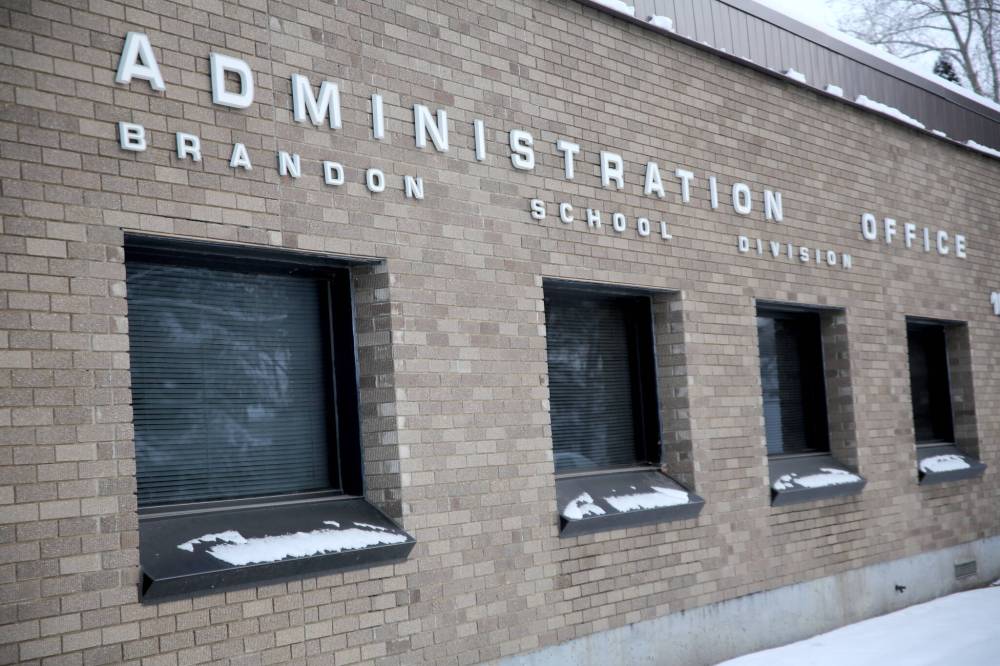
The Brandon School Division office on Sixth Street. (The Brandon Sun files)
“BSD expense per pupil is below the provincial average and this is an indicator of the division maintaining lower expenses,” he told the board. “While the per cent of budget for regular instruction is high, the cost per pupil is low and this is an indicator that the division has reduced or not significantly increased in areas outside of regular instruction.”
This disparity directly impacts classroom resources, staffing and student support programs in BSD, Gustafson told the Sun.
Despite this funding gap, BSD has prioritized classroom expenditures to maintain quality education, though at the cost of administrative and maintenance budgets, he said.
The division’s direct support to students as a percentage of total spending is the highest in the province at 84.6 per cent, while the provincial average is 79.5 per cent. According to Gustafson, this represents “a board budgeting focus on the classroom, but also represents the smaller amount budgeted in other areas and where reductions occur.”
To address financial constraints while maintaining educational standards, BSD has channelled a higher percentage of its total budget directly into classroom instruction, he added.
The division directs 60.9 per cent of its budget toward regular instruction, the third-highest percentage among all Manitoba school divisions. However, despite this prioritization, BSD’s per-pupil spending on regular instruction ranks 28th in the province.
“The division has made sacrifices in other areas,” Gustafson said. “Cuts have been made to instructional support, such as curriculum development and clinician services, and reductions have also affected administrative and maintenance budgets.”
The board will keep advocating for increased provincial funding and ensuring rural representation in the government’s review of the funding formula, board chair Linda Ross told the Sun on Friday.
“We will advocate directly to the government, making our case for our particular circumstances, with our assessment base, and having a lower assessment base than many divisions, and how that works against us,” Ross said.
She explained there is a need for a revised funding formula that takes into account rural divisions’ unique challenges.
“The government needs to address the funding formula, which has not changed in a very, very long time,” she said. “I think the committee the government appoints to review and come up with a revised funding formula must have rural representation on it, because many of the financial issues that occur in rural divisions, like transportation, are not particularly of concern to larger urban divisions.”
While the BSD has had to make adjustments due to funding shortfalls, the board has taken care to minimize the impact on early education. Ross explained the board agreed not to touch that ratio from kindergarten to Grade 3, because it understood smaller class size has the biggest impact.
It is obvious the existing provincial funding formula is not working for Brandon, vice-chair Duncan Ross said.
“We have one of the highest tax rates, and yet we have some of the lowest dollars to work with of any divisions in the whole province,” he said. “Other than two buildings, every single one of our schools is over 50 years old.”
The division, he said, has one of the lowest funding levels for maintenance, with one of the highest percentages of money going towards education, “not because we think it’s more important than everything else — which we do — but also because we just can’t afford anything else.”
If BSD were to receive per-pupil funding in line with the provincial average, Gustafson indicated the most urgent priorities would include restoring student-teacher ratios that were adjusted due to budget constraints, reinstating previously reduced clinician and curriculum support roles, and addressing operational maintenance needs as school buildings age.
“With enrolment growth and aging infrastructure, we need to ensure that our buildings remain safe and functional for students,” he added.
» aodutola@brandonsun.com
» X: @AbiolaOdutola