
Young scientists awarded top honours
Advertisement
Read this article for free:
or
Already have an account? Log in here »
We need your support!
Local journalism needs your support!
As we navigate through unprecedented times, our journalists are working harder than ever to bring you the latest local updates to keep you safe and informed.
Now, more than ever, we need your support.
Starting at $15.99 plus taxes every four weeks you can access your Brandon Sun online and full access to all content as it appears on our website.
Subscribe Nowor call circulation directly at (204) 727-0527.
Your pledge helps to ensure we provide the news that matters most to your community!
To continue reading, please subscribe:
Add Brandon Sun access to your Free Press subscription for only an additional
$1 for the first 4 weeks*
- Enjoy unlimited reading on brandonsun.com
- Read the Brandon Sun E-Edition, our digital replica newspaper
*Your next Free Press subscription payment will increase by $1.00 and you will be charged $20.95 plus GST for four weeks. After four weeks, your payment will increase to $24.95 plus GST every four weeks.
Read unlimited articles for free today:
or
Already have an account? Log in here »
Hey there, time traveller!
This article was published 10/04/2025 (543 days ago), so information in it may no longer be current.
Four young scientists from Westman schools will be heading to Fredericton, N.B., for national competitions after winning top honours at the Western Manitoba Science Fair on Tuesday.
The fair, held at Brandon University’s Healthy Living Centre, awarded gold medals to École secondaire Neelin High School Grade 9 student Angelina Zhang, who won the Best of Fair award; Nia Smith of Crocus Plains Regional Secondary School; Abereham Moges of Christian Heritage School; and Danielle Vrignon of École La Source Shilo.
The students will represent the region at the Canada-Wide Science Fair at the University of New Brunswick from May 31 to June 7.
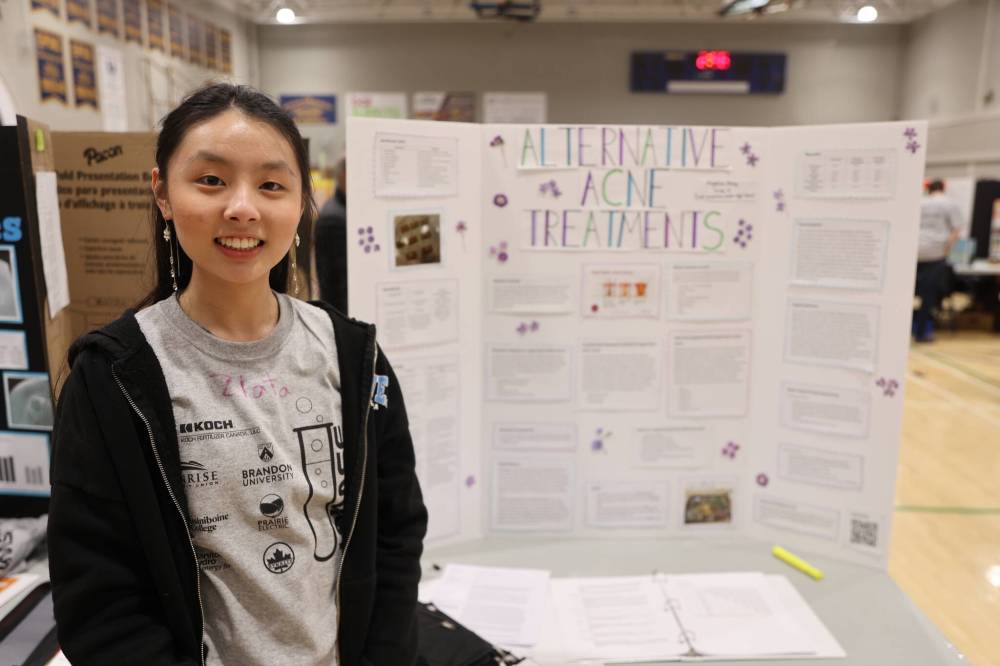
École secondaire Neelin High School Grade 9 student Angelina Zhang, winner of the Best of the Fair award, displays her project, “Alternative Acne Treatments,” at the Western Manitoba Science Fair held in Brandon University’s Healthy Living Centre on Tuesday. (Photos by Abiola Odutola/The Brandon Sun)
Zhang, who also represented the region at the nationals last year, claimed the coveted Best of Fair title for her project exploring alternative acne treatments. She tested the effects of zinc, vitamin E and Chinese herbal medicine on artificial skin to see how they influenced oil and moisture levels.
“I got acne recently, and I thought, ‘What can I do?’” Zhang told the Sun, adding that her curiosity about natural remedies drove her to explore accessible, less conventional treatments.
“I think a lot of people struggle with it, especially teenagers, so I wanted to find solutions that are more natural and potentially safer.”
Fellow winner Smith, a Grade 10 student at Crocus Plains, is also not a stranger to the national competitive science fair scene. Last year, she participated in the Canada-Wide Science Fair, although not through the Western Manitoba Science Fair. This year, she is back with a project focused on hay preservation, an issue close to her heart as someone who grew up on a small farm.
“My family faced challenges with haying last year due to high moisture levels,” Smith told the Sun. “We used a preservative on our round baler, and I wanted to see what preservative would be effective on our small square baler.”
Her project — titled “Time to Hay?” — involved testing three locally available hay preservatives against a control group. The results, although not statistically significant, indicated that preservatives like Callback or GEM dust help maintain hay quality over time.
Smith’s passion for agriculture stems from her family’s farming background, with cattle and horses on their small farm. Despite facing challenges in her experiments, such as the small bale size and inconsistent product distribution, Smith is eager to continue her work.
“I’d like to repeat my experiment with a larger sample size and use an applicator for even product distribution,” she said. Her work has the potential to help local farmers preserve hay quality and mitigate some of the challenges of maintaining animal feed during the winter months.
Although unsure about her exact future path, Smith knows she wants to stay involved in agriculture.
“It’s something I’ve always been passionate about,” she said.
Meanwhile, Grade 8 student Moges, who also represented the region at the nationals last year, took on the challenge of cancer research. Inspired by the experiences of his Ethiopian parents, who knew a couple of skin cancer patients in their home country, Moges developed a project aimed at finding a non-toxic, cost-effective therapy for melanoma.
Moges’ project, “Anti-Melanoma Drug Combination,” explored the potential of combining six chemicals — curcumin, croissant, salicylic acid, artisanate, selenomycin and piperine — to create a more affordable melanoma treatment. His findings were promising, with the combination showing a 91 per cent kill rate against cancer cells.
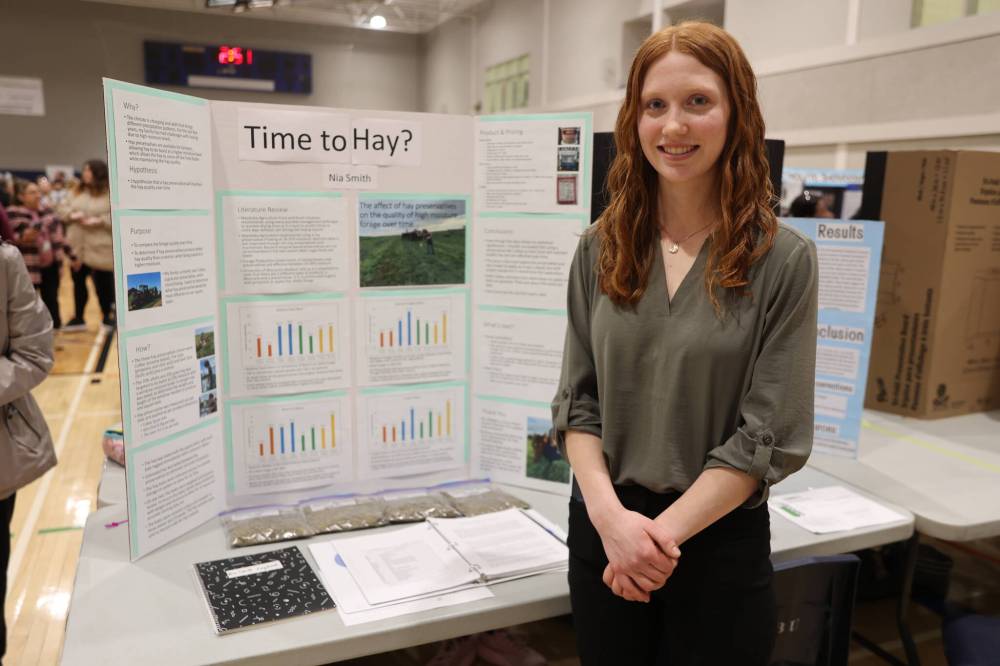
Crocus Plains Regional Secondary School Grade 10 student Nia Smith with her project, “Time to Hay?” RIGHT: Christian Heritage School Grade 8 student Abereham Moges stands in front of his project, “Anti-Melanoma Drug Combination.”
“It’s important to find solutions that are not only effective but also affordable, especially for people in developing countries,” he said.
His interest in oncological research deepened after conducting his research at the University of Manitoba.
“I just found cancer research fascinating. It’s been a journey, and I’m excited to continue,” Moges told the Sun.
Despite the challenges he faced in obtaining the correct equipment and the high cost of conducting the project, ranging from $3,000 to $4,000, Moges remains determined.
“This experience has taught me so much, and I’m ready to improve my presentation for the next competition.”
Moges also expressed gratitude for the support he received throughout his research.
“I want to thank my parents, my family and especially Dr. Steven Cornish at the University of Manitoba. He helped me get into his lab and provided valuable mentorship throughout the project.”
For young scientists, participating in the science fair is just the beginning.
Zhang expressed her excitement and aspirations for the upcoming national competition.
“I hope that going to nationals will help me see other projects and what other people are doing. It inspires me and helps me make better projects.”
Smith’s goal is to further refine her hay preservation experiment and contribute to improving farming practices. Moges, on the other hand, hopes to continue his cancer research and eventually pursue a career in oncology.
The students displayed dedication and ingenuity at the fair, event chair Trevor Maguire told the Sun.
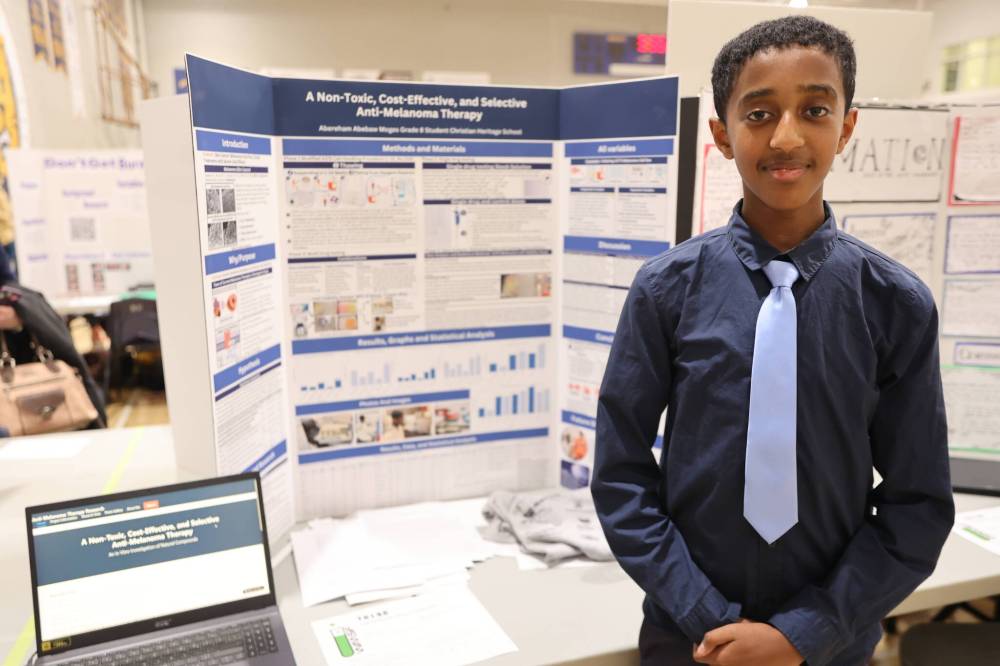
Christian Heritage School Grade 8 student Abereham Moges stands in front of his his project, “Anti-Melanoma Drug Combination.
Maguire said technology has vastly improved the fair’s operations since he began in 1997.
“We used to have kids bring everything to the fair and present it. Now, they submit their project abstract electronically, and we give that to the judges ahead of time,” he said. “This shift allows judges to come prepared with questions.”
Maguire added the internet has made it much easier for kids to complete their projects.
“When we started in 1997, kids were getting their information from encyclopedias, which were probably 10 years old. Now, they can access the latest science instantly on the internet,” he said.
The objective of the fair is to get kids interested in STEM — science, technology, engineering and math — from Grade 1 all the way to Grade 12. Maguire emphasized the importance of fostering an early interest in experimentation, noting that by Grade 5, students are already learning valuable skills like presenting their work to judges.
“By the time they’re doing a science fair project in Grade 5 and up, they’re having to do an oral presentation, they’re talking to judges, explaining their cases. They’re learning so much more than just STEM,” he said.
» aodutola@brandonsun.com
» X: @AbiolaOdutola