
Kinew hails move as ‘generational opportunity’
First ministers bring wish lists of projects
Advertisement
Read this article for free:
or
Already have an account? Log in here »
We need your support!
Local journalism needs your support!
As we navigate through unprecedented times, our journalists are working harder than ever to bring you the latest local updates to keep you safe and informed.
Now, more than ever, we need your support.
Starting at $15.99 plus taxes every four weeks you can access your Brandon Sun online and full access to all content as it appears on our website.
Subscribe Nowor call circulation directly at (204) 727-0527.
Your pledge helps to ensure we provide the news that matters most to your community!
To continue reading, please subscribe:
Add Brandon Sun access to your Free Press subscription for only an additional
$1 for the first 4 weeks*
- Enjoy unlimited reading on brandonsun.com
- Read the Brandon Sun E-Edition, our digital replica newspaper
*Your next Free Press subscription payment will increase by $1.00 and you will be charged $20.95 plus GST for four weeks. After four weeks, your payment will increase to $24.95 plus GST every four weeks.
Read unlimited articles for free today:
or
Already have an account? Log in here »
Hey there, time traveller!
This article was published 03/06/2025 (336 days ago), so information in it may no longer be current.
SASKATOON — Manitoba Premier Wab Kinew said the nation-building projects discussed by the premiers and Prime Minister Mark Carney on Monday present a “generational opportunity for Canadians,” especially those who live in poorer communities.
Provincial and territorial leaders sat down with Carney in Saskatoon and each premier was armed with wish lists of major projects they hope the federal government will deem to be in the national interest, then fast-track for approval.
“The point is to build the certainty, the stability and the ambition that builders need to catalyze enormous investment — investment to make Canada into an energy superpower,” Carney said at the closing news conference.
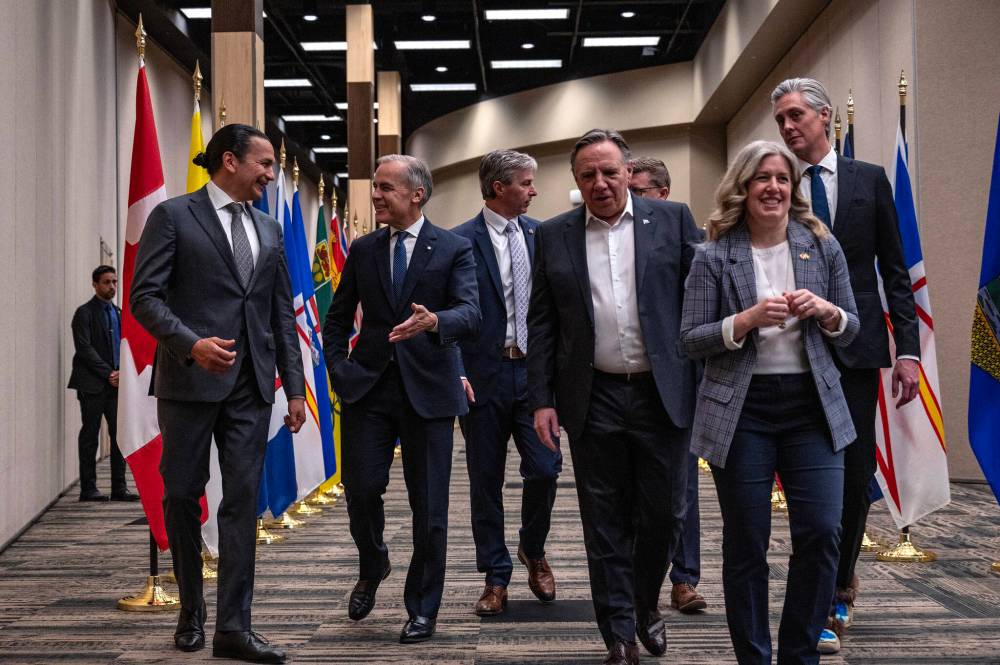
Manitoba Premier Wab Kinew (from left), Prime Minister Mark Carney, Intergovernmental Affairs Minister Dominic LeBlanc, Quebec Premier François Legault, New Brunswick Premier Susan Holt and Northwest Territories Premier R.J. Simpson during the First Minister’s Meeting in Saskatoon on Monday. (The Canadian Press)
Ontario Premier Doug Ford said the gathering was the “best” they have had in the last decade — a light jab at former prime minister Justin Trudeau, who frequently had frosty relations with the group, especially Prairie premiers looking to build out the energy sector.
Ford said the premiers, and the whole country along with them, stand united as Canada comes under attack from U.S. President Donald Trump’s tariffs — even as some in the group scrapped over pipeline politics.
While the group mulled over a number of potential natural resource and infrastructure developments in private, they did not release a final list.
“Nothing was carved in stone at this meeting,” Ford said, adding he had no expectations the prime minster would approve specific projects at the meeting.
“I described him today as Santa Claus. He’s coming and his sled was full of all sorts of stuff. Now he’s taking off back to the North Pole and he’s going to sort it out and he’s going to call us.”
The federal Liberals have yet to reveal in Parliament their promised legislation to speed up approvals for select projects to a maximum of two years. That could be tabled as early as this week.
When he was pressed on the lack of specifics after the meeting, Carney said he could name lots of examples of contenders.
He rattled off a list that included the Grays Bay Road and Port, which would connect southern Canada to the Arctic by road, along with the Ring of Fire mining project in northern Ontario. Notably, he mentioned the Pathways Alliance oilsands project, though he did not commit to any.
Carney said the group would refine what should count as priority projects over the summer and touted that as “private proponents become aware of the opportunity here, we’re going to see more projects coming forward.”
He said the upcoming federal legislation will also mandate meaningful consultation with Indigenous Peoples, including in which projects get picked and how they are developed.
Alberta Premier Danielle Smith went into the meeting warning that any list that doesn’t include new pipelines would send a bad message to her province.
She left the meeting on a positive note, saying it’s up to political leaders to find a proponent for a new pipeline and that she’s willing to give this process a chance.
“I’m encouraged by the immediate change of tone that we’ve seen from recent months,” she said. “When we hear the prime minster talking about being an energy superpower, we haven’t heard that language for some time.”
Before the meeting, Kinew was asked how confident he was that one of his pet projects — modernizing the Port of Churchill — would get the green light from Ottawa.
“We need to get our natural resources in Canada to tidewater. I think, in time, you’ll see that Hudson Bay is probably the most tenable course towards hitting international tide waters.”
He was asked about the challenges of building a heavy-traffic rail line to the northern port.
“We have tidewater. We’ve got communities who are ready to engage in northern Manitoba to bring these natural resources to market. So let’s use the private sector to figure out the engineering, the best route and how to energize the Western Canadian engine that’s going to power the Canadian economy,” he said.
In April, Kinew and Nunavut Premier P.J. Akeeagok signed a statement to work together to push for an energy corridor to the North.
Akeeagok said Monday he sees the potential to strengthen Canada’s sovereignty and the North, for a change.
“The infrastructure gap between north and south is something that, I think, we’re all taking note of, and that this is our moment as a country where we’re unified around wanting to see us prosper and to become stronger and very much look forward to seeing actual infrastructure built to ensure that our communities are healthy,” Nunavut’s premier said.
When asked how he’d like to see fellow premiers react if their projects don’t make the cut, Kinew used a hockey metaphor.
“This is Team Canada and it doesn’t matter if you’re the first shift for the initial puck drop or if you’re there killing the penalties. At the end of the day, everyone’s going to have their time on ice and everyone’s going to have a role in building up this great country,” he said.
On the issue of Chinese tariffs on Canadian agriculture and seafood products, the prime minister said he plans to work urgently to have them removed.
Carney called it a top priority and said Ottawa is speaking with Chinese officials at the ministerial level.
A statement released after the meeting said premiers want Canada’s trading relationship with China to improve.
Beijing imposed retaliatory tariffs of 100 per cent on Canadian canola oil and meal, peas and seafood after Ottawa slapped levies on Chinese-made electric vehicles, steel and aluminum.
Saskatchewan Premier Scott Moe has said China’s tariffs threaten his province’s canola industry.
Kinew agreed it’s a major priority for Manitoba.
“I think it speaks to the fact that we’re trying to solve this complex, multi-variable equation: We have the Trump administration on one side and then we have an ascendant People’s Republic of China on the other side,” he said.
“I think that this meeting here today of the first ministers … is an important step forward for us being able to have that showdown with China, have that showdown with the Trump administration and make sure that you and your jobs come out on top.”
» Winnipeg Free Press, with files from The Canadian Press