
Province declares second state of emergency
Advertisement
Read this article for free:
or
Already have an account? Log in here »
We need your support!
Local journalism needs your support!
As we navigate through unprecedented times, our journalists are working harder than ever to bring you the latest local updates to keep you safe and informed.
Now, more than ever, we need your support.
Starting at $15.99 plus taxes every four weeks you can access your Brandon Sun online and full access to all content as it appears on our website.
Subscribe Nowor call circulation directly at (204) 727-0527.
Your pledge helps to ensure we provide the news that matters most to your community!
To continue reading, please subscribe:
Add Brandon Sun access to your Free Press subscription for only an additional
$1 for the first 4 weeks*
*Your next subscription payment will increase by $1.00 and you will be charged $20.00 plus GST for four weeks. After four weeks, your payment will increase to $24.00 plus GST every four weeks.
Read unlimited articles for free today:
or
Already have an account? Log in here »
Hey there, time traveller!
This article was published 10/07/2025 (259 days ago), so information in it may no longer be current.
Manitoba declared a second provincewide state of emergency Thursday as thousands more people were forced to flee their homes amid a worsening wildfire situation.
And while Winnipeg is expected to receive most of the new evacuees for now, Westman communities could be asked to take in more people in the “near future,” Premier Wab Kinew said at an afternoon press conference.
“I would ask folks in the Westman region, knowing full well that you’ve done a great job stepping up through the previous evacuations, that we may be turning to you again to help out with your fellow Manitobans,” Kinew said.
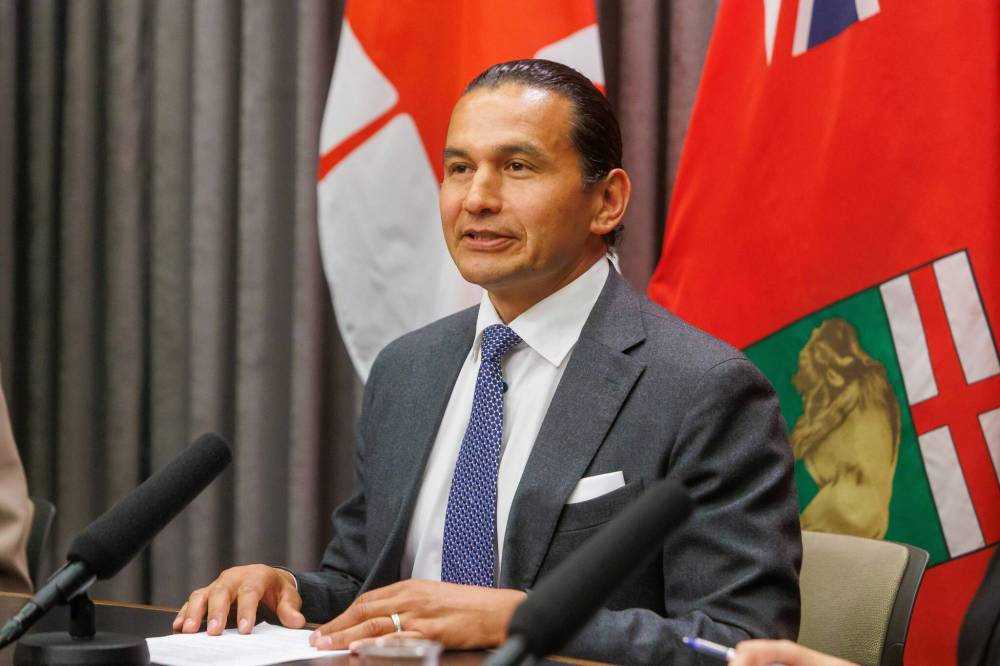
Premier Wab Kinew speaks during Thursday's wildfire update at the Manitoba Legislative Building, where he announced a second provincewide state of emergency. (Mike Deal/Winnipeg Free Press)
The premier said the main reason the province called another state of emergency “is because we need access to more facilities to be able to shelter this large number of Manitobans who are being forced to flee their homes due to wildfires.”
The RBC Convention Centre in downtown Winnipeg will set up as a shelter for up to 7,000 evacuees after an anime convention this weekend.
The first state of emergency was declared May 28 under similar circumstances. The measure was cancelled June 23 after several fires posed less of a threat and many evacuees returned home.
The situation has worsened in recent days due to high temperatures, strong winds and lightning strikes, which caused dozens of new fires.
There were 105 active fires as of Thursday afternoon.
Earlier, two more communities in northern Manitoba declared mandatory evacuation orders.
Canadian Armed Forces aircraft began airlifting evacuees out of Garden Hill Anisininew Nation on Wednesday night. Snow Lake residents were ordered to leave by noon today for the second time since June 7.
Garden Hill is a remote fly-in First Nation with a population of about 4,000 people.
An out-of-control blaze near the First Nation was about 130 acres in size as of Wednesday afternoon.
“We’ve approved Manitoba’s request for CAF support as wildfires threaten Garden Hill. Evacuation efforts are now underway,” federal Emergency Management Minister Eleanor Olszewski wrote on social media.
In a separate post, Northern and Arctic Affairs Minister Rebecca Chartrand said the federal government approved Manitoba’s request for CAF support Wednesday to evacuate Garden Hill.
Garden Hill and Snow Lake are in her constituency of Churchill-Keewatinook Aski.
“Thank you to community leaders and CAF members for ensuring the evacuation proceeds safely,” Chartrand wrote. “We are ready to provide further assistance if necessary.”
Snow Lake residents initially were forced out of the town on June 7. They were allowed to return a week later.
A new fire, which was about 16 km southeast of the town and out of control, prompted the second evacuation, Mayor Ron Scott said.
“This is totally unprecedented,” he said of the town being evacuated twice in a single wildfire season. “I think everybody is feeling a little bit frustrated and stressed out. We hoped it wouldn’t happen again.”
Prior to 2025, the last evacuation happened in 1989, Scott said.
Residents were warned Wednesday a mandatory evacuation order was possible. The order was declared in the evening after town officials were briefed by the Manitoba Wildfire Service, which recommended a mandatory evacuation, Scott said.
High winds are expected to push the 7,400-acre fire closer to Snow Lake, he said.
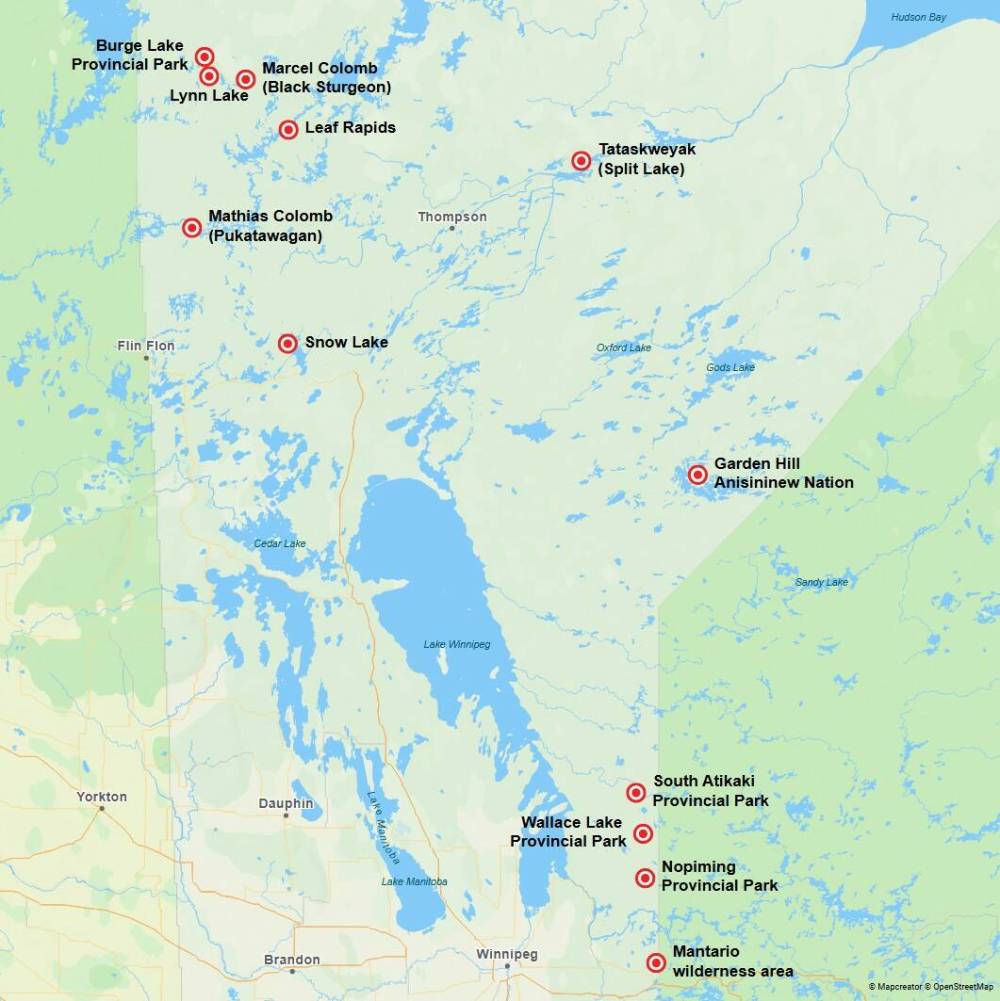
Map shows mandatory evacuation zones. Voluntary or medical evacuations are taking place in at least three communities: Nisichawayasihk Cree Nation (Nelson House), O-Pipon-Na-Piwin Cree Nation (South Indian Lake) and Pimicikamak Cree Nation (Cross Lake). (Winnipeg Free Press)
Up to 1,000 of Snow Lake’s residents are expected to leave before the noon deadline. About 30 people — volunteer firefighters and other essential staff — will stay behind, the mayor said.
Scott said one resident of Snow Lake left via a medical evacuation flight.
The Armed Forces began airlifting evacuees out of Garden Hill Anisininew Nation on Wednesday night.
Many evacuees drove out on their own. Those who don’t have personal transportation boarded two Winnipeg-bound buses, which will take them to an evacuation reception centre at a Leila Avenue indoor soccer complex, which doubles as a congregate shelter.
“Apparently, Winnipeg is booked solid, so anyone that doesn’t have family or friends to stay with will be staying in the shelter,” Scott said of the availability of hotel rooms in the capital city.
The province had said rooms are limited amid an increasing number of evacuees during the summer travel season.
Hundreds of evacuees from Lynn Lake are currently staying in Brandon. The community of 600 was forced to evacuate last weekend, just two weeks after returning home from a previous evacuation in late May, after a new blaze threatened to cut electricity to the community.
On Monday, the town confirmed in a social media post that “critical hydro infrastructure” had been damaged by wildfires.
While the power remained on, the town said officials cannot guarantee it will remain stable. If the community’s remote transmission line is damaged, it could take at least a month for the power to come back on, officials have said.
In response to Kinew’s appeal to Westman communities to be ready to take in more evacuees, Brandon Mayor Jeff Fawcett told the Sun that the city is prepared to do anything it can to help.
He said that while there isn’t a ton of hotel space, there is some, and under a state of emergency the evacuees would take priority.
“We hope that they can be as comfortable as they can in the community. I hope that they feel welcome,” he said. “We know that they’re here, not by choice, and that they aren’t at home.
“This isn’t a holiday, and we do hope that they do feel welcome and accommodated the best that we can while they are here and we really hope that they’re able to safely get back home as soon as possible.”
Starting Wednesday, Manitoba First Nation Safety Officers were helping with security and evacuee support at evacuation sites in Brandon.
sanderson@brandonsun.com