
4,000 wildfire evacuees go home
Advertisement
Read this article for free:
or
Already have an account? Log in here »
We need your support!
Local journalism needs your support!
As we navigate through unprecedented times, our journalists are working harder than ever to bring you the latest local updates to keep you safe and informed.
Now, more than ever, we need your support.
Starting at $15.99 plus taxes every four weeks you can access your Brandon Sun online and full access to all content as it appears on our website.
Subscribe Nowor call circulation directly at (204) 727-0527.
Your pledge helps to ensure we provide the news that matters most to your community!
To continue reading, please subscribe:
Add Brandon Sun access to your Free Press subscription for only an additional
$1 for the first 4 weeks*
*Your next subscription payment will increase by $1.00 and you will be charged $20.00 plus GST for four weeks. After four weeks, your payment will increase to $24.00 plus GST every four weeks.
Read unlimited articles for free today:
or
Already have an account? Log in here »
Hey there, time traveller!
This article was published 14/08/2025 (225 days ago), so information in it may no longer be current.
WINNIPEG — Reduced wildfire risk across Manitoba has helped pave the way for thousands of evacuees to return to their home communities after months in hotels and evacuation centres.
About 4,000 evacuees from Garden Hill and St. Theresa Point First Nations began returning home this week after being forced from their communities for the second time in July.
Alex McDougall, interim grand chief of Anisininew Okimawin, which represents four Island Lake First Nations, confirmed residents from the communities began flying home Tuesday. More flights were scheduled for yesterday, today and Friday.
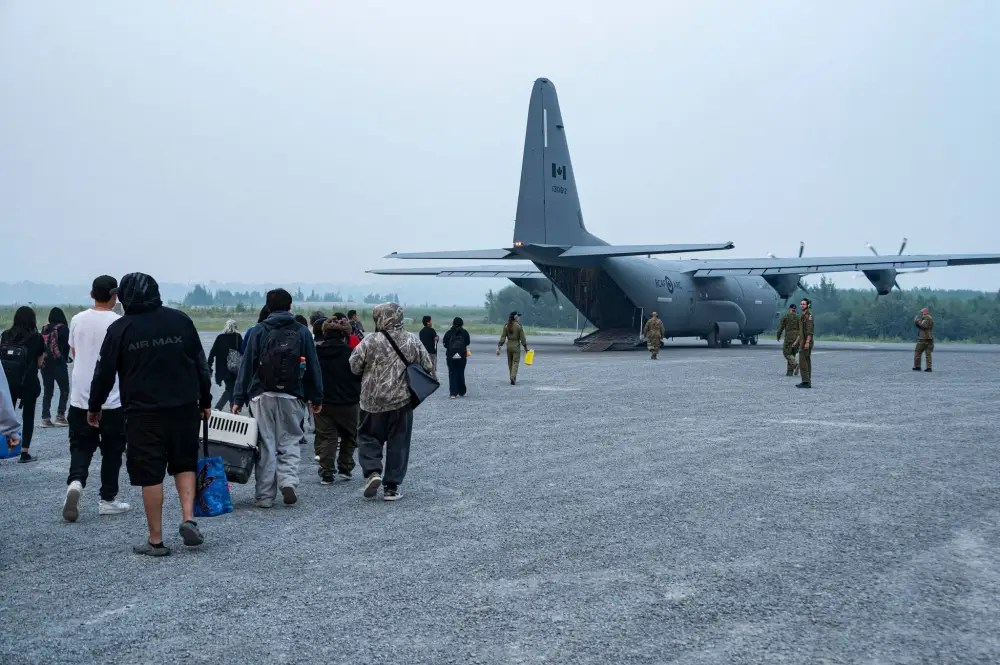
Dialysis patients, including those from the still-evacuated neighbouring community of Wasagamack, will be the last to go home. Inspectors and technicians will visit the two communities to ensure water, sewer and hydro infrastructure are all in working order before patients are flown home.
The communities, located about 600 kilometres northeast of Winnipeg, were ordered out on July 11 due to an out-of-control wildfire.
As of Wednesday, the nearby fire had burned more than 37,000 hectares and was still considered out of control. It was detected on July 6 but hasn’t grown in size since July 22, the province’s fire data shows.
The Manitoba Wildfire Service said Wednesday that fire danger is low in the majority of the province. Pockets of moderate fire danger remain in the southern and central areas of the province, and there is a mix of moderate and high fire danger in the northwest.
The province reported 161 active wildfires and a total of 413 to date. More than 1.75 million hectares of land have burned, making the 2025 wildfire season the worst on record in Manitoba in 30 years.
Evacuation orders for Stevenson Island and Little Grand Rapids were lifted Wednesday, and evacuees have started to return home, the province said.
About 14,000 Manitobans were still displaced as of last week.
In Pimicikamak Cree Nation, the community’s 600 residents got word Wednesday morning that they will begin to return home this week.
In a post to social media, Chief David Monias said flights to the community, located about 520 kilometres north of Winnipeg, were scheduled for Wednesday afternoon.
Community members were evacuated from Pimicikamak last month for the second time, owing to a wildfire raging near Cross Lake. They were ordered out three weeks after returning from an initial evacuation in mid-June. Pimicikamak resident Russ Garrioch was evacuated to Winnipeg in late July and has been staying at a Canad Inns hotel in Windsor Park since.
“It’s been a rough ride out here, I miss the people back home and looking forward to go for outings and just being around family,” Garrioch said.
Garrioch hopes the thousands of other displaced people get good news soon, too.
» Winnipeg Free Press
“I know some had tough time out here trying to adapt to the city life. It’s a jungle out here if you don’t know your way around or know anyone,” he said.
Six communities, including Snow Lake, Lynn Lake, Marcel Colomb First Nation, Leaf Rapids, Mathias Colomb (Pukatawagan) Cree Nation and Nisichawayasihk (Nelson House) Cree Nation remain in effect.
» Winnipeg Free Press