
Zebra mussels now reproducing in Clear Lake
Advertisement
Read this article for free:
or
Already have an account? Log in here »
We need your support!
Local journalism needs your support!
As we navigate through unprecedented times, our journalists are working harder than ever to bring you the latest local updates to keep you safe and informed.
Now, more than ever, we need your support.
Starting at $15.99 plus taxes every four weeks you can access your Brandon Sun online and full access to all content as it appears on our website.
Subscribe Nowor call circulation directly at (204) 727-0527.
Your pledge helps to ensure we provide the news that matters most to your community!
To continue reading, please subscribe:
Add Brandon Sun access to your Free Press subscription for only an additional
$1 for the first 4 weeks*
*Your next subscription payment will increase by $1.00 and you will be charged $20.00 plus GST for four weeks. After four weeks, your payment will increase to $24.00 plus GST every four weeks.
Read unlimited articles for free today:
or
Already have an account? Log in here »
Parks Canada has confirmed that zebra mussels are reproducing in Clear Lake following the agency’s 2025 aquatic invasive species monitoring.
In an update released on Monday, the agency said it found more evidence of the invasive species from tests conducted between June 16 and Oct. 6, when staff collected 251 environmental DNA samples from Riding Mountain National Park.
Zebra mussels have been found in multiple life stages in the lake, Parks Canada spokesperson Anisa Baker told the Sun on Monday.
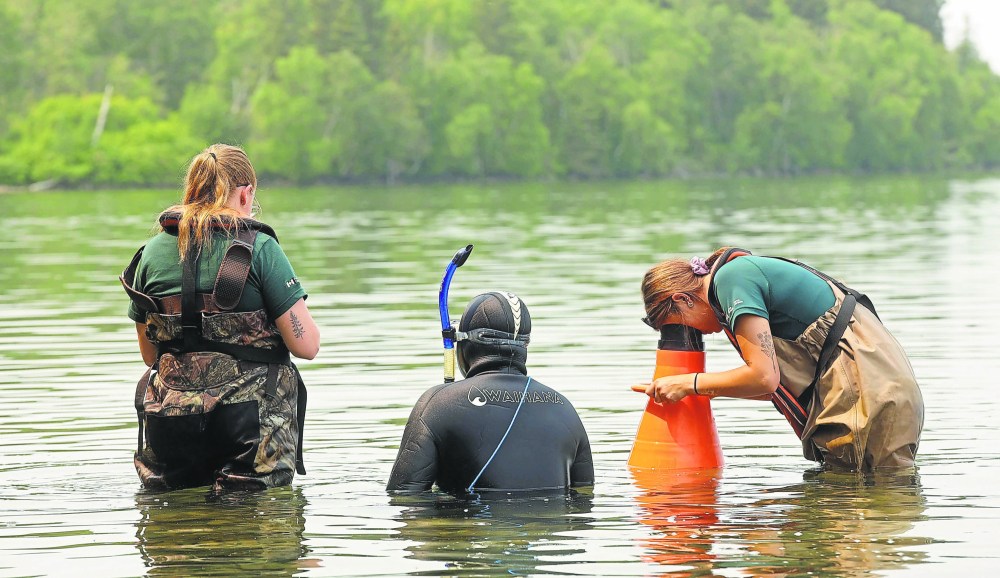
“One zebra mussel veliger (microscopic larvae) was detected for the first time in Clear Lake. Parks Canada also found two adult zebra mussels and roughly 15 juveniles,” Baker said in an email. “Zebra mussels are reproducing, with settlement and growth on docks in the eastern part of the lake.”
The update stated the agency plans to decide on watercraft management for Clear Lake by February 2026. Motorized craft have been banned from the lake for the past two years.
“To inform such decisions, Parks Canada will consider monitoring results from 2025 and previous years, a third-party literature review of the impacts of motorized watercraft on inland lakes, feedback from the management planning consultation process, and consultation with others, including Section 35 rights holders,” Baker said.
Meanwhile, cabin owners have called on the agency to make a long-awaited decision on watercraft management “soon.”
Parks Canada already has enough information to reach an informed conclusion and should “act sooner rather than later,” Brian McVicar, past president of the Clear Lake Cabin Owners Association, told the Sun.
“The sooner the better,” McVicar said. “People have waited a long time for this. This has gone on long enough, and there has to be a decision.”
McVicar strongly disputed the idea that motorized watercraft play a role in spreading zebra mussels, an issue central to Parks Canada’s upcoming decision.
“One thing was for sure, from what the park has said and what the independent specialist said — motorboats do not result in spreading zebra mussels,” he said. “There’s no science to support that.”
He said uncertainty and delays in decision-making have had significant consequences for the region, affecting property owners, tourism operators and businesses tied to recreation and hospitality.
“There are concerns from everyone — anybody with investment in and around Clear Lake,” McVicar said. “Millions of dollars have been impacted. This affects real estate, recreation, motorboats, hotels — everybody.”
McVicar said the findings align with conclusions presented this summer by an independent water scientist at a Clear Lake town hall meeting. The scientist, he said, acknowledged evidence of zebra mussels but questioned their potential to spread in the lake.
“His opinion, based on 25 years in water ecology, was that zebra mussels would likely not grow anywhere close to what they do in other lakes,” McVicar said. “The scientist pointed to two main factors: limited aquatic plant life and Clear Lake’s colder average temperatures, which are influenced by groundwater feeding the lake.”
Preventing further spread remains a priority.
Baker said Parks Canada will continue to use multiple methods to monitor for aquatic invasive species throughout Riding Mountain National Park, including substrate samplers and veliger tows in all water bodies and environmental DNA monitoring in Lake Katherine, Grayling Lake, Moon Lake, Lake Audy, Whirlpool Lake, Bob Hill Lake and Deep Lake.
She added that the agency, in collaboration with Brandon University, has started a new annual freshwater mussel survey at Clear Lake, covering 34 sites around the lake, including water quality sampling at each location.
“This program aims to identify native freshwater mussel species, assess how many mussels are present and where they live,” Baker said. “It documents habitat characteristics to locate possible refuge areas and monitor the spread and impact of invasive zebra mussels.”
Baker said that as zebra mussels are now reproducing in Clear Lake, future tests will always detect their environmental DNA, adding Parks Canada will stop zebra mussel eDNA testing in Clear Lake and redirect those efforts to other lakes in the park.
When contacted by the Sun, Clear Lake Cottage Association president Randy Brydges said the association had no comment.
Clear Lake has been grappling with the presence of zebra mussels since their first confirmed detection in November 2023, when a cluster of 48 live mussels was discovered. In October 2024, eight juvenile zebra mussels were found. That same month, zebra mussels were also discovered attached to dock infrastructure along the lake’s north shore.
» aodutola@brandonsun.com
» X: @AbiolaOdutola