
Pineapple on the Prairies: a cheesecake recipe
Advertisement
Read this article for free:
or
Already have an account? Log in here »
We need your support!
Local journalism needs your support!
As we navigate through unprecedented times, our journalists are working harder than ever to bring you the latest local updates to keep you safe and informed.
Now, more than ever, we need your support.
Starting at $15.99 plus taxes every four weeks you can access your Brandon Sun online and full access to all content as it appears on our website.
Subscribe Nowor call circulation directly at (204) 727-0527.
Your pledge helps to ensure we provide the news that matters most to your community!
To continue reading, please subscribe:
Add Brandon Sun access to your Free Press subscription for only an additional
$1 for the first 4 weeks*
*Your next subscription payment will increase by $1.00 and you will be charged $20.00 plus GST for four weeks. After four weeks, your payment will increase to $24.00 plus GST every four weeks.
Read unlimited articles for free today:
or
Already have an account? Log in here »
With Christmas in the air and family and friends coming and going, warm wishes and warm welcome are right in the spirit of things. And while we have many traditional symbols of welcome, there is one iconic image which has gone from an exotic rarity to a year round supermarket staple: the pineapple.
The pineapple was first introduced to Europe by Christopher Columbus at around 1493. Through various trade channels and travels it began to be known all throughout Europe and into the American colonies in the 1700’s. For a couple of centuries, the unusual treat was available only to the very rich. It was rare, nearly impossible to grow outside of its native region, and notoriously difficult to transport.
Though initially reserved for nobility and the upper classes of the west, its acquired “aristocratic” status, unique shape and leafy crown became an inspiration for architects, artists, artisans, and craftsmen, being incorporated into architectural accents, paintings, and furniture and even making its way into textiles and needlework as a decorative element. Historic examples include the tops of the towers of St. Paul’s Cathedral in London and even a huge cupola on top of a hothouse at Dunmore Park in Scotland. Pineapples can be seen on staircase newel posts, and stitched into table linens and quilts.
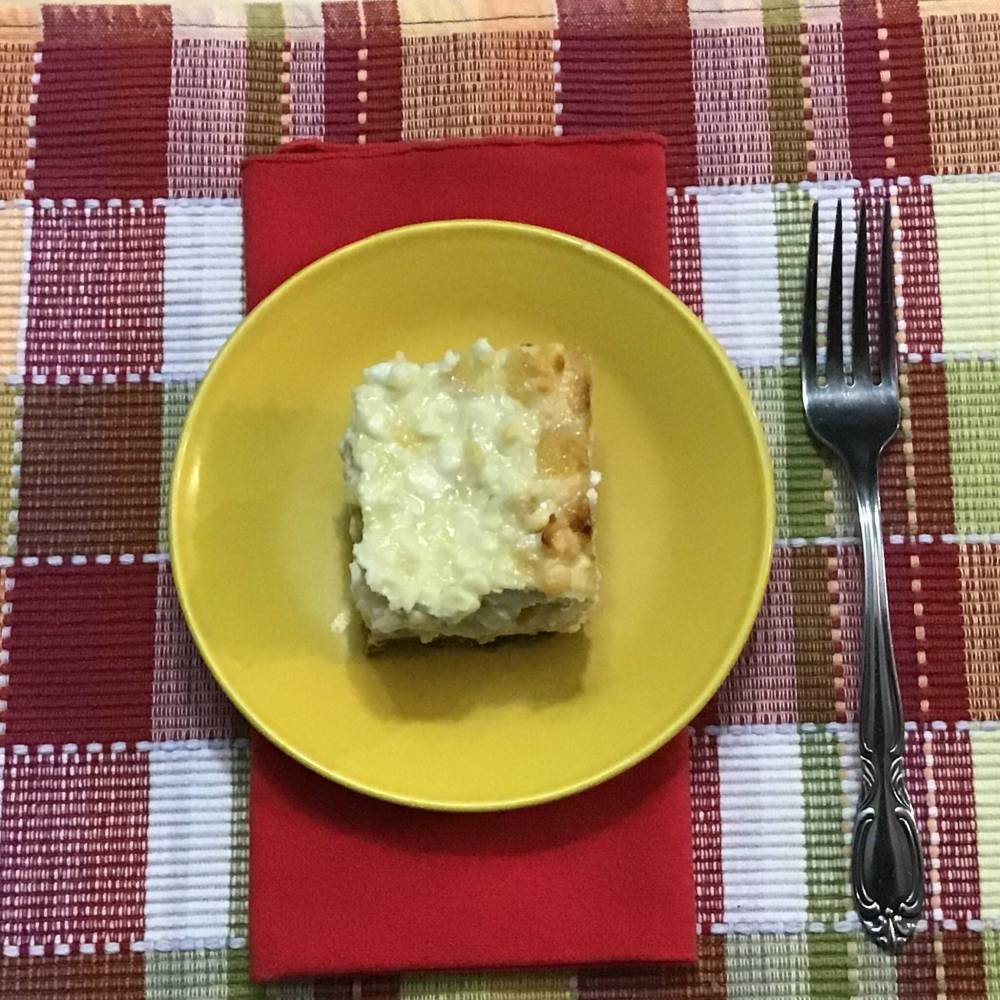
Say welcome this Christmas with pineapple cheesecake. This version is a not-too-sweet dessert. (Photo by Wendy King)
Because of its initial rarity and high society association, the pineapple became recognized as a symbol of welcome and hospitality as the wealthy offered it to special guests. But slowly, over decades, horticulturalists worked to develop and adapt ways to grow pineapple and its cultivation and sales evolved to where it is today – affordable and readily available.
By 1903, James Dole was able to produce canned pineapple at a profit. By the middle of the 20th century, canned pineapple was in North American grocery stores including Canada where one strong claim to fame is held for its contemporary popularity: the ham and pineapple pizza, created by Sotirios “Sam” Panopoulos.
The popular two-topping to-go order, known as the “Hawaiian,” was named after the brand of tinned pineapple Panopoulos used to create it. The Greek-born Canadian restaurateur introduced his inspiration at his business the Satellite Restaurant in 1962 in Chatham, Ontario. He arrived at the combination of toppings after a few trial runs and landing on the – occasionally controversial for pizza purists – blend of sweet and savoury.
Today, the hospitality industry continues to make use of the pineapple as a symbol of welcome, including it in logos, and design elements throughout places such as hotels and dining rooms.
As for using the pineapple to welcome people into our homes over the Christmas holidays, we may or may not have it as part of our home decor, but we can incorporate it into our table settings and certainly add it to our cooking.
The recipe below, for pineapple cheesecake, is a delicious “welcome in for a cup of coffee” or a not-too-sweet dessert. Made with dry curd cottage cheese — an ingredient which would have been a long time rural kitchen staple for any small holding with a cow or two — it is a simple dish to make.
A wide variety of recipes for this cheesecake are found everywhere, including the Ukrainian Pineapple Syrnyk as printed in Savella Stechisin’s excellent 1957 cookbook titled Traditional Ukrainian Cookery, where she celebrated Ukrainian settlement in Canada by gathering the recipes of “the women who treasured and practised the rich traditions of their homeland and thereby preserved them for posterity in this fair and free land of their choice.” Variations on this type of cheesecake can be found in other Slavik cuisine.
Some, like the one in Stechisin’s cookbook are somewhat more labour intensive calling for steps such as pressing the dry cottage cheese through a sieve. Some call for walnuts or raisins, some use bread crumbs to line the baking dish instead of a crust and some have no crust at all. Some call for as many as five eggs. The recipe that follows is the simplest — a family recipe with a good Ukrainian pedigree as this writer can attest.
» wendyjbking@gmail.com
Crushed Pineapple Cheesecake
Yields one 20 X 20 cm (8 x 8 in) cake pan.
Base
300 ml (1 1/4 c) crushed graham wafers
50 ml (1/4 c) melted butter
50 ml (1/4 c) sugar
Thoroughly blend together with a fork. Butter a 20 X 20 cm (8 x 8 in) baking pan. Press prepared graham wafer base evenly into the bottom of the pan.
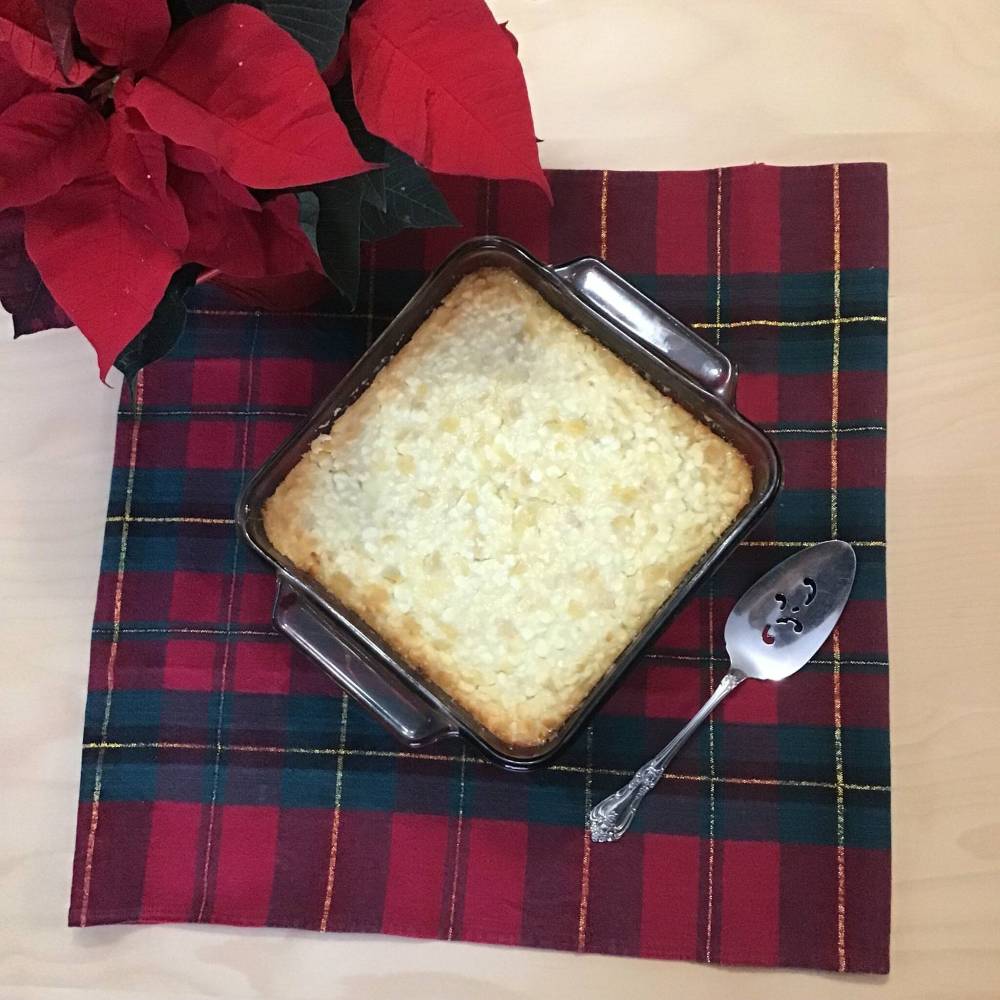
Say welcome this Christmas with pineapple cheesecake. This version is a not-too-sweet dessert. (Photos by Wendy King)
Cheesecake filling
600 g (1 1/3 lbs) dry curd cottage cheese
250 ml (1 c) sugar
2 eggs, lightly beaten
250 ml (1 c) sour cream
5 ml (1 tsp) vanilla
45 ml (3 Tbsp) corn starch
1 X 398 ml tin crushed pineapple, well-drained.
Preheat oven to 175°C (350°F).
In a large mixing bowl, mix cheese and sugar with a fork until well blended. In a smaller bowl, mix sour cream, vanilla, and cornstarch. Mix in the eggs. Add sour cream mixture to cottage cheese and sugar, mix well until all ingredients are thoroughly incorporated. Gently mix in drained pineapple. (Cottage cheese curds will still be quite whole, this is not meant to be a smooth batter like a cheese cake made with cream cheese.)
Pour evenly into prepared baking pan (as above). Bake for 40 minutes until set and lightly golden around edges. After 40 minutes, check every 10 minutes if more time is needed. Cool completely before slicing and serving from pan. Once thoroughly cooled, cover with cling wrap and refrigerate.
Best served cold.