
Tariff deal brings relief on eve of Ag Days
Advertisement
Read this article for free:
or
Already have an account? Log in here »
We need your support!
Local journalism needs your support!
As we navigate through unprecedented times, our journalists are working harder than ever to bring you the latest local updates to keep you safe and informed.
Now, more than ever, we need your support.
Starting at $15.99 plus taxes every four weeks you can access your Brandon Sun online and full access to all content as it appears on our website.
Subscribe Nowor call circulation directly at (204) 727-0527.
Your pledge helps to ensure we provide the news that matters most to your community!
To continue reading, please subscribe:
Add Brandon Sun access to your Free Press subscription for only an additional
$1 for the first 4 weeks*
- Enjoy unlimited reading on brandonsun.com
- Read the Brandon Sun E-Edition, our digital replica newspaper
*Your next Free Press subscription payment will increase by $1.00 and you will be charged $20.95 plus GST for four weeks. After four weeks, your payment will increase to $24.95 plus GST every four weeks.
Read unlimited articles for free today:
or
Already have an account? Log in here »
Hey there, time traveller!
This article was published 16/01/2026 (252 days ago), so information in it may no longer be current.
As farmers from around the country get ready for the kickoff to Manitoba Ag Days 2026, there’s some focus on international challenges facing the industry — and a recent breakthrough on tariffs.
The three-day event hosts 580 exhibitors who will showcase everything from best practices in their field to inventions.
The 49th edition of Ag days runs from Tuesday to Thursday at the Keystone Centre in Brandon and its theme this year is “Produced on the Prairies.”
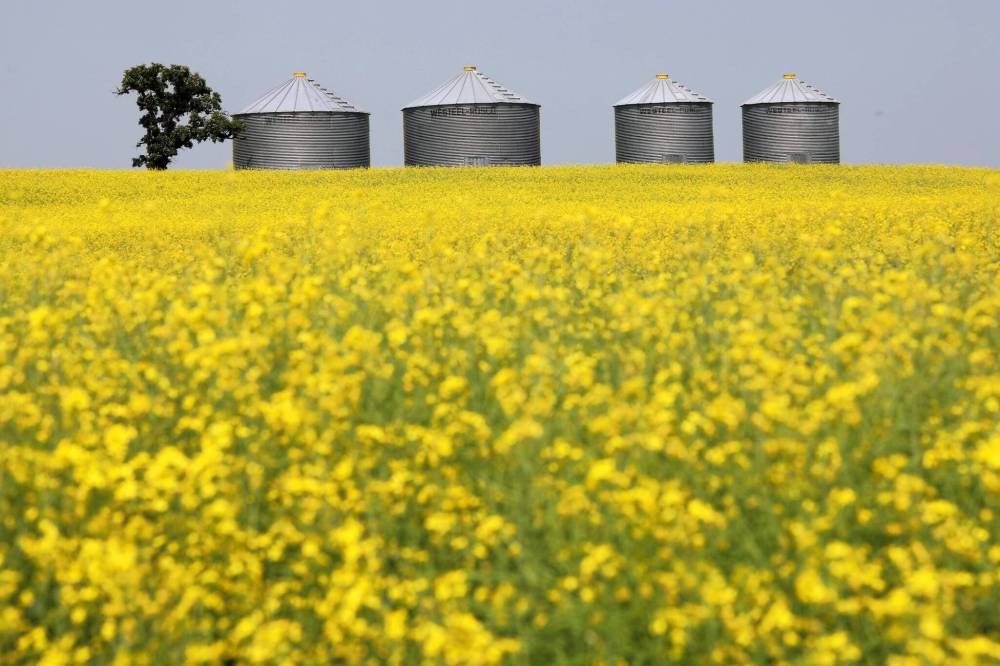
Grain bins stand out against a field of canola in bloom near Oak River. On Friday, China’s tariff on Canadian canola seed was dropped to 15 per cent from 84 per cent, while the tariff on canola meal was dropped completely. (Tim Smith/The Brandon Sun files)
Agriculture experts, dignitaries and a geopolitical analyst are included on the long list of more than 80 speakers scheduled to attend.
This year’s event comes while certain sectors, like cattle, are enjoying a boom, and others have been struggling, including the canola sector under Chinese tariffs.
On Friday, China’s tariff on Canadian canola seed was dropped to 15 per cent from 84 per cent, while the tariff on canola meal was dropped completely. That comes after Prime Minister Mark Carney met with Chinese President Xi Jinping in Beijing for trade talks.
The changes take effect March 1 and are guaranteed until the end of the year.
The executive director of the Manitoba Canola Growers Association said the announcement is good for the industry.
“It is positive news coming out of Beijing this morning. Excited to see that the Canadian government is recognizing the value of the Canadian agriculture sector in trade,” Delaney Ross Burtnack said Friday morning.
“Just a relief to finally see some positive momentum on this file.”
The tariffs being lowered and dropped come as Canadian tariffs on Chinese-made electric vehicles were reduced to 6.1 per cent, up to a maximum of 49,000 vehicles entering the country. Chinese EVs were previously under a 100 per cent tariff.
Manitoba Premier Wab Kinew told reporters in Winnipeg on Friday that seeing the progress “is welcome news for the ag sector.”
“The ag sector in Manitoba is massive. It’s a huge part of the Canadian economy and a huge part of the Manitoba economy, so this is welcome news,” he said, according to a transcript sent to The Brandon Sun by the province.
Kinew said he hopes to see tariffs on pork also dropped soon, as that is another important industry in the province.
Burtnack said the tariff announcement means farmers will be able to sell their product into China once again.
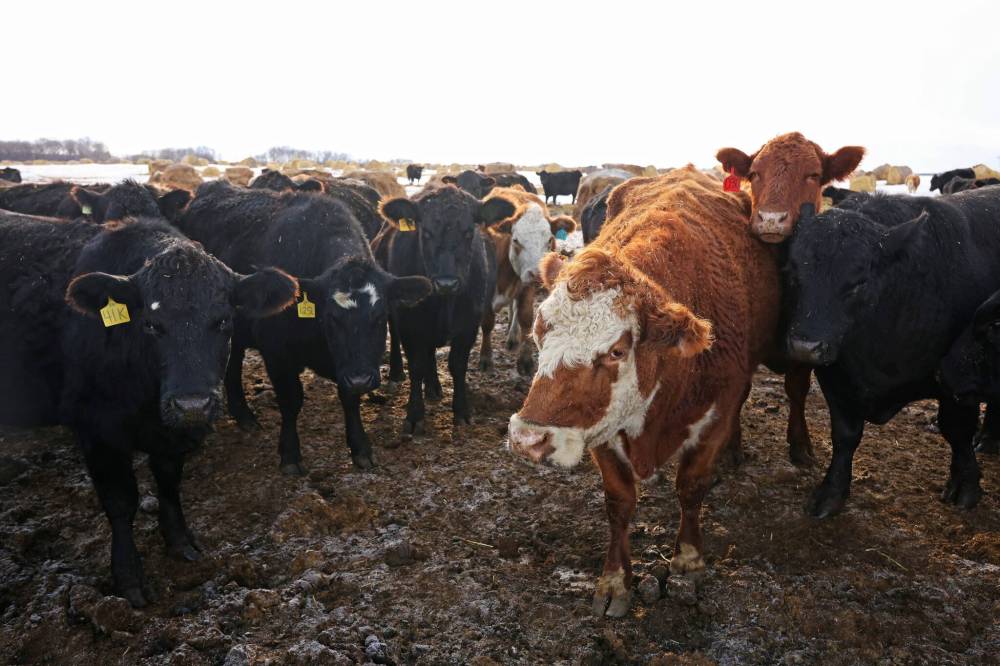
Curious cattle eye the camera at Melody Acres farm north of Bradwardine on a mild Thursday morning. While some farmers are facing tough international challenges, beef producers are experiencing a boom with record high prices. (Tim Smith/The Brandon Sun)
She hopes that a fully open market will open again soon.
One day earlier, Burtnack said the tariffs have been “a huge barrier to farmers to be able to sell,” and that “every farmer is feeling a pinch already in terms of the price.”
She said Ag Days having a portion dedicated to the current geopolitical landscape, and how it affects farmers, is beneficial.
“There’s some farmers who just don’t realize that global politics is closer to home than they think,” Burtnack said. “Having that insight, it’s actually really important information as farmers make decisions about what to do with their grain.”
That includes knowing how prices can change, she said, and having a “trigger price” based on what’s going on elsewhere.
The rest of the three-day affair, she said, is incredibly important for farmers to learn about new innovations and make connections.
Teresa Hildebrand, Ag Days’ media co-ordinator, also said the geopolitical component of the event is valuable for producers.
“We are competing against (the) same commodities being grown at different places in the world, and so it’s important to know what’s happening in those places, and our farmers are curious about how they fit into that global market,” Hildebrand said.
Presentations on geopolitics and a variety of other subjects are “hugely helpful,” she said.
“It helps you get a perspective that’s bigger than your own operation, and though you’re keeping track of those things throughout the year, sometimes it’s nice to be able to have that dedicated time to focus on just that topic with people around you who are also interested in that topic.”
And it’s not just the presentation itself, but the conversations before and after with other people in the same situation that bring insights, Hildebrand added.
“Just being able to say, ‘Hey, I’m not in this alone.’”

Jacob Shapiro is scheduled to speak Wednesday at Ag Days. (Ag Days website)
Jacob Shapiro, who is the director of research at The Bespoke Group and hosts The Jacob Shapiro Podcast, is scheduled to speak Wednesday at Ag Days.
In a phone interview from his home city of New Orleans, La., Shapiro said it’s important for farmers to understand the global situation, as North American agriculture is “going through a cyclical downturn.”
He said the world is going from a unipolarity — dominated by the United States — to a multipolarity, where multiple national governments are battling for power, economic influence and trade.
“In an era of globalization, the farmer is just trying to produce as much as possible, as efficiently as possible, and then the market will absorb it,” Shapiro said
“But food is now becoming handmade into national security, and you’re getting countries that are either interested in increasing their self-sufficiency … or are looking to have trading partnerships with countries that are more aligned with them politically.”
Farmers now have to “completely refocus” how they think about their bottom line in relation to both exports and local markets, he said.
Shapiro said Wednesday’s presentation will focus on the rise of multipolarity, and whatever the top headlines are that day.
He added that while he often focuses on problems people are facing, this time he will speak about the opportunities available for growth.
Burtnack said the event as a whole will provide plenty of good information for farmers.
“Ag Days is a fantastic event,” Burtnack said. “It’s so beneficial, there’s not a lot of opportunities to bring the entire community of farmers together alongside the industry, to connect and learn from each other.”
Cattle farmer Brian English agreed, saying he has learned a lot since he started his farm west of Rivers more than 20 years ago.
He said the first time he heard of bale grazing was at Ag Days, which has proved to be valuable in his day-to-day work.
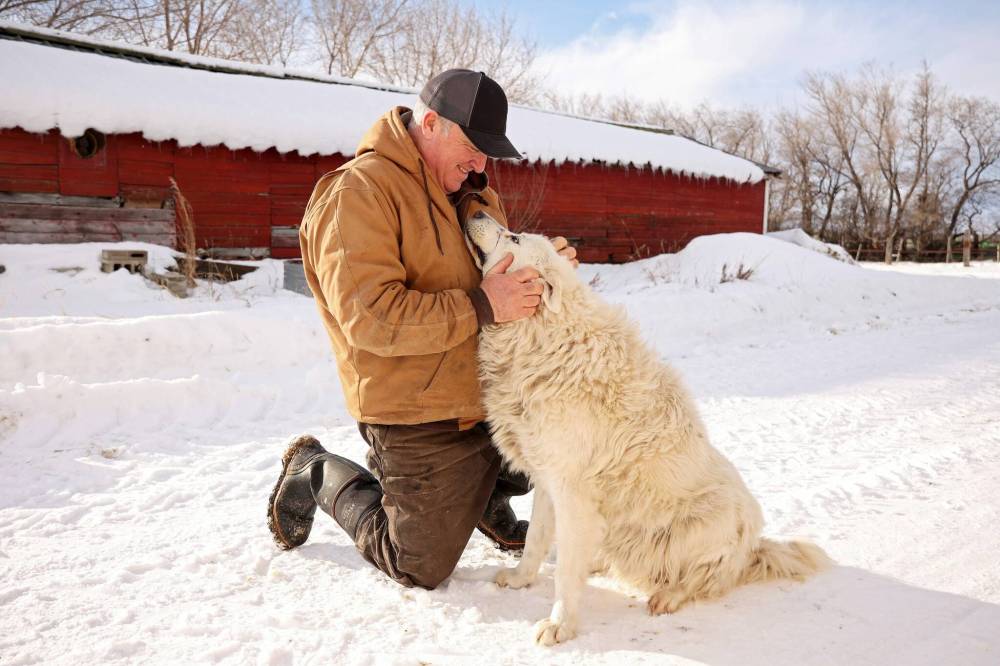
English has a friendly moment with his dog Boomer on Thursday morning.
“I learned a lot of things along the way,” English said. “That’s where I kind of got my information from — some of the speakers. It’s very valuable.
“Ag Days was some of the first places where I got a lot of information,” he said.
Now as a regional director for the Manitoba Beef Producers, he will be set up at a booth and looking to talk to producers.
Ag Days serves as a place where farmers can speak to each other, English said, as opposed to having to tend to the farm, usually on their own or with family.
He said he’s also planning to listen to some of the many speakers.
His industry is currently in a boom, he said.
“This is probably the best of times for us. We haven’t seen prices like that ever in the cattle industry,” English said.
He said things are “very promising” and that he’s encouraged.
» alambert@brandonsun.com, with files from The Canadian Press