
Drones take centre stage at Ag Days
Advertisement
Read this article for free:
or
Already have an account? Log in here »
We need your support!
Local journalism needs your support!
As we navigate through unprecedented times, our journalists are working harder than ever to bring you the latest local updates to keep you safe and informed.
Now, more than ever, we need your support.
Starting at $15.99 plus taxes every four weeks you can access your Brandon Sun online and full access to all content as it appears on our website.
Subscribe Nowor call circulation directly at (204) 727-0527.
Your pledge helps to ensure we provide the news that matters most to your community!
To continue reading, please subscribe:
Add Brandon Sun access to your Free Press subscription for only an additional
$1 for the first 4 weeks*
*Your next subscription payment will increase by $1.00 and you will be charged $20.00 plus GST for four weeks. After four weeks, your payment will increase to $24.00 plus GST every four weeks.
Read unlimited articles for free today:
or
Already have an account? Log in here »
Manitoba Ag Days kicked off Tuesday with a strong spotlight on agricultural innovation — and the large-scale drones showcased on the trade show floor drew plenty of attention.
The Spider-i M400 agricultural spray drone, one of the pieces of equipment displayed, marks a shift in how producers should think about drone technology, Ag Drone Canada president Travis Karle told the Sun in an interview.
Karle, who has been a pilot for 35 years, said he has spent the last four years working with a couple of different drone manufacturers to develop a proper spray drone — a high-capacity, high-volume, aerial spray drone.
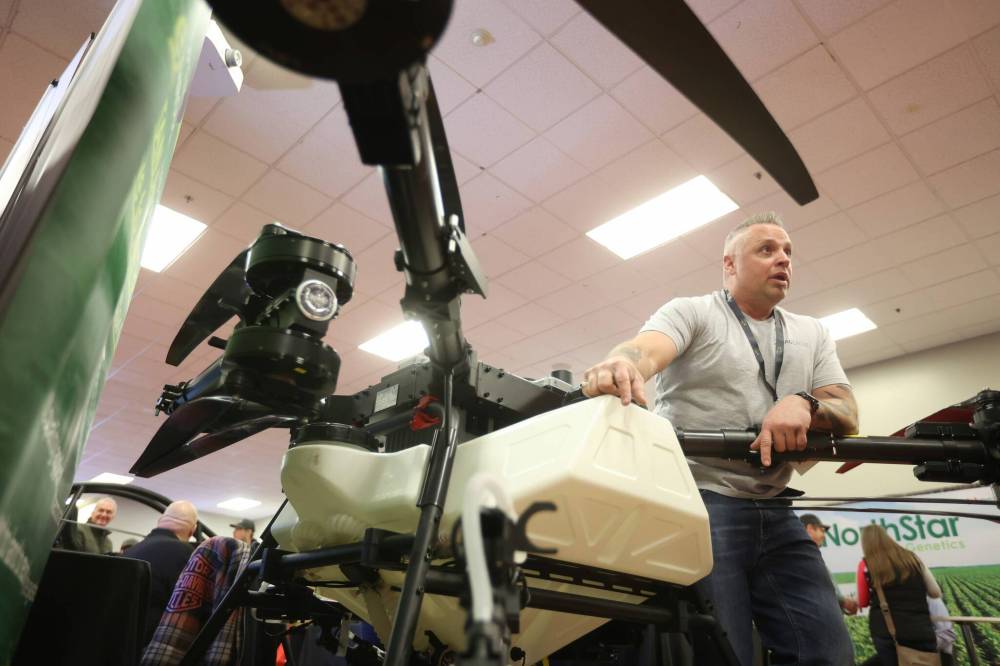
Travis Karle, president and CEO of Ag Drone Canada, leans over a Spider-i M400 agricultural drone while speaking with visitors to Ag Drone Canada's booth at Manitoba Ag Days 2026 on Tuesday. (Tim Smith/The Brandon Sun)
Karle described the M400 as “by far the biggest drone in the industry,” featuring a tank capacity of up to 210 litres, three batteries and extended flight time.
“Instead of thinking of that as a drone, now we’re looking at a piece of farm equipment,” he said. “We’re 100 acres per hour plus with that drone of that size.”
Beyond spraying, Karle said the drone can be adapted for several uses.
“You can use it for granular, for spreading fertilizer or cover crop,” he said. “It’ll lift 220 kilograms. It has three different applications — you can use it for firefighting or lifting, or just as a transport drone.”
The drone is priced at around $95,000, and Karle said its affordability compared to traditional equipment is a key advantage.
“For the ag industry, the big deal is initial investment costs are really low compared to a ground rig or a plane,” he said. “Our operating costs go down by at least 80 per cent.”
Although the first units were manufactured overseas, Karle said future production will move to Saskatchewan.
“We’re going to be doing all the building here, right at Nipawin,” he said. “By April or May, we’ll have about 50 units here.”
Other exhibitors highlighted similarly advanced — but smaller — drone options.
Flaman Agriculture drone specialist Todd Fraser showcased the DJI Agras T100, calling it the company’s newest spray drone.
“It’s their newest spray drone on the market,” Fraser said. “It can do your spraying, and it also has a spreading tank for broadcasting canola seed or spreading fertilizer.”
Fraser said the drone carries a 100-litre liquid tank and a 150-litre spreading tank, with a working spray width of 30 to 36 feet.
“In terms of capacity, you can probably do about 70 acres an hour,” he said.
Fraser added that the T100 stands out for its safety and navigation technology.
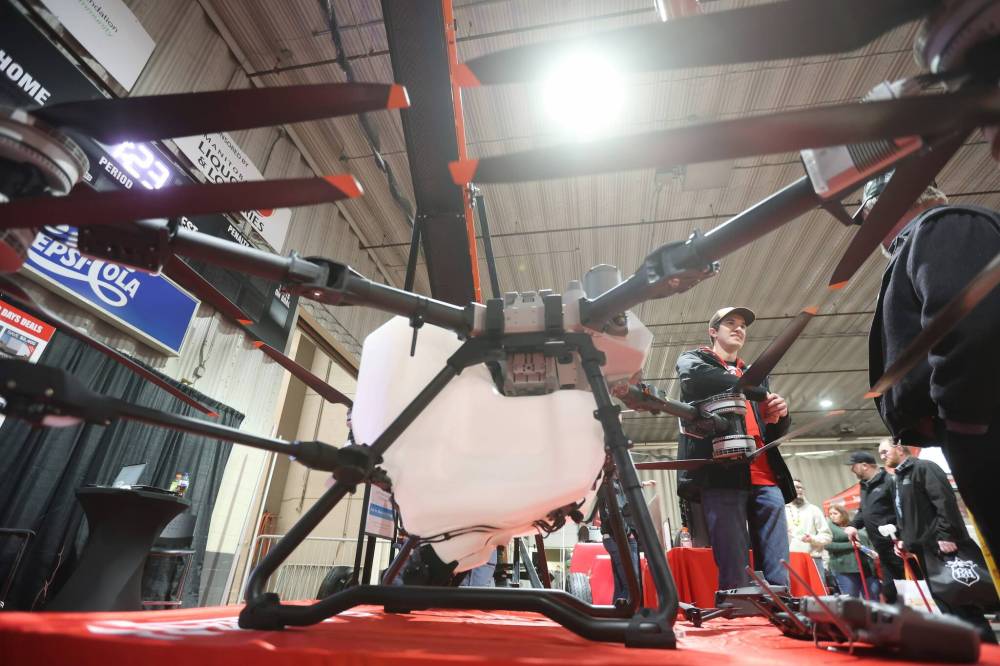
Todd Fraser speaks with a visitor to Manitoba Ag Days 2026 about the uses for a DJI Agras T100 drone on display at the Flaman booth on Tuesday. "There are bigger drones out there," he said, "but they're not where this one is in terms of technology." (Tim Smith/The Brandon Sun)
“This thing has vision sensors, radar, it has LiDAR just for collision avoidance,” he said. “There are bigger drones out there, but they’re not where this one is in terms of technology.”
The T100 is priced at about $48,500, Fraser said, and interest from producers has been strong.
“Lots of people are really interested,” he said. “It’s made quite a big step forward in terms of technology from where the last generation of drones was.”
Infrastructure supporting drone operations was also on display.
Braiden Setter-Shwaluk of Setter Manufacturing Division, based in Russell, said his company focuses on helping farmers integrate drones into everyday operations.
“We’re displaying what we can do for farmers if they buy a trailer and they want it set up as a drone trailer or just a loading system for their farmyard and sprayers,” Setter-Shwaluk said.
At the booth, Setter Manufacturing displayed both the DJI T50 and T100 drones.
“The T50 is a little smaller with a 10-and-a-half-gallon spray tank, and the T100 is the next size up at a 24-gallon spray tank,” Setter-Shwaluk said. “That’s the biggest one we have right now.”
He said the drones use spinner-based spray systems rather than traditional nozzles, allowing operators to adjust droplet size in real time.
“You can do super fine, like a fog spray, or drop it to a really big droplet size on higher wind days,” he said.
He said drones may also offer improved accuracy compared to spray planes.
“A drone, you’re anywhere from 10 to 12 feet above the crop constantly,” Setter-Shwaluk said. “With being that close to the crop, your downwash is being pushed into the crop. It’s not drifting as bad … I find it to be a little bit safer than a plane.”
Setter-Shwaluk added that he has tested drone seeding and spraying on his own farm.
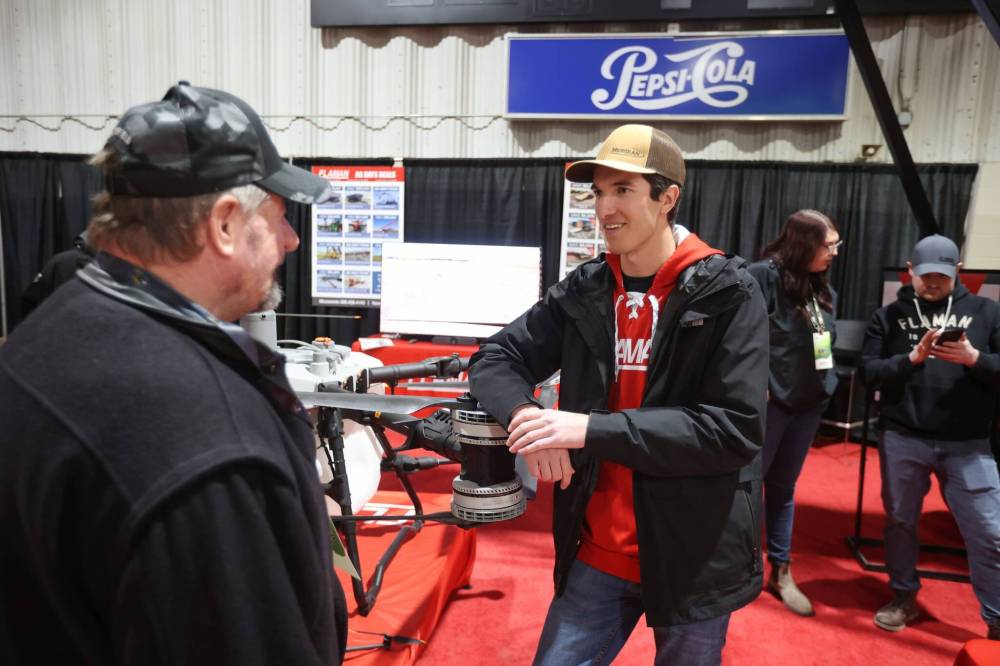
Todd Fraser with Flaman speaks with a visitor at the Flaman booth on Tuesday. (Tim Smith/The Brandon Sun)
“I did a little trial plot on my farm — two and a half acres of canola — and I spread canola seed with the drone,” he said. “It came out just as well as the rest of our crops.”
Landview Drones’ Marcus Weber said drone technology has been evolving in agriculture for years.
“We’ve been doing this for 10 years. Drones in agriculture really aren’t that new. The use that we’re making of them is what’s new,” he said.
“In the last three to four years, we’ve seen a shift from not just mapping but actually applying product.”
Weber also emphasized that drones are used well beyond agriculture.
“That drone is used heavily by search and rescue,” he said. “A drone a farmer would use for mapping a field can also be used for finding people when they’re lost in the bush.”
Weber said training and certification is important for farmers.
“It doesn’t matter which drone you’re flying — if it’s 250 grams or more, you need a certificate in Canada, and we offer those services,” he said.
» aodutola@brandonsun.com
» X: @AbiolaOdutola