
Shapiro says he’s ‘bullish’ on multipolarity
Geopolitical analyst shares insights on China, crops and global markets with Ag Days audience
Advertisement
Read this article for free:
or
Already have an account? Log in here »
We need your support!
Local journalism needs your support!
As we navigate through unprecedented times, our journalists are working harder than ever to bring you the latest local updates to keep you safe and informed.
Now, more than ever, we need your support.
Starting at $15.99 plus taxes every four weeks you can access your Brandon Sun online and full access to all content as it appears on our website.
Subscribe Nowor call circulation directly at (204) 727-0527.
Your pledge helps to ensure we provide the news that matters most to your community!
To continue reading, please subscribe:
Add Brandon Sun access to your Free Press subscription for only an additional
$1 for the first 4 weeks*
*Your next subscription payment will increase by $1.00 and you will be charged $20.00 plus GST for four weeks. After four weeks, your payment will increase to $24.00 plus GST every four weeks.
Read unlimited articles for free today:
or
Already have an account? Log in here »
Prime Minister Mark Carney’s recent trip to Beijing was “one of the most momentous things that has happened in Canadian geopolitics in literally generations,” a speaker at Ag Days told an audience of 325 people at Brandon’s Keystone Centre on Wednesday.
Geopolitical analyst Jacob Shapiro drew attention early in his presentation to last Friday’s agreement by Carney and Chinese President Xi Jinping to reduce canola tariffs in exchange for slashing Canada’s tariff on Chinese-made electric vehicles.
But Shapiro, who is based out of New Orleans, La., warned farmers to be wary of selling to the Chinese market.
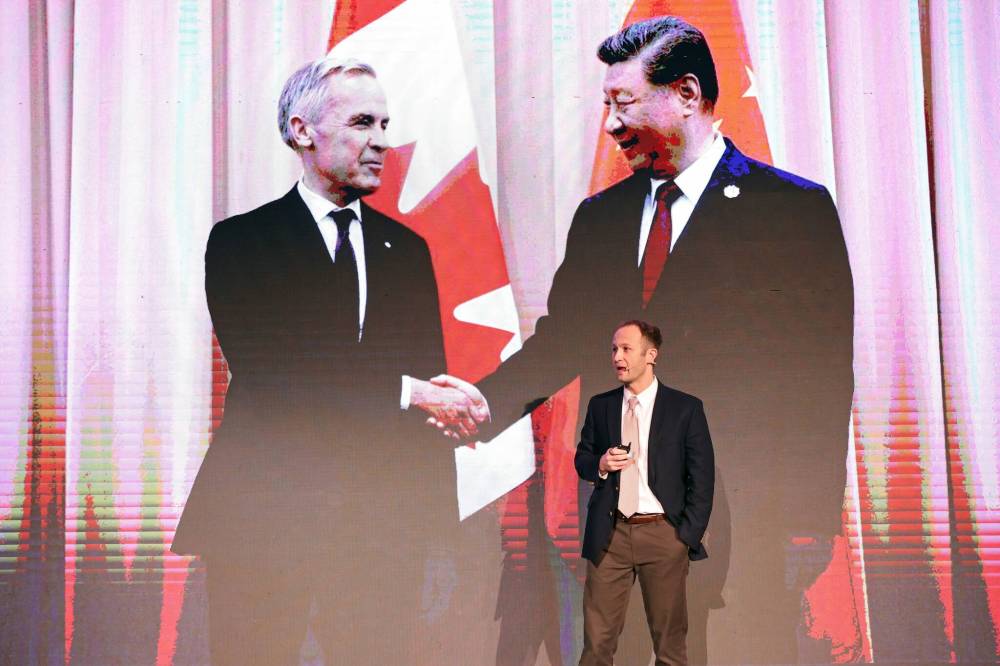
Geopolitical analyst Jacob Shapiro stands before an image of Prime Minister Mark Carney shaking hands last week with Chinese President Xi Jinping during his talk in the Keystone Centre as part of Manitoba Ag Days 2026 on Wednesday. (Tim Smith/The Brandon Sun)
“They are not a viable source of economic growth and export growth for farmers in North America,” he said.
If China doesn’t need Canadian products at some point, he said, it could simply stop buying from the market entirely, and switch to different suppliers.
He added, however, that if people can make money off the market now, they should “by all means laugh your way to the bank, make as much as you possibly can.”
On the most marketable crops, Shapiro said vegetables, fruits and proteins are sectors that aren’t being grown enough, based on studies, while grains and sugars are overproduced. Dairy products are close to the level needed.
“I see this and I see a massive opportunity hiding in plain sight,” Shapiro said. “We have too much of one thing, but not enough of the other thing. Why don’t we go think about attacking the other thing?”
He said while producers should look to Asia-Pacific and South Asian countries as potential markets, they need to look at exporting to other Canadian markets as well.
“I’m not saying no to exports completely, but I am saying let’s think a little bit more seriously about what exports look like in this global environment,” Shapiro said.
“I think your best export market in a geopolitically multipolar world is Canada. You are … one of the most agriculturally blessed countries in the entire world.”
He said that change creates opportunity, and that he’s “extremely bullish and optimistic right now.”
Shapiro, director of research at The Bespoke Group and host of The Jacob Shapiro Podcast, titled his talk, “Geopolitics: What Lies Ahead?”
The one-hour presentation in the FCC Theatre at Assiniboine Credit Union Place focused on how the world has shifted from being dominated in trade and influence by the United States to a more multipolar arrangement.
“I think we are in a fundamental structural reorganization for global agricultural markets,” he said.
“I think the way that things have worked for the past hundred years are not going to work that way going forward.”
Shapiro described how American exports and production have changed since the end of the First World War and highlighted the rise of worldwide exports from countries like Ethiopia, Brazil, China and India.
“The United States was the pre-eminent military, cultural, economic, trade — you name it — power in the world,” he said.
While the current period of transition could be disorienting, he said, it also contains “a silver lining.”

Shapiro, director of research at The Bespoke Group, delivers his presentation in the FCC Theatre at Assiniboine Credit Union Place on Wednesday. (Tim Smith/The Brandon Sun)
“This is the way the world normally works. It is not normal for one country, or even two countries, to call the shots the way that the United States has been for the last 30 to 40 years,” Shapiro said.
Aside from the United States in the last few decades, there has only been one instance of a unipolarity, which was the United Kingdom in the 19th century, he said. There have also been bipolarities, like the Soviet Union and U.S. after the Second World War.
“Ironically, multipolar worlds are actually relatively stable, because truly multipolar worlds are worlds in which countries don’t think they can achieve all of their aims at the point of a gun or with a tariff,” Shapiro said. “So, they have to learn to compromise and balance against each other.”
The last time there was a multipolarity, he said, was in the 1890s.
Shapiro used a variety of maps and graphs to illustrate trends and changes in the trade world.
After the presentation ended, one farmer said the level of change Shapiro described is “hard to wrap your head around.”
“It scares the crap out of you, because the world is changing,” Dauphin grain farmer David Kalicinski said. “It has changed, and as a third-generation farmer, you kind of just think you’re going to do what the previous generations did.”
He said in his roughly 25 years of farming, China has been a “saviour,” as it boosted commodity prices and had an “insatiable appetite for everything.”
“A lot of the world has increased their appetite as their economies are growing and their people have gotten wealthier, and it’s scary to think that one day that won’t be the case for us,” Kalicinski said.
He said despite all the changes taking place, life still goes on, including in how he runs his business, adding he’s heard a lot of “doom and gloom” over the years.
The presentation was valuable, Kalicinski added, saying all young farmers should have attended the presentation to learn.
“I love these kinds of speakers. I wish they’d bring more of them in, because they challenge your way of thinking.”
» alambert@brandonsun.com