
Retirement living changing with the times
Advertisement
Read this article for free:
or
Already have an account? Log in here »
We need your support!
Local journalism needs your support!
As we navigate through unprecedented times, our journalists are working harder than ever to bring you the latest local updates to keep you safe and informed.
Now, more than ever, we need your support.
Starting at $15.99 plus taxes every four weeks you can access your Brandon Sun online and full access to all content as it appears on our website.
Subscribe Nowor call circulation directly at (204) 727-0527.
Your pledge helps to ensure we provide the news that matters most to your community!
To continue reading, please subscribe:
Add Brandon Sun access to your Free Press subscription for only an additional
$1 for the first 4 weeks*
- Enjoy unlimited reading on brandonsun.com
- Read the Brandon Sun E-Edition, our digital replica newspaper
*Your next Free Press subscription payment will increase by $1.00 and you will be charged $20.95 plus GST for four weeks. After four weeks, your payment will increase to $24.95 plus GST every four weeks.
Read unlimited articles for free today:
or
Already have an account? Log in here »
Hey there, time traveller!
This article was published 11/02/2026 (210 days ago), so information in it may no longer be current.
Pat and Betty Golding started touring several retirement homes in Brandon two years before they were able to move into Victoria Landing last June.
“All of a sudden, it was available and we were in within a month or two,” said Betty, 91, who sat next to her 88-year-old husband in the facility’s small library.
The couple downsized from living in a two-bedroom apartment in the city’s southwest area to making their one-bedroom suite feel like home.
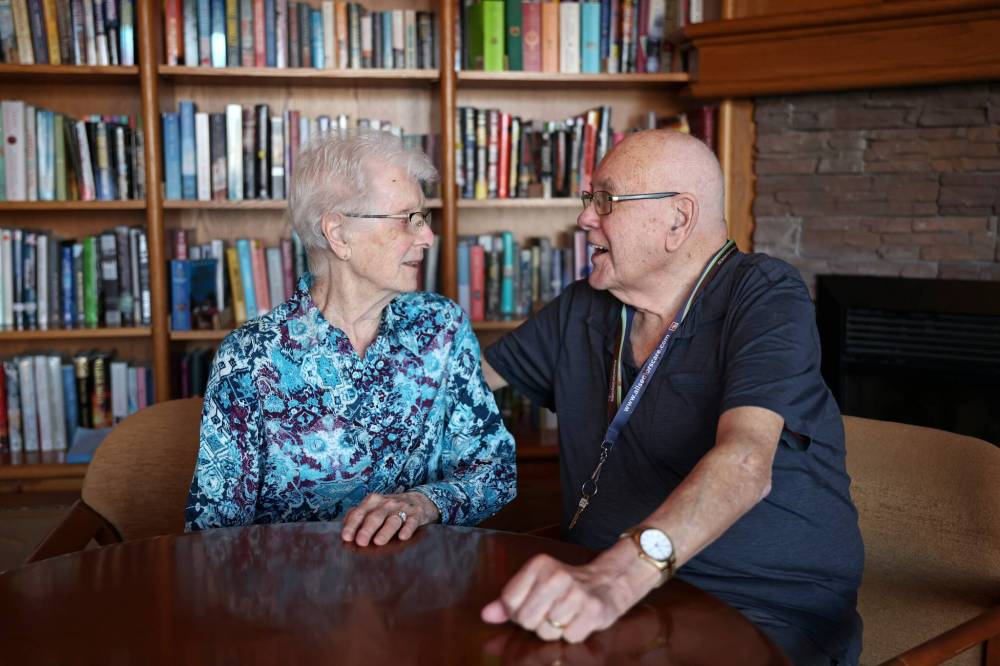
Pat and Betty Golding at Victoria Landing Retirement Residence in Brandon on Wednesday. The couple downsized from living in a two-bedroom apartment in the city’s southwest area to making their one-bedroom suite feel like home. (Tim Smith/The Brandon Sun)
Pat said they were drawn to Victoria Landing for many reasons, including the friendliness of the staff and residents, the accessibility of their bathroom ensuite and the variety of weekly activities.
“They have a lot of activities here, which we wanted,” he said, adding that while other places seemed nice, Victoria Landing was the best fit for what they were looking for.
“Both of us really love it here … Betty particularly, because she doesn’t have to cook anymore,” Pat said.
“I didn’t mind the cleaning so much,” Betty added.
Victoria Landing has 136 suites and about 145 residents, said executive director Claudia Nohr.
There is a waitlist, but people can usually get access to a suite within a couple of months, she said.
Residents range in age from their late 60s to late 90s, but in the last few years, the retirement home has seen more people moving in while still in their younger years because they need supports to help them age in place, Nohr said.
“We have people who move in because they’re ready to make that move and … have more supports,” she said.
“Then we also have people that, you know, move into the community because they’ve had something happen and they are no longer capable and able to be on their own.”
Residents pay month to month at Victoria Landing. Their rent includes three daily meals, snacks, light housekeeping, transportation, cable, building maintenance and access to an on-site nurse or health-care aide.
Information on the monthly rent is not made public on Victoria Landing’s website and Nohr declined to disclose the cost.
Residents can also enjoy amenities like the game and crafts room, library, movie theatre and spa.
Extra home-care services like walk-assist, hourly check-ins, laundry or Blossom — a memory care program — are an additional cost, Nohr said.
Most seniors choose to move into a retirement home because they want to feel safe and can socialize with others, said Riverheights Terrace general manager Darla Helena.
The average age of people living at the retirement home used to be in the 80s, but it has gone down to 78 because more people are wanting to enjoy the amenities earlier, she said.
Helena said she’s seen an increase in the number of seniors interested in moving into Riverheights Terrace since the COVID-19 pandemic because a big part of their overall health revolves around socialization.
“Rather than living alone in your home, people are able to come here (and) be comfortable in their own apartment,” she said.
“We do everything we can to make sure that the people are very happy when they live here.”
Riverheights Terrace has 119 suites and 140 residents. The price to rent a studio or one- or two-bedroom suite ranges from $3,195 to $6,445, the building’s website says.
Some studio suites are move-in ready, but residents wanting a specific unit may face a six- to 12-month wait, Helena said.
The monthly cost includes three daily meals, housekeeping, transportation, access to a salon and barbershop, parking, entertainment and activities.
Helena said residents enjoy having an afternoon tea, doing arts and crafts, playing card and board games, reading in the library and using the fitness and exercise equipment.
Prairie Mountain Health and a few private agency health-care staff are on-site to provide home-care services or residents can be approved for extra supports through a government-funded family managed care program.
The CEO of a national seniors’ advocacy group said retirement homes were initially designed for a “young, mobile, mentally capable, active population,” typically in their 70s with needs around social, housekeeping and meal supports.
But now things have shifted.
“Now what we’re seeing is that retirement homes, in many cases, have an older population than long-term care homes and a similar level of acuity for what long-term care homes were designed for,” said Laura Tamblyn Watts, CEO of CanAge.
She said many retirement homes across the country are seeing more residents with complex needs in terms of cognitive impairment, dementia and other health issues.
The average age of retirement home entrants across Canada is between 82 and 86, Tamblyn Watts said.
She said it’s rare that people proactively move into a retirement or personal care home.
“It’s always after the needs are higher than people can manage,” she said.
“People do want to stay in their own homes, and if they need help and support, they want to bring it in.”
The National Institute on Ageing annual report released last month said most older adults in Canada want to age in their own home, but affordability, health and the suitability of their home determine whether they can.
The results of the institute’s online survey of more than 6,000 Canadian adults 50 years and older showed that 81 per cent want to remain in their home for as long as possible.
Tamblyn Watts said some people choose to age in their original residence because they like the familiarity and have close connections within their residential community.
“If they have, say, failing eyesight, they can usually have a high degree of familiarity with making their way around their own kitchen that they’ve lived in for 50 years, as opposed to trying to figure out a new physical, built environment,” she said.
However, retirement is becoming a “distant dream” for many older Canadians, according to the report.
From 2022 to 2025, those surveyed who said they can’t afford to retire at their desired time rose from 37 per cent to 43 per cent, the report said.
As the cost of living increases, seniors are tightening their budget, Tamblyn Watts said.
“The pinch is extra problematic, particularly at a time where they are living often on a fixed income and so their chances of being able to go get more money is extremely limited,” she said.
The average monthly cost of senior housing in Manitoba — where a resident doesn’t require 1.5 hours or more of care per day — was more than $2,800 in 2021, according to a survey by the Canadian Mortgage and Housing Corporation.
Tamblyn Watts said the cost of a retirement home in the province is roughly between $3,000 and $7,500 per month depending on the number of bedrooms.
Even if seniors choose to age in their homes, they may still need to pay for home-care services and renovations to make their home more accessible, she said.
The increased cost of living has created a need for more seniors to access food banks across Canada and a “skyrocketing” number of seniors experiencing homelessness, Tamblyn Watts said.
She expects to see other trends in retirement living expand in the future, such as the establishment of small retirement homes nestled in residential areas that have a strong community-based focus. Even trends in co-housing that replicate a “Golden Girls” model, where people are sharing a big house and splitting the expenses.
Canada is also seeing a rise in multigenerational living, where families that didn’t traditionally live together are now doing so to cut costs.
Tamblyn Watts also expects to see the creation of more naturally occurring retirement communities — identified areas where seniors naturally congregate that have supports brought in to concentrate services.
» tdamski@brandonsun.com