
New report says youth should help guide Ottawa’s campaign against online exploitation
Advertisement
Read this article for free:
or
Already have an account? Log in here »
We need your support!
Local journalism needs your support!
As we navigate through unprecedented times, our journalists are working harder than ever to bring you the latest local updates to keep you safe and informed.
Now, more than ever, we need your support.
Starting at $15.99 plus taxes every four weeks you can access your Brandon Sun online and full access to all content as it appears on our website.
Subscribe Nowor call circulation directly at (204) 727-0527.
Your pledge helps to ensure we provide the news that matters most to your community!
To continue reading, please subscribe:
Add Brandon Sun access to your Free Press subscription for only an additional
$1 for the first 4 weeks*
*Your next subscription payment will increase by $1.00 and you will be charged $20.00 plus GST for four weeks. After four weeks, your payment will increase to $24.00 plus GST every four weeks.
Read unlimited articles for free today:
or
Already have an account? Log in here »
OTTAWA – The federal government should listen to young people as it takes on the problem of online harms, a group of youth advocates told reporters on Parliament Hill Wednesday.
The John Humphrey Centre for Peace and Human Rights held a joint press conference with the youth advocates in Ottawa to present a new report. It says current systems aren’t protecting young people in digital spaces.
“Youth are calling for clear federal action,” including a national youth advisory council on digital safety, said Blue Vetsch.

The report outlines harms young people are experiencing online, including sexual exploitation and technology-facilitated gender-based violence.
Jordan Varney told the press conference young people are also dealing with racism, misogyny and grooming, unregulated gaming spaces, “algorithmic systems that amplify misinformation, hate, and emotional manipulation,” and “data practices that prioritize surveillance and profit over consent and dignity.”
Varney said these conditions are linked to mental health effects like anxiety and addiction.
“These are not isolated incidents. They are systematic outcomes of how digital environments are governed today,” she said.
The report calls on the government to establish a youth digital safety advisory council that would have input into federal legislation, regulation and policy.
“We are at an important crossroads. As we’re thinking of new legislation, this is the moment to genuinely partner with young people early in the process, not at the end and not just symbolically,” said youth activist Fea Gelvezon.
The Liberal government plans to introduce legislation to address online harms after an earlier bill, introduced by the previous Liberal government, failed to become law. Advocates for women and children have called on the government to bring back the proposals included in that bill.
That legislation included a requirement for social media companies to explain how they plan to reduce the risks their platforms pose to users, and imposed on them a duty to protect children.
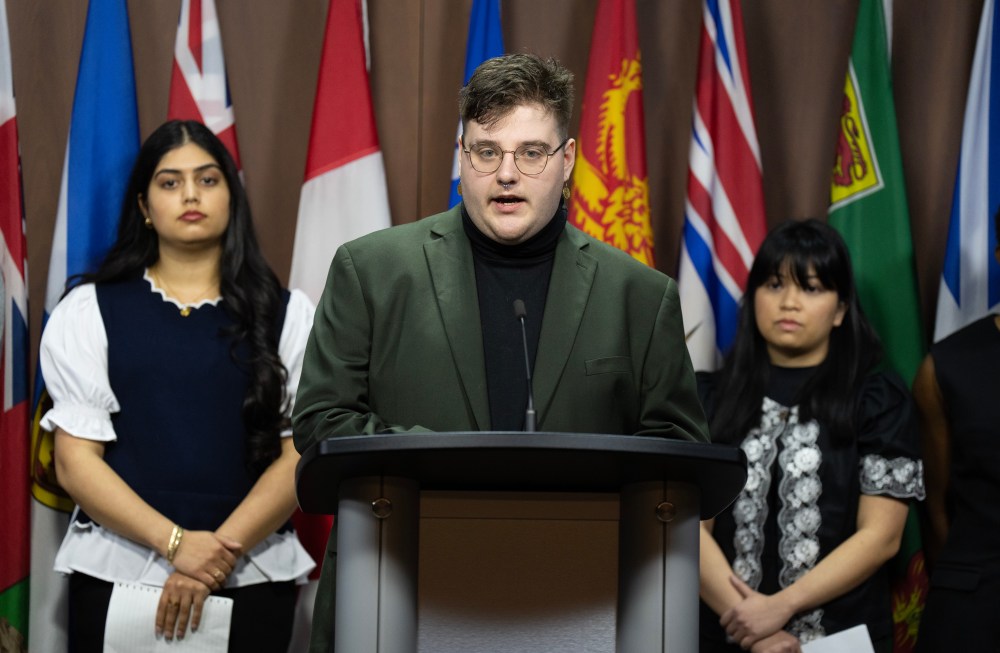
Vetsch said Wednesday one of the measures youth advocates want to see introduced is a “statutory duty of care requiring platforms to assess and prevent harm.”
Some countries have moved to ban social media use for some teens. Australia was the first country to implement a ban for kids under 16 in December, and France is set to follow with a ban for children under 15. Other nations are considering similar measures.
Vetsch said the group wants to take steps to protect youth online, but those age-restriction measures are more about policing the internet than protecting young people.
“There is absolutely no interaction with youth on the matter. They do not get to share their stories with people in power, and … they are not able to be heard and be recognized,” Vetsch said.
This report by The Canadian Press was first published Feb. 18, 2026.