
Bates calls task force ‘a big step forward’ for police
Advertisement
Read this article for free:
or
Already have an account? Log in here »
We need your support!
Local journalism needs your support!
As we navigate through unprecedented times, our journalists are working harder than ever to bring you the latest local updates to keep you safe and informed.
Now, more than ever, we need your support.
Starting at $15.99 plus taxes every four weeks you can access your Brandon Sun online and full access to all content as it appears on our website.
Subscribe Nowor call circulation directly at (204) 727-0527.
Your pledge helps to ensure we provide the news that matters most to your community!
To continue reading, please subscribe:
Add Brandon Sun access to your Free Press subscription for only an additional
$1 for the first 4 weeks*
*Your next subscription payment will increase by $1.00 and you will be charged $20.00 plus GST for four weeks. After four weeks, your payment will increase to $24.00 plus GST every four weeks.
Read unlimited articles for free today:
or
Already have an account? Log in here »
A new joint task force aimed at clamping down on drug trafficking across the province will help ensure police departments don’t “operate in silos,” Brandon’s police chief says.
“It denotes the expectation that we’re working on common priorities, that we’re sharing resources and sharing technologies, and that we’re not impeded by jurisdictional boundaries that perhaps sometimes we get trapped in,” Brandon Police Service Chief Tyler Bates told the Sun on Thursday.
Manitoba’s Justice Minister Matt Wiebe announced the formation of the task force at a news conference on Wednesday.
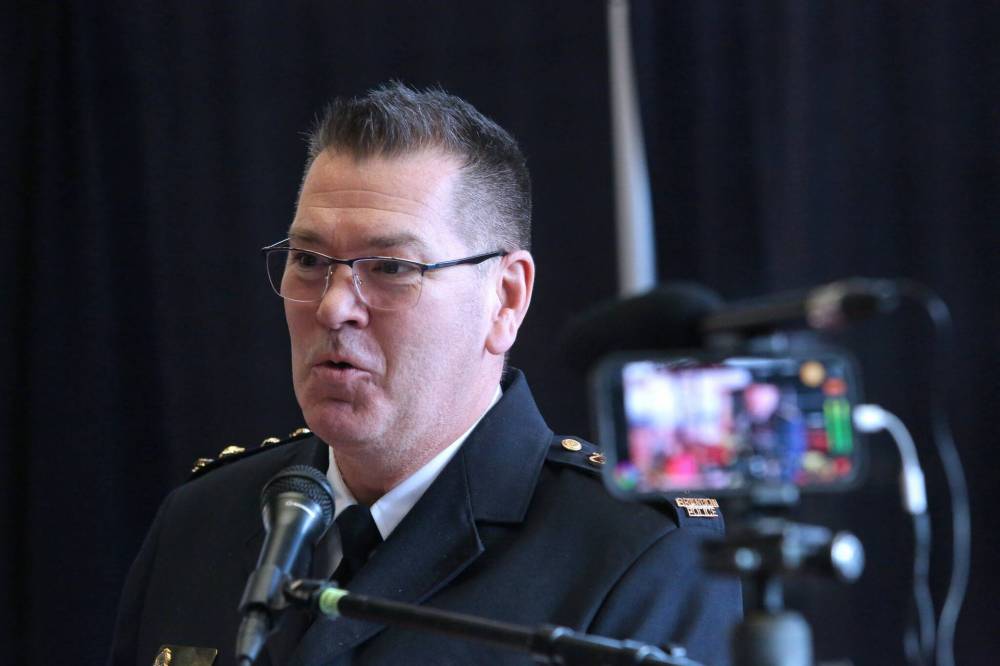
Brandon Police Service Chief Tyler Bates speaks during a press conference in the foyer of Brandon City Hall earlier this year. (Matt Goerzen/The Brandon Sun files)
The Organized Crime and Drug Trafficking Task Force is made up of senior officials from Manitoba Justice, RCMP, Canadian Border Services Agency, Manitoba Criminal Intelligence Centre, Brandon Police Service, Manitoba First Nations Police Service and Altona, Winkler and Morden police services.
Bates said while there are intelligence committees that senior leaders of police agencies participate in to share information, it’s meaningful to have the provincial government set up a task force.
“It just goes one step further to formalize that into a task force whereby there’s expected deliverables and initiatives that we’re working together on,” he said.
It’s important for police agencies not to focus only on the areas they are responsible for, Bates said, because the people involved in organized crime or drug trafficking aren’t restricted by geographical boundaries.
“They operate across our province, across our nation, and even are interconnected internationally as well,” he said. “The reality is that someone … could be selling illicit substances in Winnipeg one day and Brandon the next.”
By having decision-makers meet regularly, it ensures that they are aligned in terms of priorities and best practices.
He said in the first meeting, which took place after the announcement on Wednesday, it was evident that drug addiction “hits close to home for everybody.”
“We see the death, we see the misery in all of our communities as it pertains to drug addiction.”
In 2025, Brandon police received 171 drug calls for service and laid 67 charges for possession of an illicit substance for the purpose of trafficking, according to BPS. Police seized 1,979 grams of methamphetamine and 2,147 grams of cocaine in the same time frame.
While there was a 98 per cent decrease in methamphetamine seized and a 64 per cent decrease in cocaine seized compared to 2024, Bates said “individual large seizures” of both drugs in 2024 contributed to the volumes seized in 2021.
Last year, there were 46 apparent overdoses and five apparent overdose deaths in Brandon, according to BPS. Bates noted the numbers could change as BPS receives autopsy reports, which usually take several months.
While this is down from 52 apparent overdoses and 11 apparent overdose deaths in 2024, it doesn’t necessarily mean things are getting better, Bates said.
“Sometimes it’s gratuitous … there’s some close calls that don’t result in fatality and result in a medical emergency instead,” he said. “The volumes are still way beyond where we would want to see them.”
Bates said the effectiveness of the task force will be assessed by the level of “interoperability” between agencies.
“(It’s) definitely a big step forward beyond just intelligence sharing,” he said. “I know I’m not alone amongst my colleagues in being excited about the direction this might go.”
» sanderson@brandonsun.com