
Carney looks to strengthen economic ties with India on trip to Mumbai, New Delhi
Advertisement
Read this article for free:
or
Already have an account? Log in here »
We need your support!
Local journalism needs your support!
As we navigate through unprecedented times, our journalists are working harder than ever to bring you the latest local updates to keep you safe and informed.
Now, more than ever, we need your support.
Starting at $15.99 plus taxes every four weeks you can access your Brandon Sun online and full access to all content as it appears on our website.
Subscribe Nowor call circulation directly at (204) 727-0527.
Your pledge helps to ensure we provide the news that matters most to your community!
To continue reading, please subscribe:
Add Brandon Sun access to your Free Press subscription for only an additional
$1 for the first 4 weeks*
*Your next subscription payment will increase by $1.00 and you will be charged $20.00 plus GST for four weeks. After four weeks, your payment will increase to $24.00 plus GST every four weeks.
Read unlimited articles for free today:
or
Already have an account? Log in here »
MUMBAI – Prime Minister Mark Carney landed in India on Friday to start a four-day visit hoping to continue the reset of the trade and diplomatic relationship he started last spring with Prime Minister Narendra Modi’s government.
But the issue of whether India is still engaged in the kind of foreign interference that led to a diplomatic crisis between the two countries in the past two years is threatening to overshadow the economic goals of the trip.
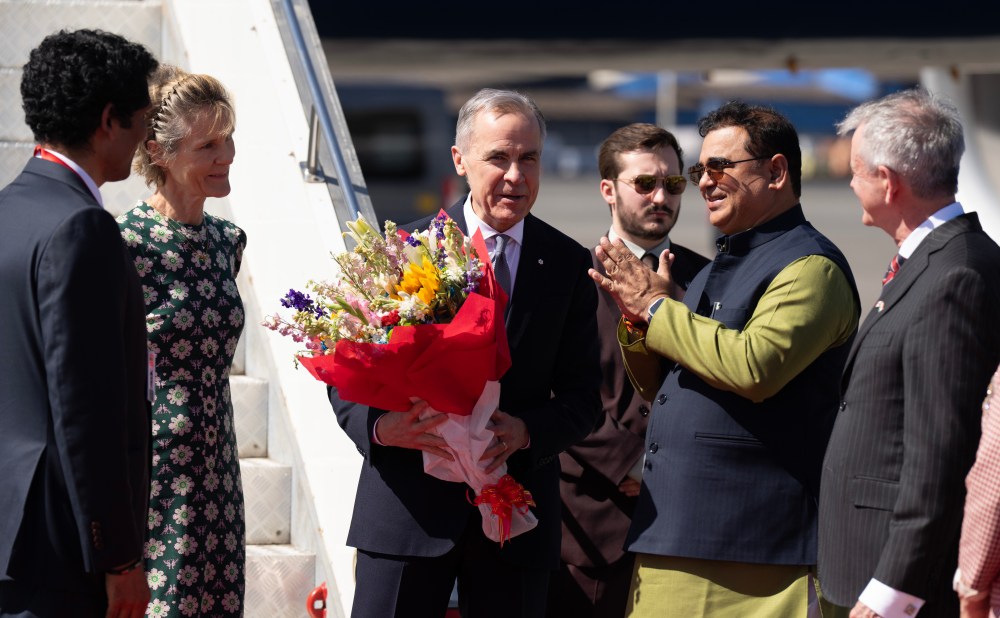
Upon arriving at the Mumbai airport, Carney and his wife, Diana Fox Carney, were given a red-carpet welcome by a delegations of government officials and the high commissioners for both countries.
His first meeting was with Natarajan Chandrasekaran, chairman of the Tata Group, the largest multinational conglomerate in India.
Carney will spend two days in Mumbai, mainly in business meetings, before flying to New Delhi on March 1, where he will meet with Modi.
Carney and Modi are each looking to decrease their countries’ dependence on trade with the United States under President Donald Trump.
“Both for India and for Canada, the big picture is one of diversification and reducing overreliance on the U.S.,” Asia Pacific Foundation vice-president Vina Nadjibulla said in an interview ahead of the trip.
“There is definitely sort of a Trump accelerator in play here, because both sides are moving quicker than they have in the past when it comes to forging partnerships and making deals.”
Since becoming prime minister, Carney has been criss-crossing the globe in an effort to strengthen relations with other countries. His speech to the World Economic Forum in Switzerland last month — in which he urged middle powers to work together to counter great power coercion — earned headlines around the world.
Modi recently signed one of the largest trade deals in history. India’s trade pact with the European Union covers roughly two billion people.
“The same logic as what is driving Prime Minister Carney is also driving Prime Minister Modi,” said Sushant Singh, a lecturer on South Asian Studies at Yale University.
Canada and India are working to rebuild a diplomatic relationship that came to a screeching halt in recent years over accusations about India’s involvement in acts of violence and intimidation targeting Canadian Sikhs.
There have been tensions in the bilateral relationship for decades over the activities of Sikh separatists in Canada who call for the creation of an independent country, to be called Khalistan, out of India’s Punjab region.
India has long accused Canada of not doing enough to quiet the separatist movement, while Canada has defended the freedom of those to express themselves while condemning any violence.
Those tensions clouded then prime minister Justin Trudeau’s first visit to India in 2018, but erupted into a full blown diplomatic dispute in September 2023 when Trudeau said Canada had evidence linking Indian government agents to the murder of Canadian Sikh activist in British Columbia.
In 2024, the RCMP said there was evidence of a wider campaign of intimidation and violence by agents with links to the Indian government, and expelled the high commissioner and five diplomats when they would not co-operate in the investigations.
India also expelled Canadian diplomats.
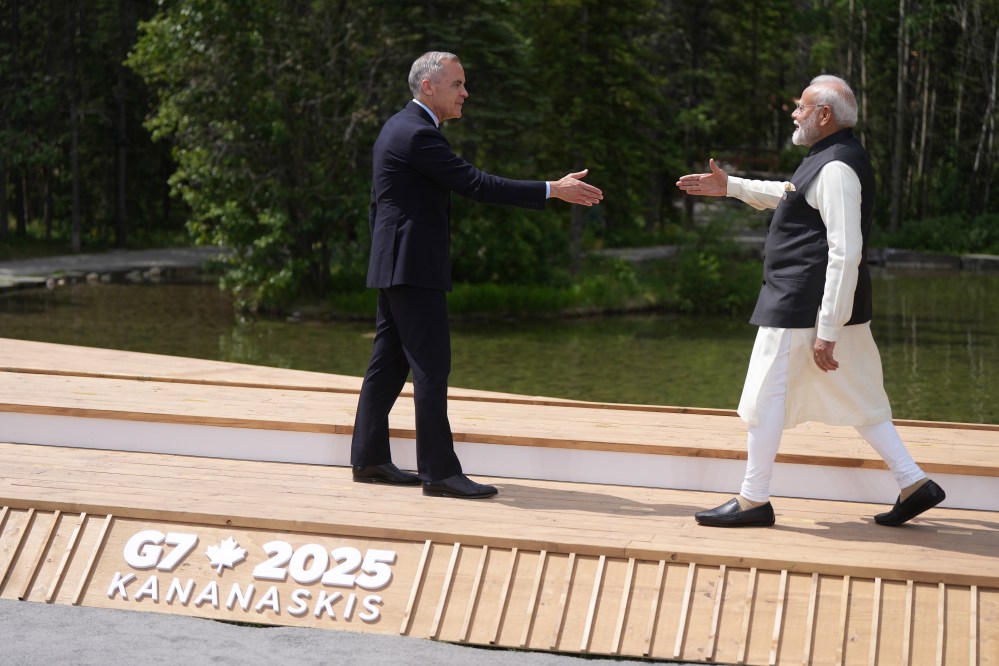
Carney made the first move to restore ties last spring, inviting Modi to the G7 summit in Alberta in June, where the two agreed to reappoint high commissioners. The two met again at the G20 summit in November, where they agreed to launch formal trade talks to cover a wide range of goods and services, including agriculture and agri-food, digital trade, mobility, and sustainable development.
Canada and India have established processes between law enforcement in both countries to investigate criminal allegations, completely apart from other diplomatic or trade discussions.
But those moves and this trip are causing some anger and frustration in Canada, including among some members of Carney’s own Liberal caucus. B.C. Liberal MP Sukh Dhaliwal criticized Carney’s decision to invite Modi to the G7 last year. This week he denounced comments made by a federal official that Carney would not be making this trip if Canada still believed agents of the Indian government were involved in extortion or threats of violence in Canada.
A spokesperson for the prime minister did not answer questions about whether Carney agrees with the official’s assessment or whether the official is on the trip.
“As the prime minister has said, Canada will continue to take measures to combat any forms of transnational repression, transnational organized crime, and any contravention of the Criminal Code or rule of law on Canadian soil,” Audrey Champoux said in a statement.
“Respect for the ongoing law enforcement dialogue will continue to be the basis of our step-by-step approach to re-engagement with India.”
The premiers of Saskatchewan and New Brunswick, who are in India with Carney, both seemed to hope the discussions about security would not overshadow efforts to improve trade.
Saskatchewan Premier Scott Moe said moving forward on trade talks and advocating for India to remove tariffs on pulses, particularly on peas and lentils, would be his priorities.
“We will have disagreements with various countries around the world that we still aspire to trade with, and even where those disagreements are (present), it’s important for us to not leave the conversation,” Moe said.
India introduced a 30 per cent tariff on pea imports last year. In 2025, Canadian exports of peas and lentils to India plummeted compared with the same period in 2024.
“We do have a pulse tariff currently that we’d looking to, hopefully be removed at some point in time,” Moe said in a scrum with reporters shortly after arriving in India.
Nadjibulla said the two countries have been working on the relationship through multiple meetings between their foreign ministers.
“When they met in October in Delhi, they launched a road map for rebuilding and resetting the relationship that has specific areas for co-operation, AI and technology being one of them, energy being another,” she noted.
India’s envoy to Ottawa, High Commissioner Dinesh Patnaik, said in an interview that there have been multiple visits and a lot of interaction among Indian and Canadian parliamentarians, ministers, senior bureaucrats and diplomats.
“This is solidifying what is already present. We have so much good happening,” he said of Carney’s visit.
Carney’s trip to India starts with a large part of the preparatory work already completed, Nadjibulla said. While Beijing and Ottawa launched various talks and agreements after Carney’s trip to China in January, the prime minister is heading to New Delhi with substantial work already underway, she said.
But Canada has ground to make up, Nadjibulla said, noting that during the diplomatic crisis of the past two years, India has signed strategic economic partnership agreements with the other G7 countries.
“We have to now make up for that lost time and really put forward an agenda that will set us up for a 20-year kind of partnership. The time horizon has to be multi-decade,” she said.
But Sushant warned that while Trump has brought the two countries closer together, things could change once the president is no longer in power.
“Unless intrinsically two countries believe that they can align and work together, but instead are being driven only by external factors or one single leader, once that leader is not there or once things change, then this relationship could again go down south,” he said.
This report by The Canadian Press was first published Feb. 27, 2026.