
Foreign Affairs Minister Anand says NATO must turn its focus to the North
Advertisement
Read this article for free:
or
Already have an account? Log in here »
We need your support!
Local journalism needs your support!
As we navigate through unprecedented times, our journalists are working harder than ever to bring you the latest local updates to keep you safe and informed.
Now, more than ever, we need your support.
Starting at $15.99 plus taxes every four weeks you can access your Brandon Sun online and full access to all content as it appears on our website.
Subscribe Nowor call circulation directly at (204) 727-0527.
Your pledge helps to ensure we provide the news that matters most to your community!
To continue reading, please subscribe:
Add Brandon Sun access to your Free Press subscription for only an additional
$1 for the first 4 weeks*
*Your next subscription payment will increase by $1.00 and you will be charged $20.00 plus GST for four weeks. After four weeks, your payment will increase to $24.00 plus GST every four weeks.
Read unlimited articles for free today:
or
Already have an account? Log in here »
OTTAWA – Foreign Affairs Minister Anita Anand touted Canada’s new commitment to defence spending and the domestic defence sector and called for a NATO policy pivot to the Arctic at a major defence and security conference in Ottawa on Wednesday.
“We’re reaching two per cent of GDP this year and five per cent of GDP by 2035,” she said, referring to the NATO alliance’s commitment to spend the equivalent of five per cent of GDP on defence within a decade.
That updated target was pushed by U.S. President Donald Trump, who has accused other allies of freeloading on the United States. European countries in NATO have also moved to quickly re-arm as Russia’s full-scale invasion of Ukraine continues.
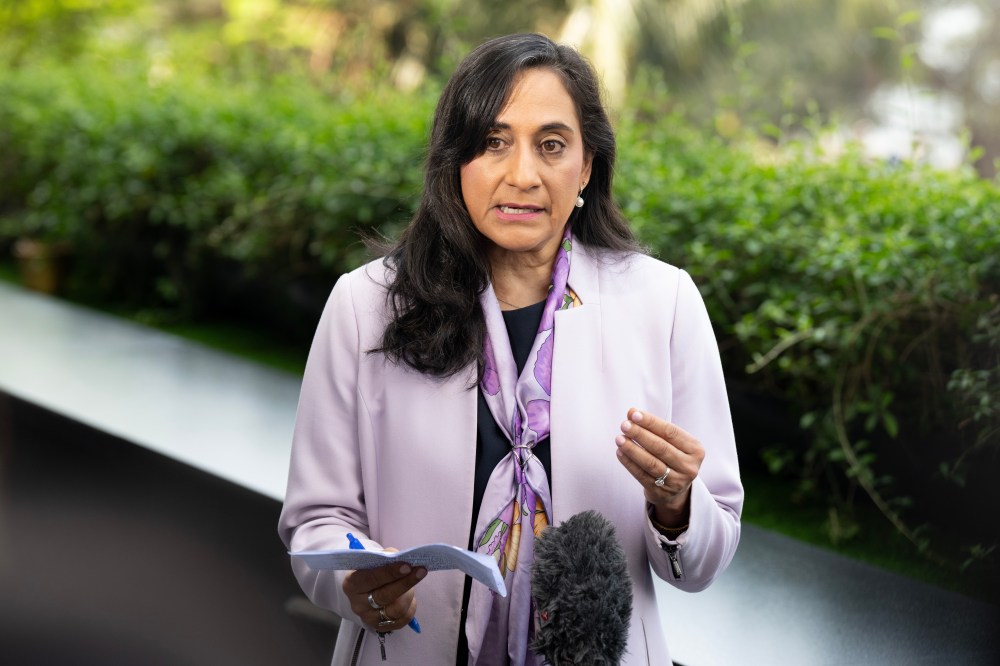
At the same time, Anand said, the alliance needs to shift its focus to the North.
“Last August, I raised the point about ensuring that NATO has efforts that are geared towards Arctic security and protection, and my foreign minister colleagues around that table, the Nordic Five, agreed with me wholeheartedly,” she said.
The Nordic Five includes Denmark, Iceland, Norway, Finland and Sweden — the latter two countries being the newest members of NATO.
Anand said Canada wants to see a NATO Arctic strategy that is more comprehensive than the Arctic Sentry mission launched earlier this year, and that includes a permanent presence in the region.
She said she planned to discuss the topic with NATO Secretary-General Mark Rutte later in the day.
The Conference of Defence Associations Institute’s annual conference is focused this year on how NATO allies will fulfil their pledge to reach the 2035 spending commitment.
Former defence minister Bill Blair told the same conference two years ago that the military was in a recruitment “death spiral.”
Participants in a panel discussion at the conference on Wednesday said the military has made some progress with recruitment, thanks in part to higher wages and recruitment bonuses introduced by the government this year.
Stéfanie von Hlatky, a professor of political studies at Queen’s University, warned that while Canada’s spending commitments “assume that we can grow and sustain the Armed Forces now and over the long term,” there are still major recruitment and retention challenges.
Maj.-Gen. J.J. Major, the Armed Forces’ chief of staff for plans, policy and modernization, said there are now more people applying to join the military than there are open positions.
“Though it is longer, I think, than anybody would still like it to be, we have improved the processing time by about a month,” he said.
Anand, who was defence minister before Blair, told the crowd Wednesday that she “stood on this stage in 2023 indicating that our commitment to NATO, two per cent, was of the utmost importance.”
The Liberal government at the time had no plan to get to its NATO spending target.
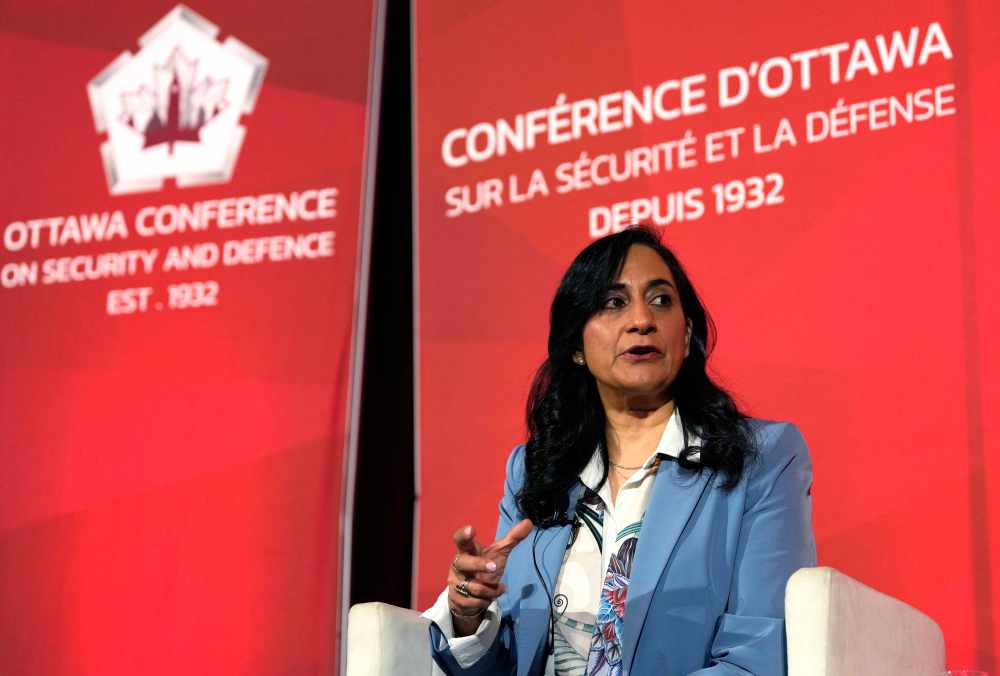
Prime Minister Mark Carney’s government recently released a defence industrial strategy — something Blair began work on during his time as minister — that sets out a plan to boost domestic defence production.
Anand said governments have long considered defence and security separate from economic growth, but that is no longer the case.
“The defence industrial strategy is about activating the small and medium-size enterprises in this country, as well as larger corporations,” she said.
Conference participants watched a panel discussion Wednesday about Canada’s role in the Indo-Pacific moderated by Vincent Rigby, a former national security and intelligence adviser to prime minister Justin Trudeau.
Rigby said Canada has been struggling to find its way in the Indo-Pacific region for the last several years, even after the release of a regional strategy in 2022.
Carney’s efforts to improve relations with China — which his government now describes as a “strategic partner” — are seemingly at odds with the 2022 strategy document, which frames China as an increasingly disruptive global power.
The panellists agreed Canada likely needs to refresh that strategy — which was meant to cover a 10-year period — and should link it to the Arctic and Europe.
“It ain’t going to be easy,” Rigby said.
“It’s going to be testing the prime minister’s pragmatic diplomacy when it comes to countries like China and India and — dare I say as well — the United States.”
This report by The Canadian Press was first published March 4, 2026.