
Fuel prices may have ripple effect: Chamber
Advertisement
Read this article for free:
or
Already have an account? Log in here »
We need your support!
Local journalism needs your support!
As we navigate through unprecedented times, our journalists are working harder than ever to bring you the latest local updates to keep you safe and informed.
Now, more than ever, we need your support.
Starting at $15.99 plus taxes every four weeks you can access your Brandon Sun online and full access to all content as it appears on our website.
Subscribe Nowor call circulation directly at (204) 727-0527.
Your pledge helps to ensure we provide the news that matters most to your community!
To continue reading, please subscribe:
Add Brandon Sun access to your Free Press subscription for only an additional
$1 for the first 4 weeks*
*Your next subscription payment will increase by $1.00 and you will be charged $20.00 plus GST for four weeks. After four weeks, your payment will increase to $24.00 plus GST every four weeks.
Read unlimited articles for free today:
or
Already have an account? Log in here »
Rising gasoline and diesel prices in Brandon could eventually push up the cost of groceries and other everyday goods, according to the Brandon Chamber of Commerce.
Diesel prices in Brandon reached as high as 189.9 cents per litre on Saturday, while some stations listed regular gasoline at 144.9 cents per litre.
That represents a sharp increase from January, when gas prices in Manitoba were among the lowest in the country. At the time, stations were charging roughly 146.3 cents per litre for diesel, while regular fuel was sold for 119 cents per litre across the province, according to Statistics Canada’s website.
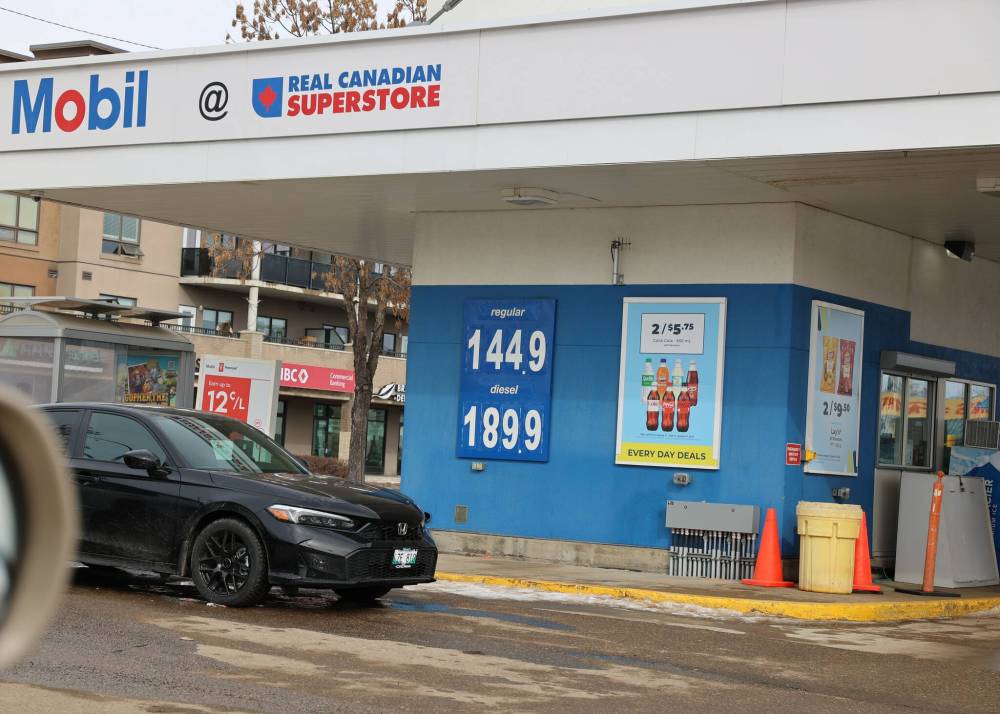
The Mobil gas station on Victoria Avenue displays its diesel and regular fuel prices on Saturday. (Abiola Odutola/The Brandon Sun)
The increase is not limited to Manitoba. Across Western Canada, fuel prices have climbed as well. On Saturday, diesel prices in Alberta were reported as high as 190.9 cents per litre, while regular gasoline reached 152.9 cents. In Regina, Sask., diesel prices were as high as 177.9 cents, with regular fuel selling for 149.9 cents per litre.
Rising fuel costs could eventually lead to higher prices for everyday goods, Chamber president Jennifer Ludwig told the Sun.
“When there is an increase in price in the supply chain, consumers will inevitably end up seeing a price increase at some point in time,” Ludwig said. “Retailers in all industries work very hard to manage their costs to keep prices as reasonable as possible for their customers. However, there is only so much that a business can do before having to pass some of those increased costs on to the customer.”
She said businesses are also facing other economic uncertainties.
“This is yet another thing that businesses are having to manage, on top of the turmoil of tariffs and international trade,” Ludwig said. “Business owners are very good at pivoting and problem-solving, but there comes a time when we all just hope for some stability going forward.”
She said if higher fuel prices remain in place for a long period, delivery and transportation costs will likely increase for many businesses.
For residents, higher fuel costs could add to the challenge of managing everyday expenses, she said.
Ludwig said households in Brandon are already stretching their budgets to keep up with rising costs.
“Just like businesses, the people of Brandon are figuring out how to make their hard-earned money stretch that much further,” she said.
Ludwig said that some residents may begin adjusting their travel habits to cope with the higher prices.
“In light of increased fuel costs, residents may turn to alternate methods of travel — walking, carpooling or public transportation if available.”
Broader global factors are influencing prices, said Viet Vu, manager of economic research at the Dais think tank at Toronto Metropolitan University.

Brandon Chamber of Commerce president Jennifer Ludwig says when there is a price increase somewhere in the supply chain, it is inevitable that consumers will also end up seeing a price increase at some point in time. (Abiola Odutola/The Brandon Sun)
Vu said energy markets operate on a global scale, meaning disruptions anywhere in the world can quickly affect prices in Canada.
“It’s not the fact that there is a separate market with separate prices in the Middle East compared to North America,” Vu said. “Oftentimes, there’s a single world price that almost every single producer and every single buyer of oil are subjected to.”
Vu said that conflict in the Middle East is creating uncertainty in global oil supply. Ships carrying roughly 20 million barrels of oil per day have been stranded in the Persian Gulf due to threats to vessels attempting to pass through the Strait of Hormuz, a key shipping route for global oil exports.
He said any prolonged disruption could push prices higher if supply to the global market is reduced.
Still, Vu described the current increases as relatively moderate compared with past spikes.
“Historically speaking, it’s certainly higher than last week, and it’s higher than how we ended the year,” he said. Vu said drivers in Toronto are paying about $1.52 per litre, which remains below the roughly $1.80 per litre seen during price surges about two years ago.
» aodutola@brandonsun.com, with files from The Canadian Press
» X: @AbiolaOdutola