
Leaked documents reveal ‘mind-blowing’ truancy rates
Advertisement
Read this article for free:
or
Already have an account? Log in here »
We need your support!
Local journalism needs your support!
As we navigate through unprecedented times, our journalists are working harder than ever to bring you the latest local updates to keep you safe and informed.
Now, more than ever, we need your support.
Starting at $15.99 plus taxes every four weeks you can access your Brandon Sun online and full access to all content as it appears on our website.
Subscribe Nowor call circulation directly at (204) 727-0527.
Your pledge helps to ensure we provide the news that matters most to your community!
To continue reading, please subscribe:
Add Brandon Sun access to your Free Press subscription for only an additional
$1 for the first 4 weeks*
*Your next subscription payment will increase by $1.00 and you will be charged $20.00 plus GST for four weeks. After four weeks, your payment will increase to $24.00 plus GST every four weeks.
Read unlimited articles for free today:
or
Already have an account? Log in here »
WINNIPEG — More than 15,000 students — including six in 10 children and youth in one Manitoba school division — were chronically absent from class in 2023-24.
Leaked government documents expose the troubling state of truancy in elementary and high schools across the province.
“Unbelievable” and “mind-blowing” were among the descriptors that came to mind for Kent Dueck when he saw the data, which an ex-NDP MLA obtained and made public on Wednesday.
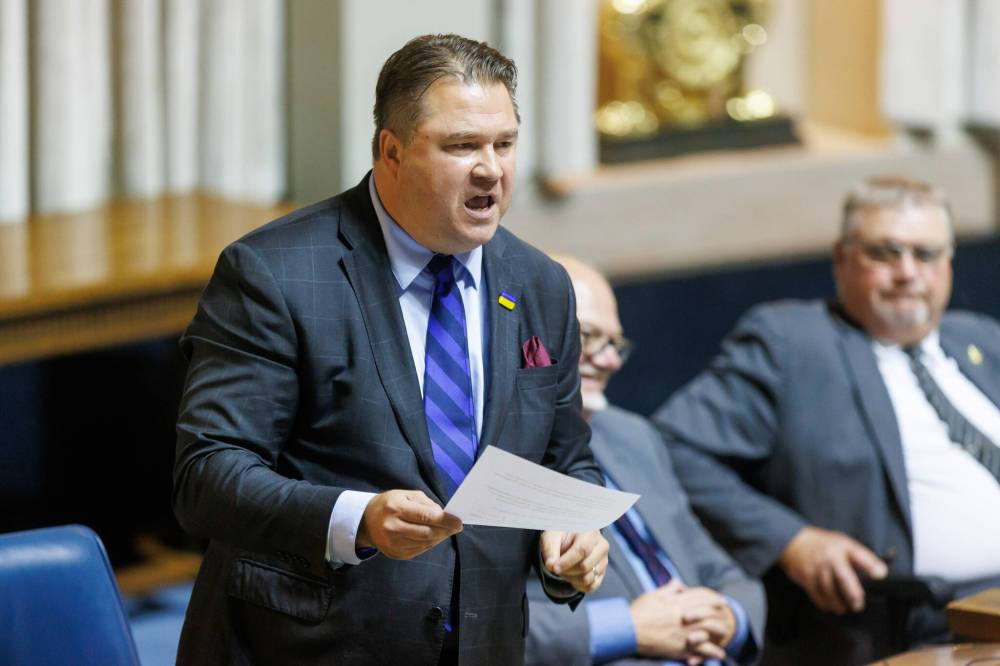
Independent MLA Mark Wasyliw speaks in the Manitoba legislature. He accused the NDP government of covering up student absenteeism data. (Mike Deal/Winnipeg Free Press files)
Dueck, the executive director of Inner City Youth Alive, has spent more than a decade advocating for interventions to address absenteeism in Winnipeg.
“This should force us into action on the issue,” he said. “Now that it’s out in the open and everybody knows, I think we’re in a much better position — at least we can start to generate solutions and rethink our model.”
Independent MLA Mark Wasyliw raised the issue in the legislature Wednesday and tabled a stack of related documents.
Wasyliw, a former school trustee, was the education minister’s legislative assistant before he was kicked out of the NDP caucus in September 2024.
During question period, he accused the government of a “coverup” based on its rejection of a freedom-of-information request he filed over the summer and a leaked dataset that contradicts it.
The province denied Wasyliw’s request for chronic absenteeism data on the grounds the department of education “does not collect (it).”
A document he obtained from a senior government official suggests otherwise. The internal briefing note, which is dated July 26, 2024, includes a breakdown of “severe chronic absenteeism” across Manitoba’s 37 public school divisions in 2023-24.
The province defines severe chronic absenteeism as an elementary student missing 20 per cent of classes during a reporting period. At the high school level, a student is flagged if they have 20 or more unexcused absences in a core course.
Eight per cent of kindergarten-to-Grade 12 students in the province met those thresholds in 2023-24, the first year the province began systematically collecting data.
In northern Manitoba’s Frontier School Division, that figure was 60 per cent.
More than 20 per cent of the respective student populations in Kelsey (The Pas), Turtle River (McCreary) and Mystery Lake (Thompson) schools were regularly absent.
Seven other school divisions said severe chronic absenteeism was a problem for at least 10 per cent of their students. They include Flin Flon, Brandon, Park West (Birtle), Portage la Prairie, Pine Creek, Swan Valley (Swan River) and Winnipeg.
Indigenous students are disproportionately represented in these groups in all corners of the province.
Students who self-identify as First Nations, Métis or Inuit accounted for 64 per cent of K-8 students and 58 per cent of high schoolers with severe chronic absenteeism.
Among elementary schoolers, that figure surpassed 80 per cent in Winnipeg, Swan Valley, Seven Oaks, Portage la Prairie, Mystery Lake, Kelsey and Flin Flon.
“These are children that we’re writing off … The government’s known about this since 2024 and you would think, with these kind of numbers, there’d be some urgency,” said Wasyliw, who served on the Winnipeg School Division’s board of trustees between 2011 and 2019.
Dueck and Wasyliw are both proponents of increasing school outreach teams and tackling absenteeism on a case-by-case basis.
Inner City Youth Alive runs a shuttle program, staffed by community members, to reduce barriers to getting to class. Its employees also help students design re-integration plans.
Retired superintendent Reg Klassen said resources need to be put into early years instruction so students don’t fall behind and feel embarrassed — one of many reasons they stop showing up to school.
“Reading is huge because if kids can’t read at a Grade 3, Grade 4, Grade 5 level and can’t understand content, now they’re behind and they know it,” said Klassen, who oversaw schools in northern Manitoba until 2024.
Education Minister Tracy Schmidt defended the province’s decision not to release data about chronic absenteeism and would not commit to publishing figures in the future.
“Data in decision-making is very, very important but we have to balance that with our concern about not stigmatizing any particular community or school division,” Schmidt said.
The minister called the NDP’s $30-million annual commitment to supporting school nutrition programs “the biggest investment towards tackling absenteeism that’s ever been made in this province.”
Her office is developing an initiative, dubbed “Reach Out, Reach Up,” to better track schoolchildren.
» Winnipeg Free Press