
City eyes council pay raise, cutting seats
Advertisement
Read this article for free:
or
Already have an account? Log in here »
We need your support!
Local journalism needs your support!
As we navigate through unprecedented times, our journalists are working harder than ever to bring you the latest local updates to keep you safe and informed.
Now, more than ever, we need your support.
Starting at $15.99 plus taxes every four weeks you can access your Brandon Sun online and full access to all content as it appears on our website.
Subscribe Nowor call circulation directly at (204) 727-0527.
Your pledge helps to ensure we provide the news that matters most to your community!
To continue reading, please subscribe:
Add Brandon Sun access to your Free Press subscription for only an additional
$1 for the first 4 weeks*
*Your next subscription payment will increase by $1.00 and you will be charged $20.00 plus GST for four weeks. After four weeks, your payment will increase to $24.00 plus GST every four weeks.
Read unlimited articles for free today:
or
Already have an account? Log in here »
Brandon City Council on Monday agreed to schedule a special meeting to discuss whether to increase pay for council members, reduce their number and change the city’s ward system.
Administration at Monday’s council meeting presented 12 recommendations that included:
• Instituting annual pay raises for council members, increasing their per diems and raising their personal vehicle compensation.
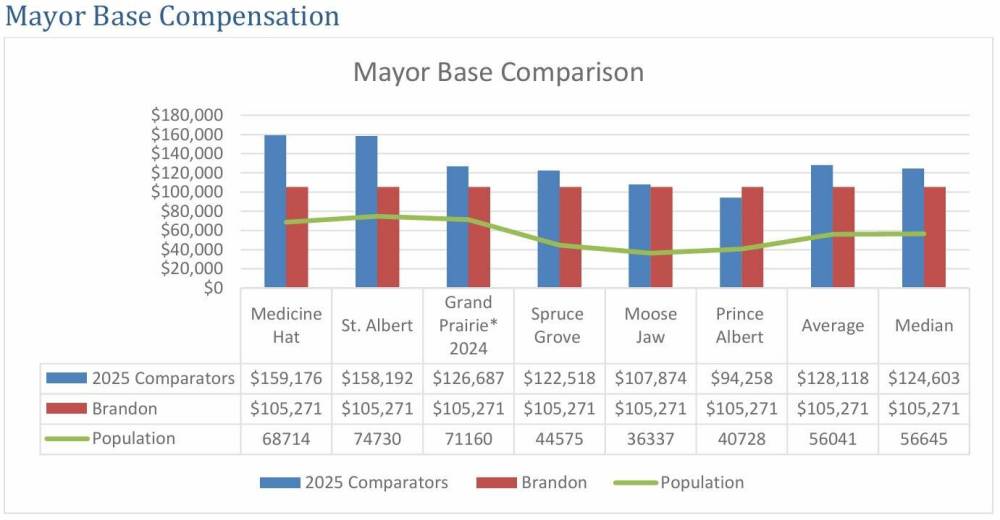
A graphic compares the base salary of Brandon's mayor with six other cities in Alberta and Saskatchewan. Brandon's mayor received the second lowest salary of the seven cities. (City of Brandon)
• Lowering the number of council members from 11 to nine and reducing the number of wards from 10 to four. The recommended change would mean having two councillors per ward for a total of eight councillors, plus the mayor.
• Increasing the mayor’s salary by three per cent every year until 2030 and setting councillor salaries at 30 per cent of the mayor’s salary.
The recommendations were based on a review carried out by administration that compared Brandon to six cities of similar size in Alberta and Saskatchewan.
The review found that the salary of Brandon’s mayor was the second lowest of all the cities.
The mayor’s base salary in Brandon last year sat at $105,271. Other cities ranged from $94,258 to $159,176.
Councillors in Brandon were paid the lowest of the seven cities, though Brandon had the most councillors with 10. Other cities had six or eight councillors each, plus a mayor.
Last year, councillors in Brandon had base salaries of $24,533. The salaries of councillors in other cities ranged from $31,671 to $86,000.
The populations of the cities ranged between 36,337 and 74,730. Brandon has a population of 59,444, according to the report. The base salaries were largely relative to the populations of the cities.
Council requested administration undertake the review in November after some councillors raised concerns over the rising level of work they had to do in relation to how much money they took home.
Six of 11 council members also answered a city poll based on their compensation.
Five of the six respondents said their compensation is either somewhat unfair or very unfair, while one respondent was neutral. Four of the six who answered also said the compensation they receive does not reflect their responsibilities.
Mayor Jeff Fawcett said before the meeting started that it’s a good discussion to have around the council table.
The solution he wants to see is one that gets the most people to feel they have an opportunity to run, he said.
He said he likes the idea of tying salaries to a percentage of provincial cabinet and MLA salaries, which is something already being done for the mayor in Prince Albert, Sask.
City manager Dave Wardrop said administration understands the sensitivity around salary increases.
“The recommendations that are being brought forward really represent the minimum level of increase that administration feels as appropriate,” Wardrop said.
“By undervaluing its compensation structure, it really doesn’t do the community a favour in the long run,” he added. “I think it’s important that people understand that to have a viable, capable, competent council, you need to recognize that role.”
Administration recommended shrinking the size of Brandon’s council because it is larger than all comparable cities.
It said that workload for members wouldn’t significantly change with the shift, and that smaller councils often have more efficient deliberations, along with better strategic planning, committee structures and debate.
The report said that council meetings could be shorter with fewer members. A further reduction to seven members would “offer an even more streamlined governance model,” and could also be considered.
Renee Sigurdson, the city’s director of legislative services, said the cities that were looked at aren’t an “apples to apples” comparison, but they are the closest available in a similar region of the country.
“What matters is whether council remains effective, representative and capable of timely decision-making as the city grows. In some circumstances, a smaller council can improve governance outcomes,” said Sigurdson, who also serves as the city clerk.
Fawcett said the system has proved to work in the past.
“Historically, (the current system) has worked, but should it get looked at and reviewed? Absolutely,” he said. “I think staff has done a good job looking at different municipalities and how they do things.
“Some would consider 10 a large council … Others may not at the table and say that it’s a growing city, but it’ll be a good discussion,” he said.
Changing the ward system, including having only four wards with two councillors in each, was recommended for a variety of reasons.
Administration’s report said at-large voting systems — where there are no wards and voters choose their preferred candidates overall — have several advantages.
The report said that the system would mean councillors are accountable to the entire city instead of just their ward; it wouldn’t create uneven representation as demographic changes happen over time in different wards; it would be similar to the Brandon School Division’s system and other small cities; it would remove confusion for voters on what ward they live in; and would remove the need to adjust ward boundaries every so often, which can be resource-intensive.
The drawbacks would mean a loss of direct representation for certain neighbourhoods, residents being unsure which councillor to reach out to with concerns, and the need for the city to ensure the workload for all councillors is balanced.
The city said the proposed two councillors per ward is being suggested to address the drawbacks.
Nearly all councillors agreed that they prefer the ward system, as it allows residents to go to a specific councillor with concerns and makes it easier to choose between candidates during elections.
Coun. Shawn Berry (Ward 7) said he’s “fearful” of going to an at-large system.
As someone who has had to pick up the slack when a nearby councillor was on leave, Berry said he’s concerned that an at-large system would mean one or a small number of councillors would be forced to take a large portion of the work.
“This type of system scares people, because that’s what can happen. I don’t know how you divide up the work fairly,” he said.
Coun. Greg Hildebrand (Ward 5) said an at-large system can make it difficult for voters to know who to vote for, especially as there are a ton of candidates vying for a relative small number of seats.
One of the recommendations was also to keep the mayor’s position full-time and councillors part-time.
If changes were to be approved, council would need to amend several bylaws.
The date of the special meeting wasn’t decided on Monday.
» alambert@brandonsun.com