
Climate group outlines megaproject concerns
Advertisement
Read this article for free:
or
Already have an account? Log in here »
We need your support!
Local journalism needs your support!
As we navigate through unprecedented times, our journalists are working harder than ever to bring you the latest local updates to keep you safe and informed.
Now, more than ever, we need your support.
Starting at $15.99 plus taxes every four weeks you can access your Brandon Sun online and full access to all content as it appears on our website.
Subscribe Nowor call circulation directly at (204) 727-0527.
Your pledge helps to ensure we provide the news that matters most to your community!
To continue reading, please subscribe:
Add Brandon Sun access to your Free Press subscription for only an additional
$1 for the first 4 weeks*
- Enjoy unlimited reading on brandonsun.com
- Read the Brandon Sun E-Edition, our digital replica newspaper
*Your next Free Press subscription payment will increase by $1.00 and you will be charged $20.95 plus GST for four weeks. After four weeks, your payment will increase to $24.95 plus GST every four weeks.
Read unlimited articles for free today:
or
Already have an account? Log in here »
Hey there, time traveller!
This article was published 21/03/2026 (194 days ago), so information in it may no longer be current.
A climate organization raised concerns over the viability of two Westman megaprojects at a Brandon event Thursday evening.
Climate Action Team Manitoba (CAT) and Sustainable Brandon hosted the event at Knox United Church to educate people about the proposed Deep Sky Manitoba project and planned upgrades to the Brandon Generating Station.
“Hopefully tonight’s presentation was a way to walk people through these discussions, sort of in a slower and more methodical way, where we can think about these as options as opposed to things that we have to do,” said James Wilt, CAT’s policy development manager.
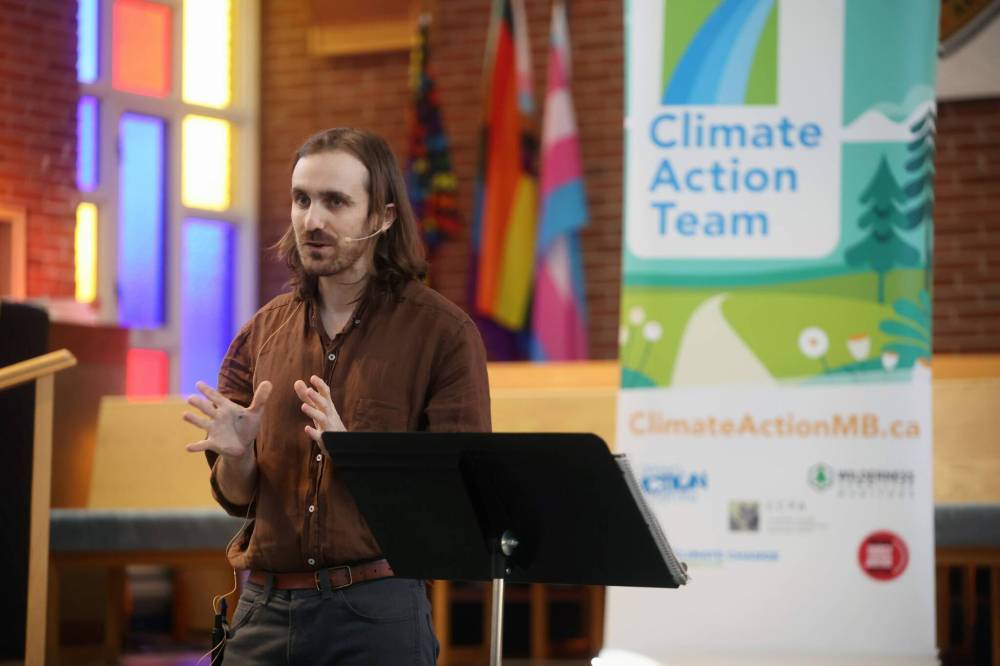
James Wilt, policy development manager with Climate Action Team Manitoba, speaks at Knox United Church on Thursday evening during an event hosted by CAT and Sustainable Brandon on the topic of new megaprojects in southwestern Manitoba. (Tim Smith/The Brandon Sun)
Manitoba Hydro is planning to build three combustion turbine units at the generating station to help power the province during peak usage times.
Minister responsible for Manitoba Hydro Adrien Sala previously told the Sun that the turbines would only be operated between two and five per cent of the year, typically during cold spells.
The cost of the project is projected at $3 billion.
CAT said it had concerns with the Hydro project based on the level of emissions and air pollution of the turbines, which would be powered with gas.
The group argued that it will be difficult for the project to become carbon-neutral; that Hydro has outdated or incorrect assumptions about wind, solar and energy storage, which could be greener alternatives; and that $3 billion is an enormous opportunity cost that could be used for something else.
The turbines will be dual-fuel and could eventually be powered by alternative fuels, like hydrogen — but CAT questioned the viability of that approach.
“We just don’t see that there’s a realistic prospect to this, and especially the size of the power plant and the amount of fuel it requires,” Wilt told the audience about the use of alternative fuels.
In response, Hydro said the upgrades and related plans were developed over the course of 18 months with thousands of hours of modelling, analysis and evaluation.
“We recognize that natural gas combustion contributes to emissions and that’s one of the reasons we use it sparingly,” a spokesperson said in a statement to the Sun on Friday.
Hydro will have a “high level of control” over the electricity that is provided to the grid, and is able to turn the turbines on and off, the statement said.
“As a result of being run only infrequently, the proposed natural gas fueled turbines in Brandon would produce relatively few emissions in a typical year.”
Alternative fuels will also be used as they become “practical and affordable,” and can also be used as a mix, the statement said.
“Manitoba Hydro is committed to a net zero electricity grid by 2035. By 2035 the combustion turbines will be either fuelled with a low carbon fuel or a blend of natural gas and a low carbon fuel, and Manitoba Hydro will purchase carbon credits to offset any remaining emissions associated with electricity generation.”
The project also prepares for the future and protects customers from major cost increases and power outages, Hydro said.
Meanwhile, carbon-capture company Deep Sky plans to build a direct air capture facility that will suck CO2 out of the air and store it deep underground.
The project, to be located in either the Rural Municipality of Pipestone or the Municipality of Two Borders, is expected to cost $200 million and store up to 500,000 tonnes of CO2 per year.
It is expected to create 100 full-time jobs, along with hundreds of construction positions, though job figures given by the company have fluctuated.
On Deep Sky, CAT’s concerns included that no large-scale proof of concept exists, the technology has extremely high costs, massive amounts of energy and water are needed to power the plant, and the technology isn’t evolving fast enough.
Another concern was that the business model relies on major companies, like airlines and tech giants, to buy credits to become carbon-neutral, essentially offsetting the emissions they’ve created.
Wilt warned of a “hype cycle” where Deep Sky might be overselling its project to garner interest before it’s ready.
“The project itself is banking on some pretty incredible future technological advances,” Wilt said.
In response to the concerns, Deep Sky’s vice-president of government affairs and public policy told the Sun that the company is looking at how the facility can be designed with renewable energy, like wind and solar.
“We take a careful, step-by-step approach to development, informed by our experience advancing carbon removal projects and shaped by best-practice guidelines,” Jason Vanderheyden said in an email Friday. “We see opportunities to support local jobs, partnerships and investment in the region.”
He said Deep Sky’s approach is committed to listening and being transparent with the community, and “taking the time to get this right.”
“Carbon removal is about safely removing excess carbon dioxide that is already in the atmosphere and storing it deep underground,” Vanderheyden said. “Alongside reducing new emissions, it is a key part of how we work to support long-term environmental outcomes.”
Wilt said he would like to see the provincial government pause the current plans for both projects in order to more closely evaluate what the best proposals are.
“In the case of Hydro, we don’t think that they are looking at alternatives closely enough or with the actual sort of genuine interest that we think is required,” he said after the meeting.
“And with Deep Sky, we are concerned that they are overselling the promise of their technology, and so we just really think that it’s incumbent on the province and the regulators to be asking these hard questions and trying to ensure that whatever decisions they make is genuine and in the public interest.”
He said through public events and speaking with the government, that slow progress is being made.
He also encouraged people to give feedback to Hydro and Deep Sky, their elected officials and their neighbours about the project.
“The nature of these discussions can be overwhelming and can be very technical, and it can be hard for people to get a strong sense of what is actually needed versus what we’re being told that we need,” Wilt said.
» alambert@brandonsun.com