
Brandon paramedics flag ‘catastrophic’ change
Advertisement
Read this article for free:
or
Already have an account? Log in here »
We need your support!
Local journalism needs your support!
As we navigate through unprecedented times, our journalists are working harder than ever to bring you the latest local updates to keep you safe and informed.
Now, more than ever, we need your support.
Starting at $15.99 plus taxes every four weeks you can access your Brandon Sun online and full access to all content as it appears on our website.
Subscribe Nowor call circulation directly at (204) 727-0527.
Your pledge helps to ensure we provide the news that matters most to your community!
To continue reading, please subscribe:
Add Brandon Sun access to your Free Press subscription for only an additional
$1 for the first 4 weeks*
- Enjoy unlimited reading on brandonsun.com
- Read the Brandon Sun E-Edition, our digital replica newspaper
*Your next Free Press subscription payment will increase by $1.00 and you will be charged $20.95 plus GST for four weeks. After four weeks, your payment will increase to $24.95 plus GST every four weeks.
Read unlimited articles for free today:
or
Already have an account? Log in here »
Residents in Brandon could face longer wait times during medical emergencies as front-line paramedics sound the alarm over a new provincial directive they say is already straining the city’s ambulance service.
Brandon Firefighter Paramedics Local 803 is raising awareness about what its union president, Gage Wood, describes as a “catastrophic” change to how ambulances are dispatched.
Wood said the issue stems from a Shared Health directive that took effect on Monday last week, requiring ambulances to take on more long-distance inter-facility transfers, including trips to Winnipeg, despite local staffing levels.
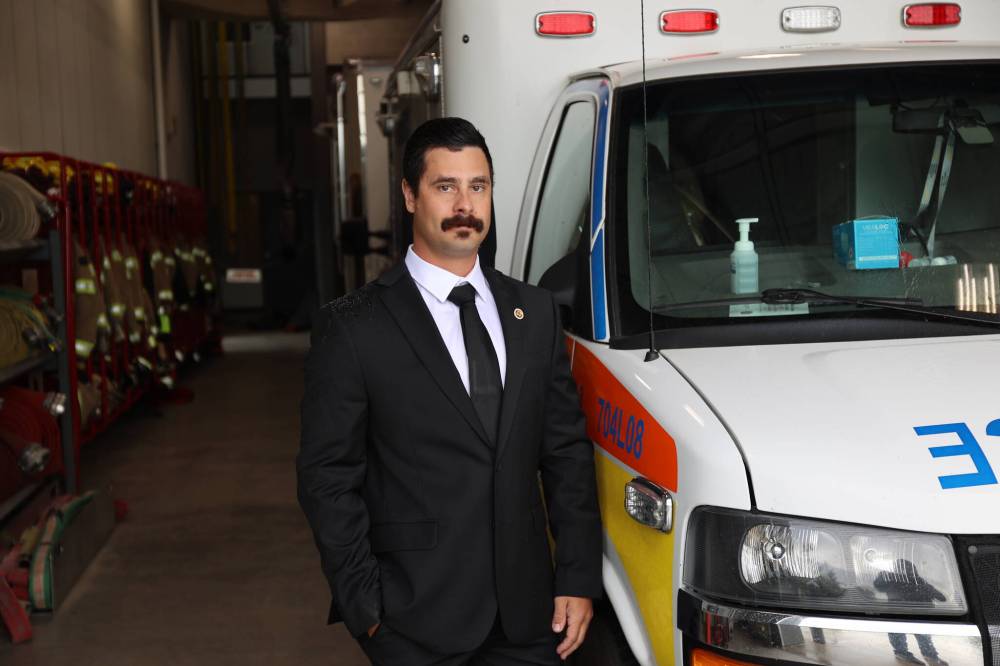
Brandon firefighter paramedic union president Gage Wood stands near an ambulance at a fire and emergency services station in Brandon in August 2025. (Abiola Odutola/The Brandon Sun files)
“If your loved one suffers a cardiac arrest, a heart attack, a stroke, this new directive means that we will have less staffed ambulances, and we will be required to call in the rural trucks to provide the service,” he said.
Brandon Fire and Emergency Services operate three ambulances that respond to calls in the city and surrounding areas, with two additional ambulances dedicated to inter-facility transfers, Wood said.
When Brandon’s primary ambulances are sent out of the city, backup is called from rural communities like Rivers, Virden, Souris, Carberry, Neepawa and Minnedosa – relief they’re already relying on twice per day at minimum, he said.
Staff, who are cross-trained as firefighters and paramedics, can no longer decline to take on patient transfers — even if they’ve reached their minimum staffing level to service the area, Wood said.
One day last week, ambulance services were stretched thin when paramedics were required to take on four inter-facility transfers to Winnipeg, leaving Brandon with only one ambulance, he said.
This meant that ambulances from Neepawa were dispatched to calls in Brandon.
“When we send a patient to Winnipeg, that truck is not of use to the citizens of Brandon for six and a half hours,” Wood said.
“We’re going to bend over backwards to make sure that we can try to get everybody where they need to go as quickly as possible, but that can’t be at the expense — especially with these IFTs — at our ability to respond to 911 calls, and it also can’t put our firefighters at risk.”
Shared Health said in a statement on Friday that Brandon and area residents “will always have ambulance service” and that inter-facility transfers are part of a service purchase agreement with the City of Brandon.
Brandon Fire and Emergency Services receive about 28 emergency calls per day, Wood said.
In 2025 alone, the department responded to 8,699 calls, up from 5,075 in 2015, a 71 per cent increase over the past decade.
Wood said local emergency medical services (EMS) have no issue responding to calls in rural Westman, but he doesn’t want those communities getting stuck servicing Brandon. This prevents rural EMS from providing care within their own jurisdictions and creates “massive coverage gaps,” he said.
He wants to see the Shared Health directive rescinded, so Brandon can have ambulances that can’t be assigned inter-facility transfers, which is in line with how Winnipeg EMS operates.
“We’re the second biggest city in Manitoba, and we’re really not being treated that way — and quite frankly, this feels like an attack on Brandon’s health care,” Wood said.
Brandon Fire Chief Terry Parlow said he’s been in talks with Shared Health since last Monday about the directive to try to find a solution.
He’s said there’s been consultation around delaying non-emergent inter-facility transfers to ensure Brandon’s primary ambulances are available for calls.
“We are working with Shared Health to try and make sure that we are able to do both, but … in a way that’s actually going to ensure primary response units are able to respond to people in Brandon and still meet our needs and actually get those same residents of Brandon to Winnipeg if they need care,” Parlow said.
There are a total of 77 firefighters cross-trained as paramedics in Brandon. Despite Brandon Fire and Emergency Services having “one of the lowest” vacancy rates in the province at seven per cent, Parlow would like to see at least seven more staff join the team.
He’s doing his best to recruit and retain more firefighter paramedics, he said.
Wood said the new directive has caused staff morale to hit a “horrendous low,” with people feeling more stressed, anxious or frustrated.
“This is going to have a detrimental effect to our ability to retain employees that aren’t from Westman, which quite frankly, we can’t afford to have happen,” he said.
“We’ve worked so hard to keep people here, and then this directive comes into effect, and you know, it’s going to wipe out all the hard work we’ve done.”
Wood said without changes from Shared Health, the risk to public safety will continue to grow.
» tadamski@brandonsun.com, with files from Abiola Odutola