
Water management outlook improving
Advertisement
Read this article for free:
or
Already have an account? Log in here »
We need your support!
Local journalism needs your support!
As we navigate through unprecedented times, our journalists are working harder than ever to bring you the latest local updates to keep you safe and informed.
Now, more than ever, we need your support.
Starting at $15.99 plus taxes every four weeks you can access your Brandon Sun online and full access to all content as it appears on our website.
Subscribe Nowor call circulation directly at (204) 727-0527.
Your pledge helps to ensure we provide the news that matters most to your community!
To continue reading, please subscribe:
Add Brandon Sun access to your Free Press subscription for only an additional
$1 for the first 4 weeks*
- Enjoy unlimited reading on brandonsun.com
- Read the Brandon Sun E-Edition, our digital replica newspaper
*Your next Free Press subscription payment will increase by $1.00 and you will be charged $20.95 plus GST for four weeks. After four weeks, your payment will increase to $24.95 plus GST every four weeks.
Read unlimited articles for free today:
or
Already have an account? Log in here »
The future of water management between Manitoba and Saskatchewan is looking up thanks to a March 27 meeting in Virden, several officials told the Sun this week.
The neighbouring provinces are “repairing fences” that were damaged over the issue of water flows from Saskatchewan threatening infrastructure in Westman each spring, RM of Sifton Coun. Scott Phillips said.
“We are already talking to our neighbours to the west. Even today we’re asking, ‘How much snow you getting?’ And stuff like that. ‘How was the snowfall melt?’” Phillips said in a phone interview.
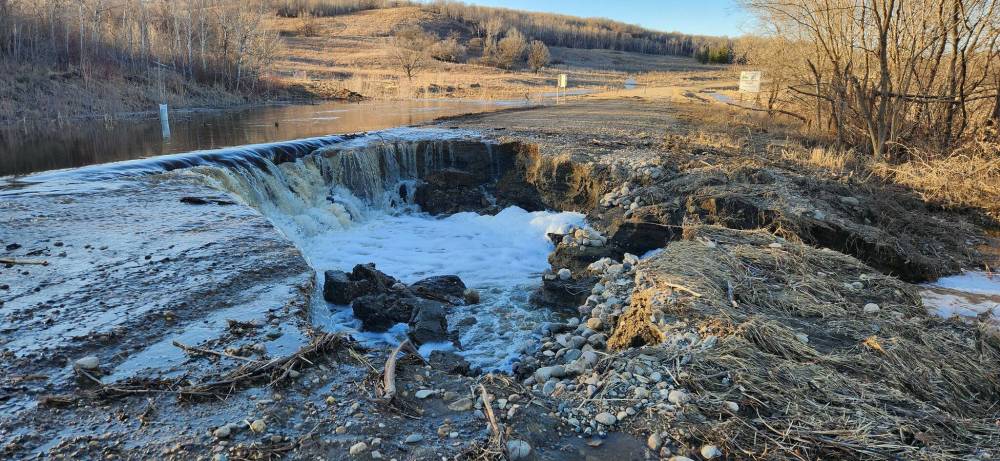
A road in the Rural Municipality of Riding Mountain West is seen demolished by water flows in this 2024 photo. The ongoing issue of water flows into Manitoba each spring was discussed during a collaborative meeting between officials from the two provinces in Virden last week. (The Brandon Sun files)
“Just little bits to, you know, open the door and get the warm and fuzzies back.”
It’s important that municipalities in the two provinces improve their lines of communication and share information, he said, noting that Westman communities downstream from Saskatchewan could prepare themselves for water influxes if they simply learn about it sooner by talking.
Grant Boryskavich, reeve of the RM of Riding Mountain West, and Mike Moyes, Manitoba’s minister of environment and climate change, also said last week’s meeting in Virden was positive.
“We’re really happy to get everyone around the table,” Moyes said in an interview with the Sun. “I’ve heard from folks at the Association of Manitoba Municipalities, as well as my own department, from environment and climate change, that it was a very positive meeting.”
Moyes said it was the first time in several years that officials from both Manitoba and Saskatchewan were brought together to discuss water management. He said he would like to see the meeting repeated annually.
A report is in the works to summarize the discussion, and Moyes said there may also be opportunities for joint projects, though it is too early to say.
The meeting came a year after Phillips, Boryskavich and a number of other municipal council members in Westman called on the province for action about the problem of massive water flows into their areas. The issue was confirmed as the source of the state of emergency in Russell-Binscarth in April 2025 and of roughly $350,000 in damage to a culvert there.
Councillors at the time described the annual water run as an ongoing, unsustainable and costly problem. They also said they did not feel supported enough by the Manitoba government in fixing the issue.
The hope for the future is that the two provinces can work together on unified rules about how water is allowed to flow, Boryskavich said.
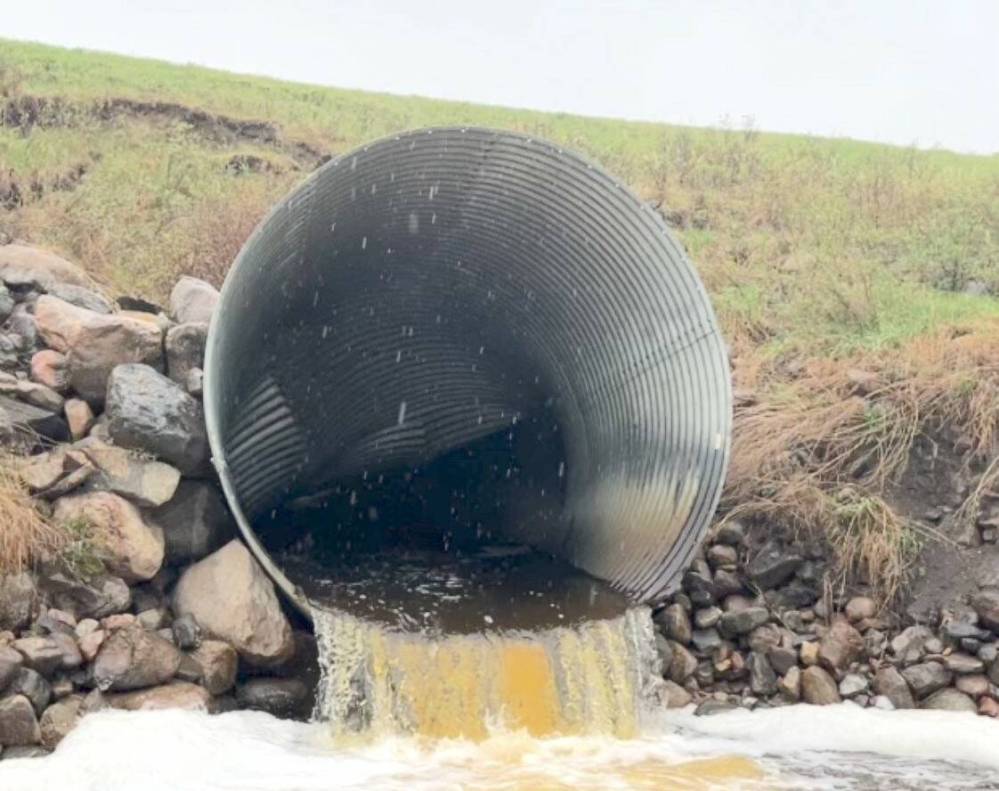
The interior of a 12-foot-diameter culvert is seen folded over as the culvert suffered a partial collapse due to spring thaw water in 2025. Repair costs were estimated at $350,000. (The Brandon Sun files)
One set of rules would address the problem of water flowing fast from Saskatchewan and then slowing down and piling up in Manitoba — the problem that Boryskavich and Phillips complained of last year.
“We’re not designed for it. We can take their water over three or four weeks. We can’t take it over three or four days,” Phillips said in 2025.
This would address a problem they both highlighted — a disparity in the size of culverts between Saskatchewan and Manitoba.
The culvert differential means that water flows much faster in many cases into Manitoba, and then bottlenecks and piles up, flooding over roads, they told the Sun last year.
“I think this is a really, really strong point,” Boryskavich said. “It would just be nice to have some consistency in the same type of drainage licensing and rules for municipalities.”
» cmcdowell@brandonsun.com