
Medical physicist honoured for improving access to cancer care
Advertisement
Read this article for free:
or
Already have an account? Log in here »
We need your support!
Local journalism needs your support!
As we navigate through unprecedented times, our journalists are working harder than ever to bring you the latest local updates to keep you safe and informed.
Now, more than ever, we need your support.
Starting at $15.99 plus taxes every four weeks you can access your Brandon Sun online and full access to all content as it appears on our website.
Subscribe Nowor call circulation directly at (204) 727-0527.
Your pledge helps to ensure we provide the news that matters most to your community!
To continue reading, please subscribe:
Add Brandon Sun access to your Free Press subscription for only an additional
$1 for the first 4 weeks*
- Enjoy unlimited reading on brandonsun.com
- Read the Brandon Sun E-Edition, our digital replica newspaper
*Your next Free Press subscription payment will increase by $1.00 and you will be charged $20.95 plus GST for four weeks. After four weeks, your payment will increase to $24.95 plus GST every four weeks.
Read unlimited articles for free today:
or
Already have an account? Log in here »
A Brandon-based medical physicist has been recognized for his role in expanding access to advanced cancer treatment in western Manitoba.
Navid Khaledi, a medical physicist and radiation safety officer with CancerCare Manitoba, is the recipient of the Applauding Values-Clinical Excellence Award, an honour that highlights contributions to patient care across the province.
Khaledi said the recognition reflects not just individual effort, but the work of an entire clinical team.
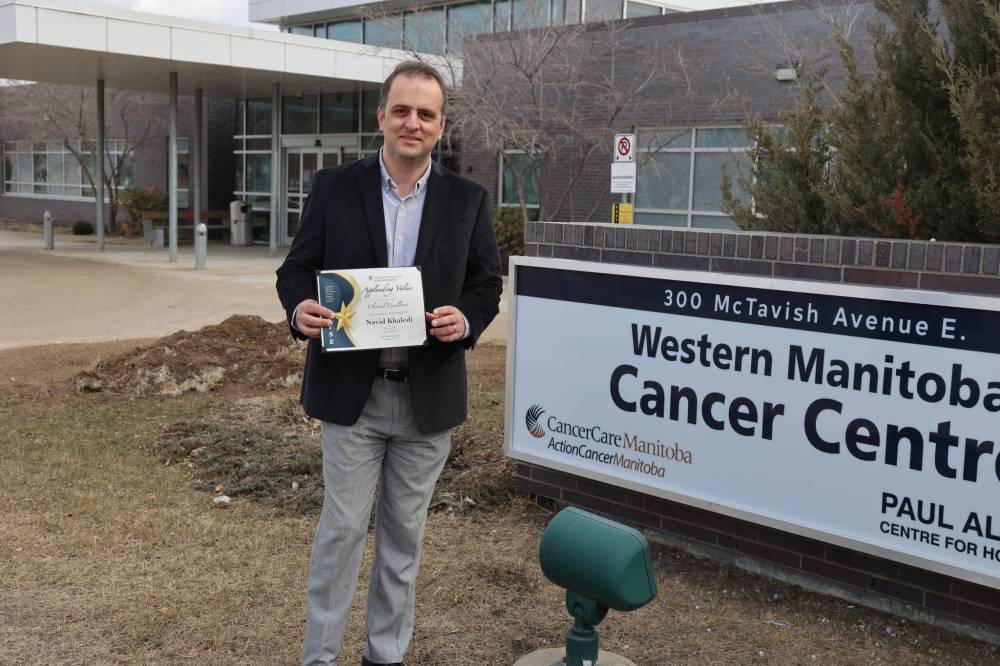
CancerCare Manitoba medical physicist and radiation safety officer Navid Khaledi holds his award certificate, standing in front of the Western Manitoba Cancer Centre on Saturday. (Abiola Odiutola/The Brandon Sun)
“Receiving this award is very meaningful because it reflects work that has supported improved patient care in Western Manitoba,” he told the Sun. “While the recognition is individual, the work itself has been a strong team effort involving radiation oncologists, radiation therapists and clinical staff.”
Khaledi is one of the recipients of CancerCare Manitoba’s RISE Award, held on Tuesday in Winnipeg.
The RISE Awards are internal recognition honours at CancerCare Manitoba (CCMB) that celebrate staff and teams who demonstrate excellence in cancer care across Manitoba. The acronym “RISE” reflects the organization’s core values of Respect, Innovation, Service and Excellence.
His work has been closely tied to improvements at the Western Manitoba Cancer Centre, where patients are now able to access more advanced forms of radiation therapy without travelling to Winnipeg, he said.
Among those advancements is the introduction of stereotactic body radiation therapy (SBRT) for select prostate and lung cancer patients.
SBRT delivers highly precise radiation in fewer treatment sessions while minimizing exposure to surrounding healthy tissue. For some prostate cancer patients, this can mean fewer visits for treatment, while certain lung cancer patients benefit from more targeted therapy designed to reduce side effects.
“All treatment decisions are made by the clinical care team based on each patient’s individual situation,” Khaledi said in an interview.
The shift has had a tangible impact on patients and their families across the region.
“Receiving treatment closer to home can make a meaningful difference,” he said. “It may reduce travel time, fatigue and time away from family or work, which can be especially important during cancer treatment.”
Much of Khaledi’s role takes place behind the scenes, but he said it is central to ensuring safe and effective care.
His day-to-day work includes reviewing treatment plans, collaborating with oncologists and radiation therapists, and verifying that equipment performs to strict standards. As the sole medical physicist in Brandon, he carries responsibility for ensuring every treatment meets rigorous safety and quality requirements.
“While patients may not see this work directly, it plays a critical role in making sure treatments are precise, effective and tailored to each individual,” he said.
Expanding advanced treatment capabilities in a regional centre has not come without challenges.
Maintaining the same level of safety and quality found in larger urban facilities required strong collaboration, detailed quality processes and ongoing training, he said.
“Success depended on teamwork and shared commitment across the clinical team rather than the efforts of any single individual,” Khaledi said.
Looking ahead, he hopes to see continued growth in cancer care options for patients in western Manitoba, supported by collaboration across the province.
“Ongoing collaboration across Manitoba will remain important to ensure that patients in Western Manitoba continue to receive high-quality, patient-centred care close to home,” he said.
» aodutola@brandonsun.com
» X: @AbiolaOdutola