
Province better prepared for fire season: NDP
Advertisement
Read this article for free:
or
Already have an account? Log in here »
We need your support!
Local journalism needs your support!
As we navigate through unprecedented times, our journalists are working harder than ever to bring you the latest local updates to keep you safe and informed.
Now, more than ever, we need your support.
Starting at $15.99 plus taxes every four weeks you can access your Brandon Sun online and full access to all content as it appears on our website.
Subscribe Nowor call circulation directly at (204) 727-0527.
Your pledge helps to ensure we provide the news that matters most to your community!
To continue reading, please subscribe:
Add Brandon Sun access to your Free Press subscription for only an additional
$1 for the first 4 weeks*
- Enjoy unlimited reading on brandonsun.com
- Read the Brandon Sun E-Edition, our digital replica newspaper
*Your next Free Press subscription payment will increase by $1.00 and you will be charged $20.95 plus GST for four weeks. After four weeks, your payment will increase to $24.95 plus GST every four weeks.
Read unlimited articles for free today:
or
Already have an account? Log in here »
The provincial government says it is more prepared to deal with this year’s wildfire season — though it doesn’t expect 2026 to be as busy as last year.
Cabinet ministers Lisa Naylor and Ian Bushie gave a summary of the interim after-action review of the 2025 wildfire season in Brandon on Tuesday, highlighting improvements for the coming season.
The review is helping to shape this year’s wildfire response, Naylor, the minister responsible for the Emergency Management Organization, said at a news conference at the Keystone Centre during the first day of the Association of Manitoba Municipalities convention.
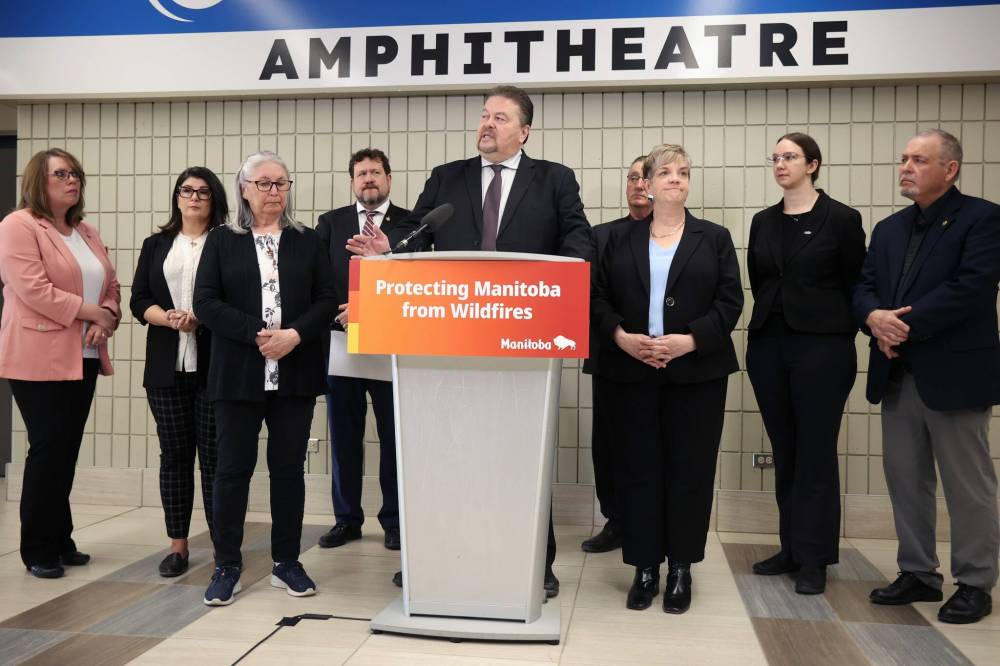
Natural Resources and Indigenous Futures Minister Ian Bushie speaks during a press conference at the Keystone Centre in Brandon on Tuesday after the province released its 2025 Wildfire Interim After Action Review. (Photos by Tim Smith/The Brandon Sun)
Naylor said last year’s wildfire season “tested Manitobans like never before.”
In total, there were 445 wildfires across the province last year and more than 2.38 million hectares burned, the most in the past 30 years, the report says. Additionally, 33,000 people were evacuated from 59 communities.
Two people from the Lac du Bonnet area also died last May because of wildfires.
The province isn’t expecting the 2025 wildfire season to repeat itself this year, Natural Resources and Indigenous Futures Minister Ian Bushie said. He pointed to drought conditions and saturation levels as reasons for the lower risk, along with the province being better prepared.
The province in last month’s budget allocated nearly $5 million to add 19 new firefighters, 15 more Emergency Management Organization staff and four more conservation officers.
The funding will also cover upgrades to the Manitoba Wildfire Service’s weather information and fire mapping systems, the cost of a new initial attack and fire base near Thompson, and improved aerial firefighting services.
Other concrete actions guided by the interim report, the province said, will make it easier for evacuees to register and receive financial supports and for First Nations safety officers to be deployed outside their communities to assist with emergency response.
“This interim report is about taking the opportunity to learn about the 2025 wildfire season, and taking action now to further strengthen our wildfire response and to keep Manitoba families and communities safe,” said Naylor, while flanked by Brandon East MLA Glen Simard and several municipal and First Nations leaders.
“We are acting now to make sure that Manitoba is ready for the 2026 wildfire season,” she said.
Naylor said the key to a good response is working with municipalities and First Nations, along with neighbouring jurisdictions like Saskatchewan and Ontario.
Bushie said the review is meant for the province to build on what happened last year.
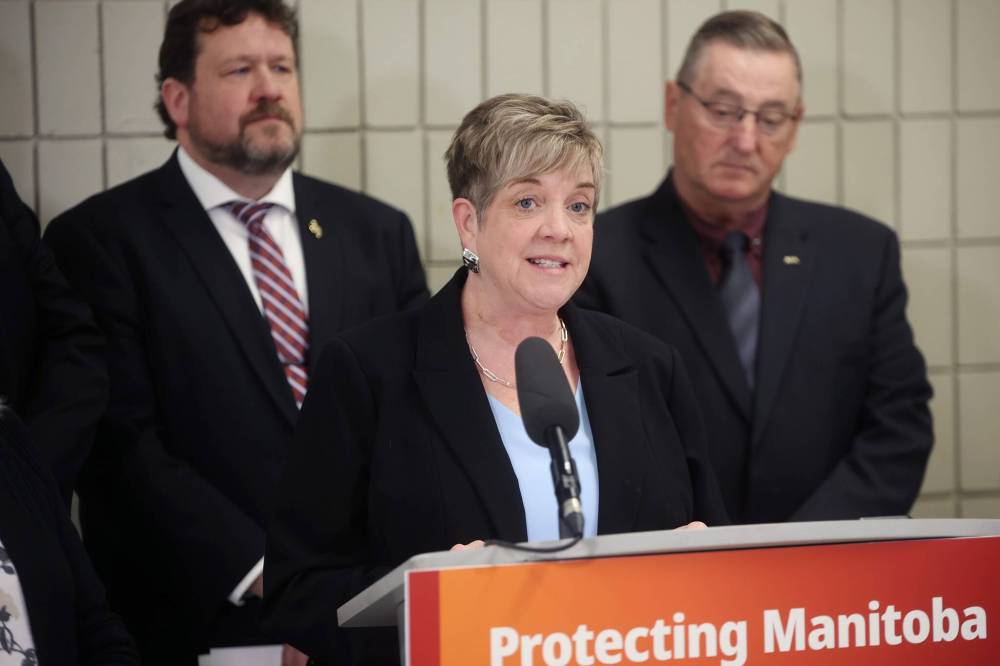
Lisa Naylor, minister responsible for the Emergency Management Organization, speaks during Tuesday’s press conference at the Keystone Centre.
He said the province’s resources were strained but still held.
“They held because they had support. They had support of all levels of government, from First Nation governments, municipal governments, federal government. And that was important,” he said.
“We want to continuously build that momentum, to totally build up that capacity, so we are fully prepared. And I want Manitobans to clearly know that whatever it takes, we will be there for you.”
Rural Municipality of Lac du Bonnet Reeve Loren Schinkel said May 13, 2025 — the day two residents died — will never be forgotten in his community. He said the province’s response last year was swift, but the fire spread too quickly.
He said his community would never have gotten through the ordeal if it weren’t for the response and help from the province and different agencies.
The impacts of wildfires in his community “would have been certainly more devastating” if it weren’t for the outside help, Schinkel said.
“We have learned a lot from that fire,” Schinkel said. “Our emergency measures team has been revamped. Although we were prepared, can one ever be fully prepared for an event like that?”
He said his community received a grant for its airport, which will help during the next wildfire response. He also called the province’s additional resources “a step in the right direction.”
“What the province is doing is investing in the future. I mentioned the grant that we received at the airport. Those are critical infrastructure needs that we all need,” the reeve said.
Shirley Ducharme, acting grand chief of Manitoba Keewatinowi Okimakanak and chief of O-Pipon-Na-Piwin Cree Nation, said the 2025 wildfire season revealed gaps in Manitoba’s northern infrastructure and in the evacuation response.
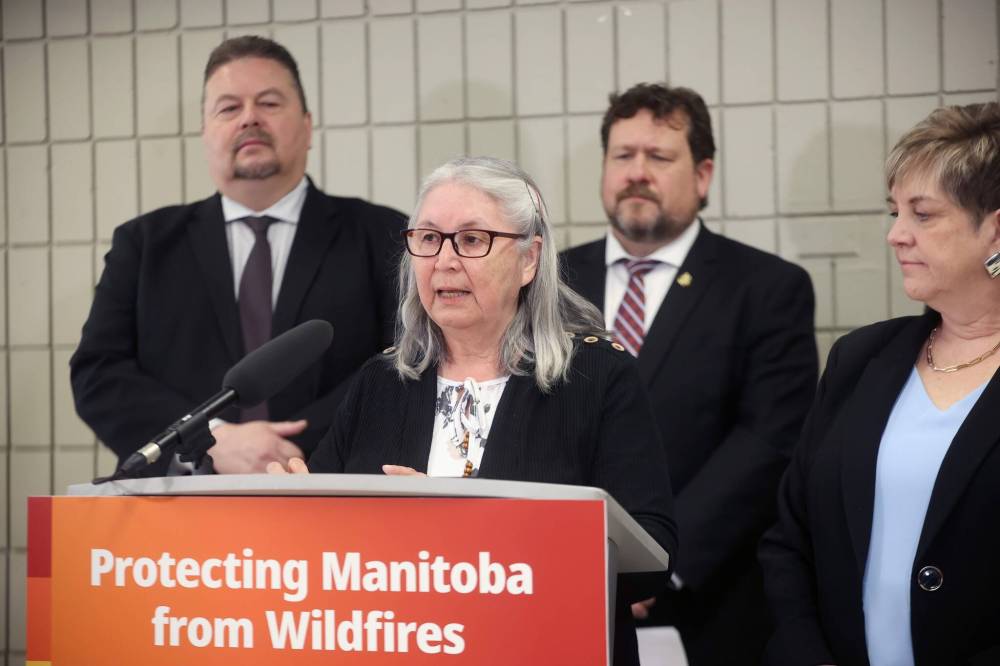
Shirley Ducharme, acting grand chief of Manitoba Keewatinowi Okimakanak and chief of O-Pipon-Na-Piwin Cree Nation, said the 2025 wildfire season revealed gaps in Manitoba’s northern infrastructure and in the evacuation response.
She said she’s glad to see more dedicated firefighting resources for northern parts of the province and a promise to train more wildfire training in First Nation communities.
“These steps reflect movement in the right direction. However, meaningful progress for our northern nations depends on continued collaboration,” she said.
She said longstanding gaps need to be addressed, including some communities waiting weeks or months for power to be restored.
Naylor said the province learned a lot during the Lac du Bonnet fires last year, as resources were stretched thin with people responding to other fires across the province.
“We were as prepared as we could possibly have been through a season like we had. We hope we won’t see a season like that this year, but at the same time, we’re going to be even more prepared,” Naylor said.
Brandon Mayor Jeff Fawcett didn’t respond to a request for comment by press time about the city potentially hosting evacuees again this year.
» alambert@brandonsun.com