
City seeks approval to reduce default speed limit
Advertisement
Read this article for free:
or
Already have an account? Log in here »
We need your support!
Local journalism needs your support!
As we navigate through unprecedented times, our journalists are working harder than ever to bring you the latest local updates to keep you safe and informed.
Now, more than ever, we need your support.
Starting at $15.99 plus taxes every four weeks you can access your Brandon Sun online and full access to all content as it appears on our website.
Subscribe Nowor call circulation directly at (204) 727-0527.
Your pledge helps to ensure we provide the news that matters most to your community!
To continue reading, please subscribe:
Add Brandon Sun access to your Free Press subscription for only an additional
$1 for the first 4 weeks*
- Enjoy unlimited reading on brandonsun.com
- Read the Brandon Sun E-Edition, our digital replica newspaper
*Your next Free Press subscription payment will increase by $1.00 and you will be charged $20.95 plus GST for four weeks. After four weeks, your payment will increase to $24.95 plus GST every four weeks.
Read unlimited articles for free today:
or
Already have an account? Log in here »
Brandon City Council is urging the provincial government to let it lower the city’s default speed limit in an effort to help make residential roads safer.
The default speed limit in urban areas across the province currently sits at 50 kilometres per hour, while roads in rural areas are at 90 km/h.
Councillors have repeatedly discussed reducing the default limit for residential streets in Brandon.
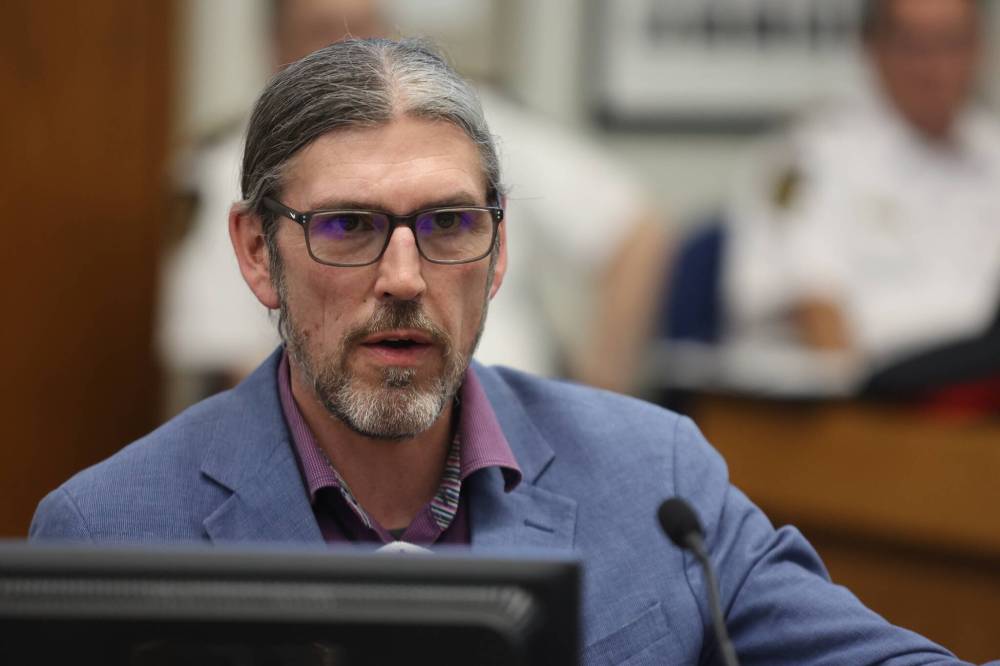
Brandon Coun. Kris Desjarlais (Ward 2), speaking at Monday’s council meeting, said the city’s interest is in saving lives. (Alex Lambert/The Brandon Sun)
“I hope that we bring residents on board for this conversation and dialogue around residential speed zones, whether it’s 40 or even 30 (km/h),” Coun. Kris Desjarlais (Ward 2) said at Monday’s council meeting.
Council agreed to send a letter to Municipal Relations Minister Glen Simard requesting the city take over setting the default speed limit.
“The best way for our municipality to proceed with a legislation change would be to petition the minister,” city traffic and transportation planner Sam van Huizen said at the meeting.
A provincial change would allow the city to put up “gateway signage” at entrances to Brandon that notify drivers of the default speed limit. The province could also lower the default speed limit across the board, which would impact hundreds of communities in all parts of Manitoba.
Currently, the city is able to individually reduce the speed limit below the default limit on all residential roads, but would have to put up signs at every intersection alerting drivers to the change.
Van Huizen said the cost to do that would be $2.25 million for more than 4,000 posts and signs, which would be “fiscally irresponsible.”
“We basically can’t effectively enact similar neighbourhood-size reductions to speed limits at our local level without running into some physical requirements for signage and such,” van Huizen told the Sun after the meeting.
During the meeting, Desjarlais said the cost for the city to enact the change on its own is just too high.
“I don’t think any of us are interested in spending two and a half million to switch over, but I think we are interested in saving lives,” Desjarlais said.
He noted that parts of Toronto have gone down to 30 km/h on residential streets in order to save lives.
Lately, the City of Winnipeg has been similarly petitioning the city to lower the default speed limit to 40 km/h.
Last month, Premier Wab Kinew told CBC that Winnipeg can make the change on its own — by putting a sign at every intersection — but that a provincial decision would mean changes for every community.
Brandon Mayor Jeff Fawcett said it makes sense for the Wheat City to send its request at the same time as Winnipeg.
“The bottom line is, Winnipeg had been kind of kicking this around a little bit … and the whole concept is it has to be done provincially. It can’t be random cities doing things differently,” Fawcett said after the meeting.
“So it’ll be discussions over the next year or two.”
Fawcett said the feedback the city received from residents about pilot projects has been fairly positive.
The city in 2021 reduced the speed limit on part of Durum Drive to 40 km/h to address speed and traffic volumes. The program was later expanded to include neighbourhoods and a 30 km/h zone near Rideau Park, according to a city report.

City of Brandon traffic and transportation planner Sam van Huizen speaks to council members at a council meeting on April 20. (Alex Lambert/The Brandon Sun)
Van Huizen agreed that the city has seen positive results from the project.
“You’re never going to please everybody, but certainly we’ve seen people who are very much in favour of this, have seen the benefits of a reduced speed limit,” he said. “We’ve also seen and heard people not see those benefits.”
Road safety is a two-tiered approach, he said, and a lower speed limit is only one way the city’s streets can be made safer.
“The other side is traffic calming — basically the way we physically design our roadways to help encourage a reduced speed limit,” van Huizen said. “Right now, the city’s in a nice big grid pattern. It was built over the last few decades, with a default speed limit of 50 kilometres an hour in mind.”
In the past, traffic calming measures included speed bumps and bump-outs.
As the city designs and builds new neighbourhoods, there’s a focus on those traffic calming measures, he said. That can also include speed tables — where part of the road is elevated — and not designing streets in a grid pattern.
If the default speed limit were to change, van Huizen said the city is aware that uptake might not be immediate.
“It doesn’t happen overnight, it’s almost a culture of change,” he said.
He likened it to when laws were implemented around drunk driving and wearing seatbelts, which took a long time for some people to get used to, but most people can’t imagine not wearing a seatbelt today.
He said it’s too early to say if speed limits on arterial streets in Brandon would also be lowered or if they would remain at their current status.
The letter to Simard is also being copied to Transportation and Infrastructure Minister Lisa Naylor and other related departments, van Huizen said.
A press secretary for Simard didn’t respond to a request for comment by press time.
The Sun also reached out to Winnipeg Coun. Janice Lukes, who chairs her city’s public works committee, but didn’t hear back.
» alambert@brandonsun.com