
Paramedics raise alarm over diverted funds
Advertisement
Read this article for free:
or
Already have an account? Log in here »
We need your support!
Local journalism needs your support!
As we navigate through unprecedented times, our journalists are working harder than ever to bring you the latest local updates to keep you safe and informed.
Now, more than ever, we need your support.
Starting at $15.99 plus taxes every four weeks you can access your Brandon Sun online and full access to all content as it appears on our website.
Subscribe Nowor call circulation directly at (204) 727-0527.
Your pledge helps to ensure we provide the news that matters most to your community!
To continue reading, please subscribe:
Add Brandon Sun access to your Free Press subscription for only an additional
$1 for the first 4 weeks*
- Enjoy unlimited reading on brandonsun.com
- Read the Brandon Sun E-Edition, our digital replica newspaper
*Your next Free Press subscription payment will increase by $1.00 and you will be charged $20.95 plus GST for four weeks. After four weeks, your payment will increase to $24.95 plus GST every four weeks.
Read unlimited articles for free today:
or
Already have an account? Log in here »
A union representing paramedics in the province is sounding the alarm after learning Shared Health is using funds dedicated to fill vacant paramedic positions to hire emergency medical responders instead.
The Manitoba Association of Health Care Professionals (MAHCP) wrote the Manitoba government in March with concerns it was reducing the level of safe emergency medical care available to patients by replacing paramedic positions with lower-skilled emergency medical responders.
Silvester Komlodi, the deputy minister of health, seniors and long-term care, responded in a letter last week, saying provincial funding hasn’t been cut for primary-care paramedics (PCPs) despite ongoing recruitment challenges that have resulted in vacancies.
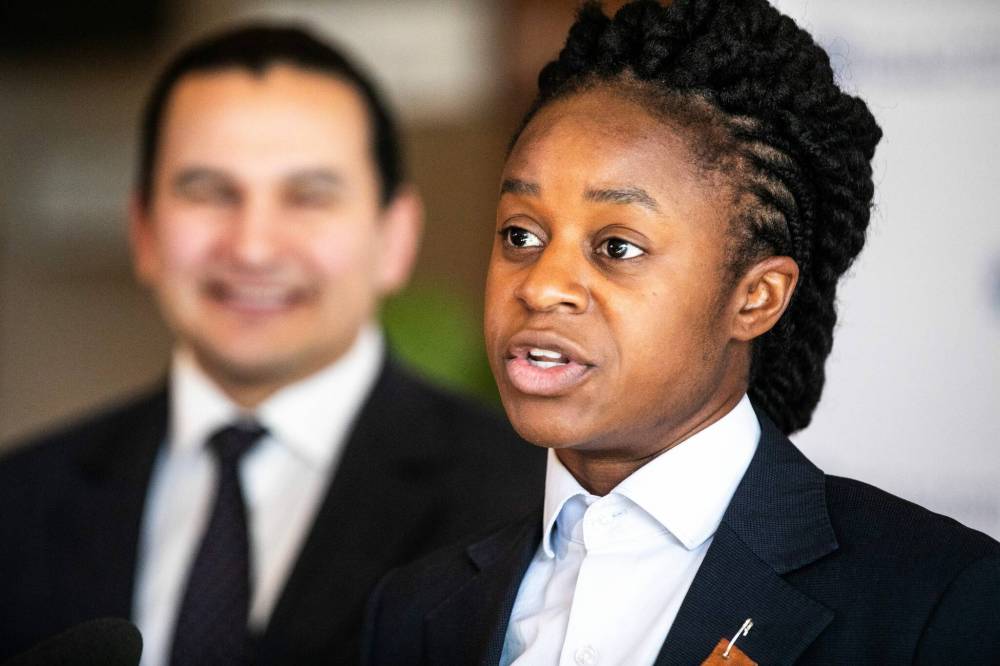
Health Minister Uzoma Asagwara said emergency medical responders “are not going to be replacements for paramedics.” (Mikaela MacKenzie/Winnipeg Free Press files)
“In limited circumstances, and on a temporary basis, some of this funding has been used to hire emergency medical responders to ensure that ambulances can continue operating in communities facing staffing shortages,” Komlodi said.
Health Minister Uzoma Asagwara said Thursday that emergency medical responders “are not going to be replacements for paramedics” and that municipalities have requested Shared Health take this approach.
MAHCP president Jason Linklater said at a news conference on Thursday that the growing paramedic staffing crisis can affect anyone living or travelling in Manitoba.
“When primary, intermediate and advanced care paramedics respond to 911 calls, the person who shows up is qualified, highly skilled and the best chance Manitobans have at surviving an emergency,” he said.
Emergency medical responders don’t have the same scope of training compared to paramedics. For example, they can’t diagnose a patient’s illness or injury, give fluid or medications through an IV, inject a needle into muscle, insert a device for airway ventilation or provide medication for pain, heart attacks, psychosis or seizures, the union said.
Linklater said the MAHCP recently learned that emergency medical responders were being sent on calls in rural and remote areas without a paramedic in the ambulance, putting patients at risk.
According to Komlodi, this has been a standard practice for decades.
Komlodi said Shared Health has assured the Manitoba government “that there is no evidence indicating that the use of EMR-staffed ambulances has created safety concerns for providers or patients.”
“Calls that are assigned to ambulances staffed by two EMRs are watched very closely by shift supervisors, and additional resources (are) assigned to respond when appropriate based on the acuity of the incident.”
Asagwara said the province is working to establish a bridging program that will support emergency medical responders who choose to advance their education and complete training to become a primary-care paramedic.
“EMRs are the first step we’re going to get folks to being PCPs, and then hopefully they can become (advanced care paramedics) in time,” Asagwara said.
Linklater said Shared Health data it obtained through a freedom of information request show there were 162 vacant paramedic positions across Manitoba in December 2025 with 49 vacancies in the west zone.
The data show a two-year decline in paramedics working under Shared Health from 519 filled positions in December 2023 to 483 in December last year.
Asagwara said the province now has a net gain of 41 out of 200 paramedics it promised to hire since forming government in 2023.
“We set an ambitious goal because Manitobans deserved that,” they said.
Shared Health data show the province has a net loss of 34 paramedics since 2023.
Linklater said people, including elderly residents and those living with medical conditions, are afraid a declining paramedic workforce will cost someone their life.
In rural areas, paramedics are short-staffed and sometimes the closest ambulance is an hour away, he said.
Wayne Chacun, the MAHCP’s treasurer and an intermediate care paramedic in Virden, said the province is not posting positions in the east and south zones “unless absolutely necessary” because they want new grads to take positions in harder-to-fill areas like the north and west zones.
“The problem is most of these people aren’t from the west and north,” he said, adding that they will work there for a short period of time, but ultimately, they want to be closer to family, but are now being prevented from doing so.
“What we then end up seeing is people truly leaving the system. They quit out of frustration,” he said.
Komlodi said the province uses a “vacancy management strategy” to ensure equitable service delivery across different regions in Manitoba because it has seen a “consistent migration of staff” to the greater metropolitan areas, causing an imbalance of EMS coverage.
He said more than 60 primary, intermediate and advanced paramedic positions were posted last month across all provincial EMS zones and more postings are expected.
While the government has taken concrete steps to retain and recruit nurses and doctors, it’s not investing enough money in the paramedic workforce, Chacun said.
“They’re trying to put a Band-Aid on a gushing wound, and it’s not enough,” he said.
Chacun estimates there’s about 100 PCP education seats in Manitoba, but at least 50 to 100 more are needed.
“If people can get educated where they’re more likely to work, they’re more likely to stay,” he said.
The MAHCP has brought many solutions forward, including the implementation of an “earn as you learn” pathway for emergency medical responders to receive paid education and bursaries as they train to become PCPs.
The union would also like to see travel, accommodation and other incentives covered for paramedics picking up shifts in hard-to-fill areas.
Asagwara said the province is already implementing suggestions from MAHCP and will continue to work with them.
» tadamski@brandonsun.com