
Book club discussion focuses on rise of AI
Advertisement
Read this article for free:
or
Already have an account? Log in here »
We need your support!
Local journalism needs your support!
As we navigate through unprecedented times, our journalists are working harder than ever to bring you the latest local updates to keep you safe and informed.
Now, more than ever, we need your support.
Starting at $15.99 plus taxes every four weeks you can access your Brandon Sun online and full access to all content as it appears on our website.
Subscribe Nowor call circulation directly at (204) 727-0527.
Your pledge helps to ensure we provide the news that matters most to your community!
To continue reading, please subscribe:
Add Brandon Sun access to your Free Press subscription for only an additional
$1 for the first 4 weeks*
- Enjoy unlimited reading on brandonsun.com
- Read the Brandon Sun E-Edition, our digital replica newspaper
*Your next Free Press subscription payment will increase by $1.00 and you will be charged $20.95 plus GST for four weeks. After four weeks, your payment will increase to $24.95 plus GST every four weeks.
Read unlimited articles for free today:
or
Already have an account? Log in here »
The rapid rise of artificial intelligence is outpacing the policies needed to guide its use, Brandon University Prof. Gautam Srivastava said during an event Thursday evening at the Brandon Public Library.
The Mayor’s Book Club discussion, centred on “Empire of AI: Dreams and Nightmares in Sam Altman’s OpenAI” by Karen Hao, expanded into a broader look at how governments, schools and communities are struggling to keep pace with AI’s growth.
Srivastava said the lack of clear policy frameworks is becoming increasingly evident as tools like ChatGPT and other large language models become widely accessible.
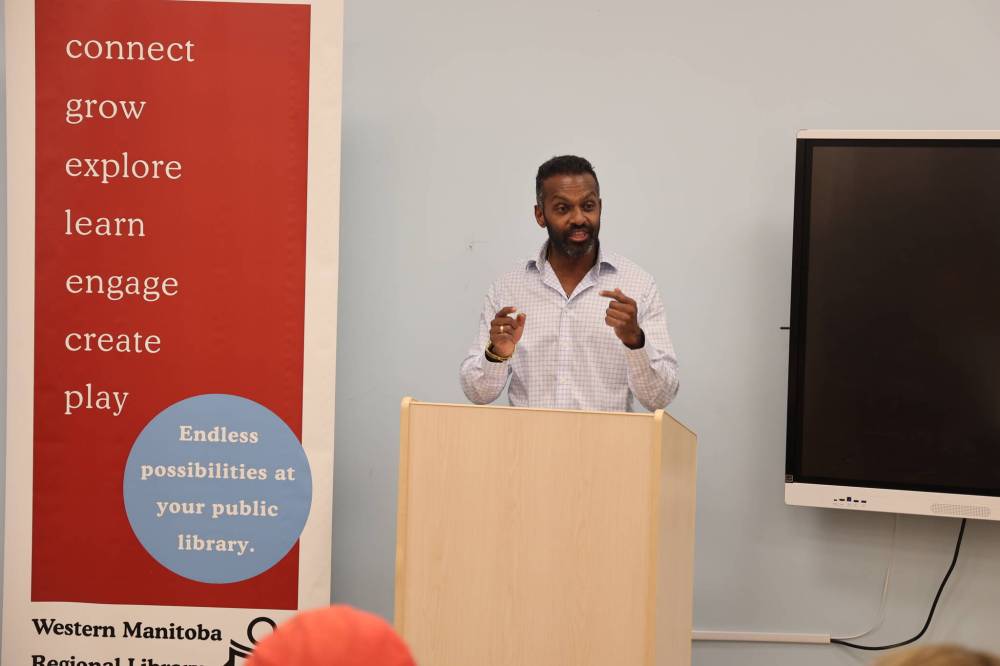
Brandon University Prof. Gautam Srivastava says the lack of clear policy frameworks is becoming increasingly evident as tools like ChatGPT and other large language models become widely accessible. (Abiola Odutola/The Brandon Sun)
“In the last six years, artificial intelligence has grown exponentially, and now students and the public have access to these tools,” he told the Sun. “But the policy structures to support their practical and productive use are not fully in place.”
Education is one of the most immediate areas feeling the impact, he said.
While AI can provide quick answers, he said, institutions are still figuring out how to ensure students continue to develop critical thinking and problem-solving skills.
“How do you balance the use of artificial intelligence tools that can give you the answer versus problem-solving and being able to critically think for yourself?” he said. “These policies aren’t necessarily in place yet.”
He said that the policy gap extends beyond classrooms to municipal and provincial governments, particularly in the handling of data.
“How is data being stored? How is it being fed into artificial intelligence? What are the guardrails to ensure privacy and integrity?” Srivastava asked. “These are things that need better policies.”
Canada has often lagged in technology policy compared to some European countries, and Manitoba still has significant ground to cover, he said.
He said policy development must be multi-faceted, covering education, ethics, security and environmental considerations.
“Youth today have unlimited access to technology without fully understanding the consequences,” he said. “We need education policies and curriculum that teach ethical and responsible use of AI from early years through post-secondary.”
The event also featured discussions on environmental impacts and generational implications of AI, reflecting the wide range of issues tied to the technology.
Brandon Mayor Jeff Fawcett said the goal of the book club session was to create space for those conversations.
“Everybody talks about AI, but a lot of people don’t really know what that actually is,” he told the Sun. “Is it just faster Google, or something more?”
He said the book club discussion — one of several he has hosted — aims to bring people together around timely topics, often in collaboration with local institutions.
While he would have liked to see a larger turnout, Fawcett described the discussion as thoughtful and engaging, with about 16 participants exploring various aspects of the new technology.
“This is such a fast-moving subject, faster than books sometimes,” he said. “We’re talking about a lot of different aspects of AI, and there are no absolute answers.”
He said similar discussions are likely to continue as AI evolves.
“It’s a reason to get people together, to be face to face and have real conversations,” Fawcett said. “Even when the topic itself is something as digital as AI.”
» aodutola@brandonsun.com
» X: @AbiolaOdutola