
City eyes native plants as grass replacement
Advertisement
Read this article for free:
or
Already have an account? Log in here »
We need your support!
Local journalism needs your support!
As we navigate through unprecedented times, our journalists are working harder than ever to bring you the latest local updates to keep you safe and informed.
Now, more than ever, we need your support.
Starting at $15.99 plus taxes every four weeks you can access your Brandon Sun online and full access to all content as it appears on our website.
Subscribe Nowor call circulation directly at (204) 727-0527.
Your pledge helps to ensure we provide the news that matters most to your community!
To continue reading, please subscribe:
Add Brandon Sun access to your Free Press subscription for only an additional
$1 for the first 4 weeks*
- Enjoy unlimited reading on brandonsun.com
- Read the Brandon Sun E-Edition, our digital replica newspaper
*Your next Free Press subscription payment will increase by $1.00 and you will be charged $20.95 plus GST for four weeks. After four weeks, your payment will increase to $24.95 plus GST every four weeks.
Read unlimited articles for free today:
or
Already have an account? Log in here »
The City of Brandon will explore planting native plants along roads and on boulevards instead of regular grass, council agreed on Monday.
Some members said they would support a pilot project with that aim after a Brandon man spoke to council on Monday, extolling the benefits of switching to native greenery.
“By bringing back native plants, we bring back life, we create a city that’s not just neat but vibrant,” Justin Venema told council members.
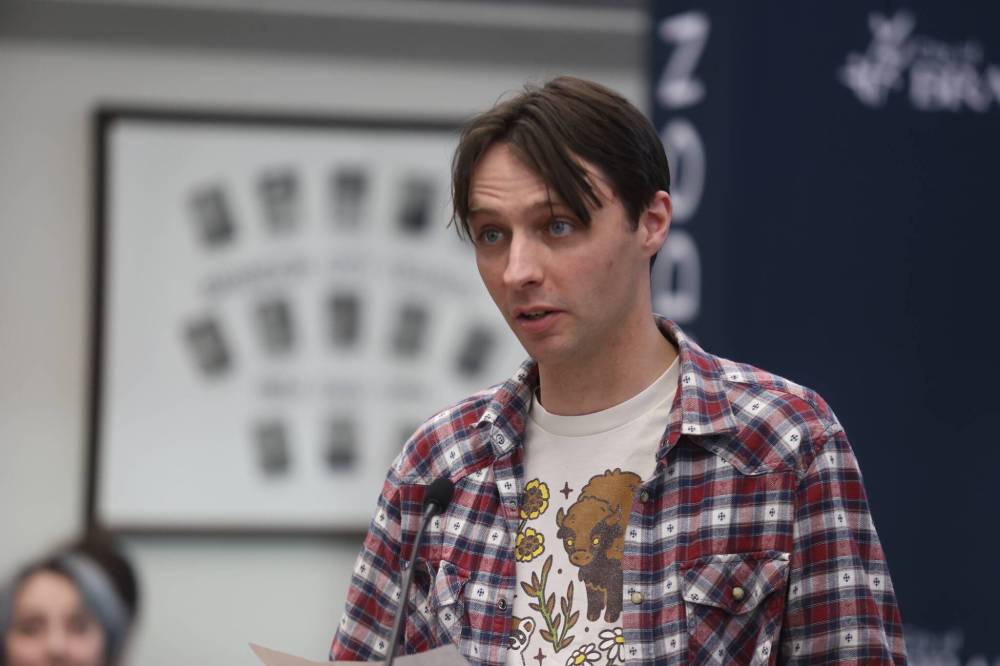
Brandon resident Justin Venema speaks during Monday evening’s council meeting. Venema said the preference for manicured lawns is “a cultural habit that we’ve inherited from 17th-century European aristocrats.” (Alex Lambert/The Brandon Sun)
Venema, 29, said grass is often thought of as natural or the default, but that manicured lawns are far from it.
“It’s a cultural habit that we’ve inherited from 17th-century European aristocrats,” the Brandon School Division educational assistant said, adding that having a lawn was a status symbol showing that land could be taken up by something that doesn’t provide a use.
He said Brandon should change how it manages its green infrastructure, suggesting “a shift from high-maintenance turf grass to biodiverse native prairie landscaping.”
A request for proposals from earlier this year shows the city approved the purchase of seeds for a blend of different types of grass, a large portion of which is Kentucky bluegrass, the type Venema spoke about.
He said Kentucky bluegrass has shallow roots, hates the hot summers and needs to be cut and watered by city staff.
“To keep it alive in Brandon, we have to fight nature,” Venema said.
Mayor Jeff Fawcett, while supporting the proposal, said the city doesn’t typically water grass.
Venema suggested native species like big bluestem and black-eyed Susan as alternatives, both of which have long roots and don’t need to be watered, he said.
“Most importantly for city council’s budget, they do not need regular maintenance, as artificial ecological grass lawns do.”
He estimated that a switch would save the city about 90 per cent savings for upkeep, as the native plants would not need to be mowed nearly as often.
Venema also calculated that 20 hectares of the native plants would save the city about $300,000 in savings over a 10-year period.
“It’s a question of what kind of city we want to leave to the next generation,” he said. “Areas with biodiverse plants act as habitats to all sorts of creatures such as bees and butterflies that our local farms depend on.
“Those creatures cannot survive in chemically treated lawns. It is a biological desert for them.”
City spokesperson Merrilea Metcalf wasn’t able to confirm whether the cost estimates Venema gave were accurate.
Venema asked that the city identify five sites for a pilot project that are currently high maintenance.
He also highlighted that the deep-rooted plants would help with flood mitigation as they would act like a sponge, and that other cities have had successful pilots.
Coun. Kris Desjarlais (Ward 2) said the city has had conversations about the topic in the past.
“I’m like, ‘Why are we still mowing all of our boulevards, we’ve got to stop doing this, it’s ridiculous,’” Desjarlais said.
He said he’s on board with Venema’s proposal.
“I love the idea and I think five pilot areas this year is easily done and something we should be considering for all of our boulevards like this,” the councillor said.
Coun. Bruce Luebke (Ward 6) said he would be “all in” on doing the proposed pilot or even expanding it.
“I would definitely be in favour of doing this,” he said.
Council said First and 26th streets, where boulevards are either bare or being worked on, could be a good spot to start.
Fawcett said he’s on board with the plan, and would also bring the topic up to the province for the boulevards it maintains.
He warned that it will take time for things to look good.
“The aesthetics of it are awful for a year,” Fawcett said.
“You’d need to have signage up saying, ‘This is supposed to look this way,’ until it actually takes,” he said, laughing.
At the end of the presentation, Luebke motioned for the city look into the pilot project, which council approved.
Venema said he was very pleased by council’s reception to his proposal, and it shows that sharing what he cares about can pay off.
“It makes me happy. Hopefully, (we will) see it start and grow exponentially,” he told the Sun after the meeting.
He said he brought the topic to council because change might not happen if no one brings it forward.
“If you want to see the change the world, you can’t sit in the sidelines and just hope and cross your fingers,” he said.
Last October, Venema made a similar presentation to Brandon School Division trustees, asking them to consider future landscaping be done with native plants and for lands to be biodiverse.
Trustees at a subsequent meeting in November said Venema’s proposal was a good idea and directed him to speak to the city as well.
School board vice-chair Duncan Ross at the time said the division can take the proposal into consideration in the future, but noted that it wasn’t in a great financial position.
Additionally, the city is doing another pilot program with planting native grasses, Metcalf told the Sun on Friday.
The project will have three locations, including at the Canada Packers Sports Complex, at the traffic circle at 26th Street and Maryland Avenue, and at the retention pond at the Brandon Municipal Cemetery.
» alambert@brandonsun.com