
PST cut extended to corner stores
Advertisement
Read this article for free:
or
Already have an account? Log in here »
We need your support!
Local journalism needs your support!
As we navigate through unprecedented times, our journalists are working harder than ever to bring you the latest local updates to keep you safe and informed.
Now, more than ever, we need your support.
Starting at $15.99 plus taxes every four weeks you can access your Brandon Sun online and full access to all content as it appears on our website.
Subscribe Nowor call circulation directly at (204) 727-0527.
Your pledge helps to ensure we provide the news that matters most to your community!
To continue reading, please subscribe:
Add Brandon Sun access to your Free Press subscription for only an additional
$1 for the first 4 weeks*
- Enjoy unlimited reading on brandonsun.com
- Read the Brandon Sun E-Edition, our digital replica newspaper
*Your next Free Press subscription payment will increase by $1.00 and you will be charged $20.95 plus GST for four weeks. After four weeks, your payment will increase to $24.95 plus GST every four weeks.
Read unlimited articles for free today:
or
Already have an account? Log in here »
WINNIPEG — Slurpees will be PST-free starting July 1, after Premier Wab Kinew announced an expanded grocery tax exemption that will now include convenience stores and small mom-and-pop shops.
Kinew made the announcement during a media scrum following an unrelated event in Lockport on Friday, a shift that comes after backlash from small business owners left out of the measure included in last month’s provincial budget.
“We’re working on a more expansive definition,” Kinew said. “This will capture most of what we would think of mom-and-pops, and we will have that budget bill in May, where you will see the details.”
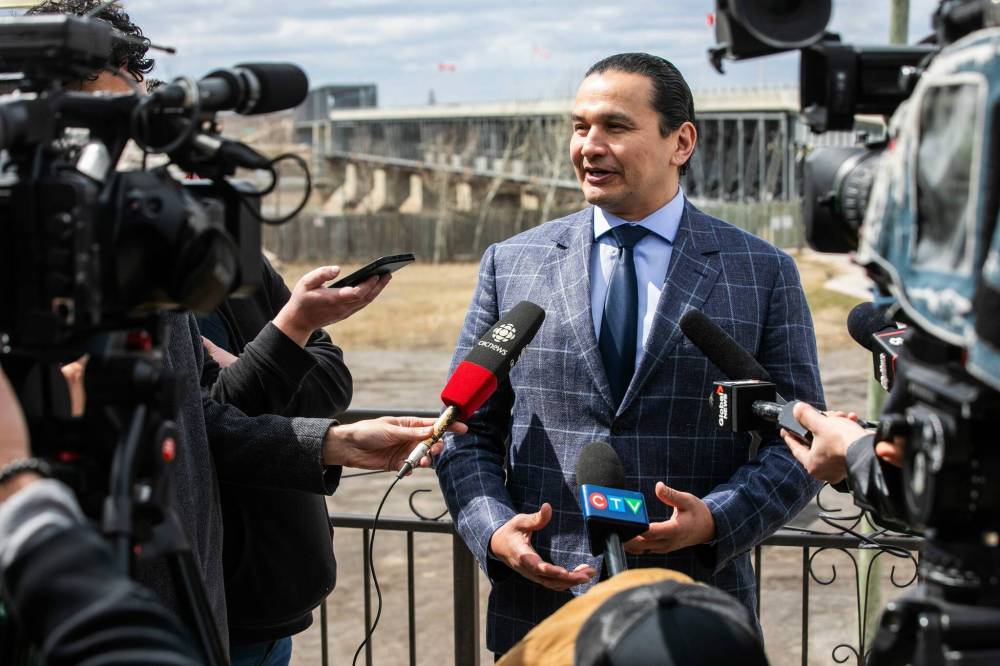
Premier Wab Kinew holds a media scrum in Lockport on Friday. (Mikaela MacKenzie/Winnipeg Free Press)
The premier acknowledged the challenge of drawing a clear line between convenience stores and smaller independent retailers. “As far as I can tell … you can’t,” he said.
Under the original framework, businesses had to meet certain criteria — including a minimum size — to qualify as grocery stores. While staple items such as meat, vegetables, fruit and dairy were already exempt from provincial sales tax, the latest budget broadened that to include prepared meals, candy and other snack foods.
The change is expected to reduce provincial revenue by $24 million, according to budget projections released last month, which also forecast a $498-million deficit for 2026–27.
Kinew said Friday the expanded exemption would trim an additional $2 million.
The premier had previously raised concerns that widening the tax break could encourage more junk-food purchases.
“To be clear, I always want to encourage people to eat healthy, that’s why we’re talking about rotisserie chickens and prepared salads,” he said. “But at the same time, it’s up to you. We just want to help with affordability.”
The Retail Council of Canada, which had lobbied to have smaller businesses such as convenience stores included in the exemption, welcomed the change Friday.
“It’s something we’ve been working on with (the premier’s team) for some time now, from a position of fairness, but also reasonable access for those that need affordability,” said regional director John Graham.
He said the smaller stores serve a critical role in many communities.
“In particular, where you may not have access to transportation or cannot afford transportation and where convenience stores are often the default grocery store for many people,” Graham said. “And from a business perspective, it levels the playing field of stores that may be located across from each other, or on the same lot. You want to see those customers treated equally.”
The Canadian Federation of Independent Business, which criticized the initial announcement in last month’s budget, calling it “fundamentally unfair,” also expressed support.
“We are anxious to see the legislation once it’s introduced,” said Brianna Solberg, CFIB’s director for the Prairies and the North.
Kinew stopped short of extending the exemption to restaurants, an industry that has pushed back on the policy, arguing it could divert customers away from eateries offering takeout meals.
“From our perspective, the same foods, regardless of where they’re sold, should be taxed the same,” Solberg said. “If extending the PST exemption to restaurants is not going to be considered, then we are going to continue to advocate that governments look at other ways to provide meaningful cost relief to the sector. This sector continues to face significant financial pressures.”
Solberg said it creates an uneven playing field for restaurants that offer prepared meals to go.
Meanwhile, a new time zone could be on the horizon across the Prairies, Kinew said Friday.
“Here’s what I can see happening by the end of the year — we might have a Prairie time zone,” he said. “We might have Alberta, Saskatchewan and Manitoba all sharing the same time.”
Alberta has already signalled its intent to stay on daylight time year-round, aligning with Saskatchewan, which does not change its clocks.
Kinew noted that sticking with standard time would effectively place all three Prairie provinces in the same time zone, a shift he said could bring economic benefits.
“Maybe that will happen this year,” he said. “The idea of us changing the clocks twice a year, I think that day has passed. In Manitoba, we’re almost certainly at the end of that.”
Public consultations are expected in the coming months, aimed at gauging Manitobans’ views on daylight time and awareness of the health considerations tied to each option.
Kinew suggested there may be greater health benefits to adopting what he described as “Saskatchewan time,” noting the province to the west remains on Central Standard Time year-round.
Manitobans will be consulted in the coming months on whether the province should adopt year-round standard or daylight time, with the goal of settling on one system by the end of the year, he said.
Kinew acknowledged the political tradeoffs involved — some favour the longer summer evenings under daylight time, while others prefer standard time.
“Maybe we can form a bit of a consensus by taking the time, explaining some of the health benefits, talking about some of the pros and cons and just taking the time to listen,” he said.
» Winnipeg Free Press