
Researchers hope to ‘change the narrative’
Advertisement
Read this article for free:
or
Already have an account? Log in here »
We need your support!
Local journalism needs your support!
As we navigate through unprecedented times, our journalists are working harder than ever to bring you the latest local updates to keep you safe and informed.
Now, more than ever, we need your support.
Starting at $15.99 plus taxes every four weeks you can access your Brandon Sun online and full access to all content as it appears on our website.
Subscribe Nowor call circulation directly at (204) 727-0527.
Your pledge helps to ensure we provide the news that matters most to your community!
To continue reading, please subscribe:
Add Brandon Sun access to your Free Press subscription for only an additional
$1 for the first 4 weeks*
- Enjoy unlimited reading on brandonsun.com
- Read the Brandon Sun E-Edition, our digital replica newspaper
*Your next Free Press subscription payment will increase by $1.00 and you will be charged $20.95 plus GST for four weeks. After four weeks, your payment will increase to $24.95 plus GST every four weeks.
Read unlimited articles for free today:
or
Already have an account? Log in here »
Researchers at Brandon University hope findings from two recent projects on intimate partner, gender-based and sexual violence can improve supports for survivors in rural, remote and northern communities.
Members of the university’s Rural, Remote and Northern Gendered Violence Research Program presented their findings during two sessions on Friday at the Mental Health on the Prairies conference held at BU.
The three-day conference that began Wednesday brought researchers, health professionals, community organizations and individuals with lived experiences together to share knowledge and engage in critical conversations about mental health.
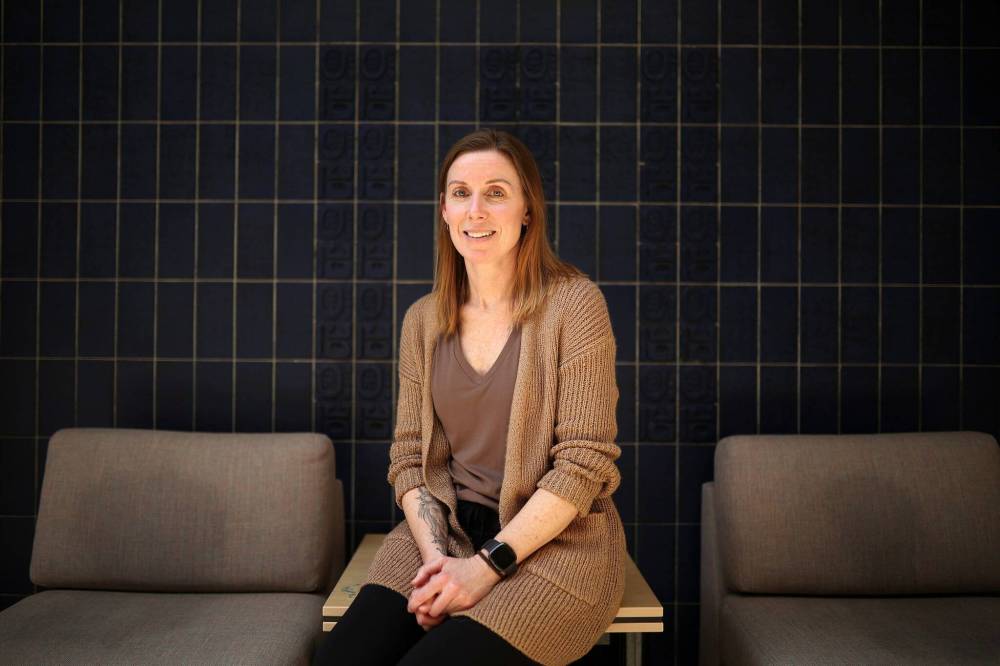
Tracy Young, co-lead of Brandon University’s Centre for Critical Studies of Rural Mental Health, is shown at the university on Friday. The centre hosted the three-day Mental Health on the Prairies conference at BU. (Tim Smith/The Brandon Sun)
The first session on Friday focused on a pilot project exploring the experiences of childbirth and parenthood for individuals who have experienced sexual violence in adulthood.
“The reason that we started this study was because we hear anecdotally all the time about experiences in the birthing process where individuals that are birthing aren’t provided with adequate information to make informed choice,” said Candice Waddell-Henowitch, the project leader.
“A lot of individuals end up being in a space where they can’t have control or voice or empowerment, and we want to try to start to change that narrative,” she said.
Waddell-Henowitch, who’s also an associate professor in the department of psychiatric nursing, said the study is meant to examine how the participants’ traumatic birth experiences could have been avoided and how better practices supporting survivors can be integrated into the health-care system.
“Sexual violence in adulthood, we know, can have a lasting impact on individuals — mentally, physically, psychologically — so that can carry into pregnancy and childbirth,” said Nadine Smith, project co-investigator.
“Clinical procedures can also trigger a trauma response, so that could definitely have a lasting impact,” said Smith, who is also an associate professor in the department of psychiatric nursing at BU.
Smith said the team used a trauma-informed approach to interview 20 participants in Manitoba from May 2025 to February 2026.
“The thing that ties each of these stories together is the trauma that resulted from the birth experience or their early postpartum experience,” said Krista Murray, a research assistant with the program.
The preliminary findings show themes involving participants advocating to have control or a choice during labour and delivery and to feel heard by care providers, she said.
“There are times when patients aren’t heard by their care team, or the team of doctors and nurses are maybe, like, out of sync with one another, and this can lead to further trauma for victims or survivors of sexual violence, and it can lead to birth trauma for those without a history of sexual violence,” Murray said.
While patients may not be able to have full control over labour and delivery in the event of an emergency, choices can be offered, such as having female nurses deliver a baby in the event that a female obstetrician isn’t present.
Murray said the data show care providers have a role in reducing and preventing further trauma or harm for birthing individuals, either with or without a history of sexual violence.
The research team received $74,000 from the Social Sciences and Humanities Research Council in 2024 to develop the project, Waddell-Henowitch said.
She said her research team will eventually take their findings to health-care providers in the Prairie Mountain Health region, so they can integrate trauma-informed practices in their care. She would also like to put together a “how to” manual for birthing individuals, so they can learn how to better advocate for themselves.
The second session on Friday provided details on a resource guide offering supports related to intimate partner and sexual violence in rural, remote and northern communities that was launched at BU in December.
The session also shared survey data based on responses the team received from organizations across the province regarding their ability to respond to the various needs of survivors.
Andrea Thomson, an associate professor in the department of psychiatric nursing, said the data show there is a lack of research specific to sexual violence in rural, remote and northern areas.
“We, in particular, want to understand the experiences of survivors and what additional supports are needed from their perspective,” she said.
Based on the findings, the team suggests there needs to be more resources providing culturally safe care in collaboration with Indigenous communities and forensic nursing, Thomson said.
She said it was “alarming” to discover there is a lack of forensic nursing — nurses trained to administer rape kits or legal aid — in rural, remote and northern areas.
“There needs to be increased funding to existing organizations to offer supports such as legal aid and other additional services to help the survivors of sexual violence, intimate partner violence and gender-based violence within their own community,” Thomson said.
She said people in rural, remote and northern areas experience higher rates of sexual violence and face barriers to accessing supports.
“There’s also close-knit communities and rural cultures that might result in people continuing to have regular contact with individuals who have perpetuated that trauma,” Thomson said.
Waddell-Henowitch said $2,500 for this project was funded through BU’s Faculty of Health Studies and Centre for Critical Studies of Rural Mental Health.
She said it’s important to believe women and gender-diverse individuals when they come forward to share their experience involving forms of violence.
These experiences need to be honoured without inflicting blame or shame on the survivor, she said.
Tracy Young, co-lead of BU’s Centre for Critical Studies of Rural Mental Health, which hosted the conference, said it is part of a larger push to reduce the stigma around mental health.
“That’s sort of the first thing you have to cross or the first wall you have to tear down, because that brings more awareness, that brings more access,” Young said.
She hopes the conference inspires attendees to “hit the ground running” on new ideas or ways to collaborate with other service providers.
» tadamski@brandonsun.com