
Fuel prices put pressure on city budget, force businesses to make tough choices
Advertisement
Read this article for free:
or
Already have an account? Log in here »
We need your support!
Local journalism needs your support!
As we navigate through unprecedented times, our journalists are working harder than ever to bring you the latest local updates to keep you safe and informed.
Now, more than ever, we need your support.
Starting at $15.99 plus taxes every four weeks you can access your Brandon Sun online and full access to all content as it appears on our website.
Subscribe Nowor call circulation directly at (204) 727-0527.
Your pledge helps to ensure we provide the news that matters most to your community!
To continue reading, please subscribe:
Add Brandon Sun access to your Free Press subscription for only an additional
$1 for the first 4 weeks*
- Enjoy unlimited reading on brandonsun.com
- Read the Brandon Sun E-Edition, our digital replica newspaper
*Your next Free Press subscription payment will increase by $1.00 and you will be charged $20.95 plus GST for four weeks. After four weeks, your payment will increase to $24.95 plus GST every four weeks.
Read unlimited articles for free today:
or
Already have an account? Log in here »
Rising fuel prices may soon strain the City of Brandon’s finances and are already forcing local businesses to make difficult choices as transportation and operating costs climb.
Diesel prices in Brandon reached as high as 204.9 cents per litre on Tuesday, while some stations listed regular gasoline at 173.9 cents per litre.
The increase marks a sharp jump from January, when diesel averaged about 146.3 cents per litre and regular fuel sat at roughly 119 cents, according to Statistics Canada.
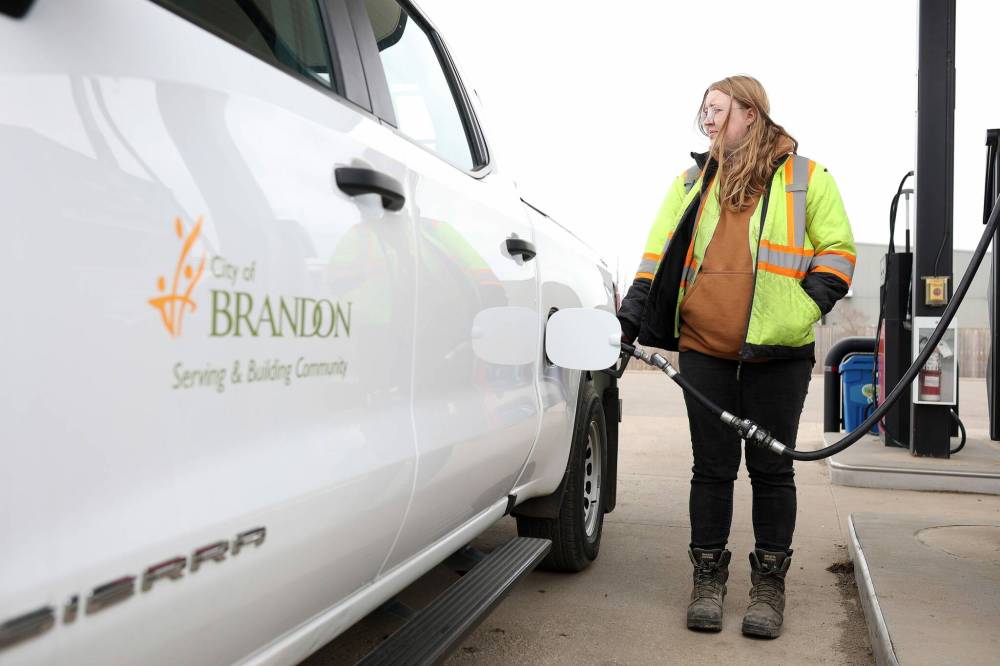
Celia Whitehead, a casual labourer with the City of Brandon, gasses up a work vehicle at the Co-op Cardlock on Richmond Avenue East in Brandon on Tuesday afternoon. (Tim Smith/The Brandon Sun)
City of Brandon director of finance Troy Tripp said the impact, while significant, remains manageable — for now.
“If current gas and diesel prices were to persist through the remainder of the year, the city could see an unfavourable variance in the range of $400,000 to $600,000 relative to budget,” he told the Sun.
Fuel and energy-related expenses account for about $2 million annually, covering roughly one million litres of diesel and 400,000 litres of gasoline used across transit, public works, emergency services and parks operations, he said.
Tripp said the financial pressure extends beyond direct fuel purchases.
“Elevated fuel prices can also affect the city indirectly through fuel surcharges applied to transportation of essential goods, such as treatment chemicals, and other contracted services,” he said. “These surcharges are being closely monitored and reviewed as part of the city’s contract management and budget monitoring processes.”
Despite the pressures, he said the situation remains under control.
“While these pressures are material, they remain manageable within the city’s overall operating framework,” Tripp said. “The city does not purchase fuel at retail pump prices and is partially insulated from day-to-day volatility through bulk purchasing and contracted supply arrangements.”
Any added costs are scrutinized, he said.
“Where fuel surcharges apply, they are assessed for accuracy and considered alongside broader contract costs,” he said.

The city is looking ahead to reduce long-term exposure to fuel price volatility.
“The city has recently installed its first electric-vehicle charging stations at the A.R. McDiarmid Civic Complex, and the process to procure the city’s first fully electric fleet vehicle additions is underway,” Tripp said.
“These initiatives are part of a broader, phased approach to modernizing the municipal fleet and reducing reliance on fossil fuels over time, where operationally and financially practical.”
For local businesses, however, the impact is more immediate and harder to absorb.
Trinity Food Store and BLG Distribution co-owner Olatoye Olaosebikan said fuel surcharges in the trucking sector have surged dramatically.
“Before, you’d see a 20 to 25 per cent fuel surcharge. Now it has gone as high as 61 per cent,” he told the Sun.
“That spike has translated directly into higher transportation costs. A delivery that once cost around $200 can now approach $300 or more.”
Even routine trucking operations have become more expensive, with a return trip to Winnipeg rising from about $180 in fuel costs to over $230, he said.

For retailers, passing those increases on to customers is not straightforward.
“You can’t transfer everything,” Olaosebikan said. “If your cost goes up by $10, you can’t increase your price by the same $10. You have to meet somewhere in the middle.”
As a result, profit margins are shrinking while prices on goods, especially frequently stocked items, continue to rise. Frozen foods, including fish products, have seen noticeable increases, putting additional strain on household budgets, he said.
Olaosebikan said customers are already “complaining bitterly,” and if high fuel prices persist, many shoppers may shift from bulk buying to smaller, more frequent purchases just to manage costs. “People won’t be able to afford the kind of food they used to eat.”
Progressive Westman director of operations Mike Sacharko said the company has seen shipping and fuel-related costs rise over time, but often chooses not to pass them fully onto customers.
“A lot of times, we’ve been eating that cost,” he told the Sun. “We want to give the customer the best deal they possibly can.”
Still, he said that fuel surcharges are becoming more common across the supply chain, particularly in freight shipping, where additional fees are now routinely added per shipment.
To offset rising costs, the company has begun investing in electric vehicles. With two already in operation and another recently added, Sacharko said the shift is already making a difference.
“There’s no gas, no oil changes — it reduces maintenance and operating costs,” he said. “I think that’s the way of the future.”

While the City of Brandon can manage rising fuel costs within its broader financial framework, the same cannot be said for many local businesses operating on tighter margins.
From higher delivery fees to increased retail prices, the effects are cascading through the local economy, impacting everything from municipal services to the cost of groceries.
“It’s just going to hit everybody,” Olaosebikan said.
» aodutola@brandonsun.com
» X: @AbiolaOdutola