
HIV rise declared public health emergency
Advertisement
Read this article for free:
or
Already have an account? Log in here »
We need your support!
Local journalism needs your support!
As we navigate through unprecedented times, our journalists are working harder than ever to bring you the latest local updates to keep you safe and informed.
Now, more than ever, we need your support.
Starting at $15.99 plus taxes every four weeks you can access your Brandon Sun online and full access to all content as it appears on our website.
Subscribe Nowor call circulation directly at (204) 727-0527.
Your pledge helps to ensure we provide the news that matters most to your community!
To continue reading, please subscribe:
Add Brandon Sun access to your Free Press subscription for only an additional
$1 for the first 4 weeks*
- Enjoy unlimited reading on brandonsun.com
- Read the Brandon Sun E-Edition, our digital replica newspaper
*Your next Free Press subscription payment will increase by $1.00 and you will be charged $20.95 plus GST for four weeks. After four weeks, your payment will increase to $24.95 plus GST every four weeks.
Read unlimited articles for free today:
or
Already have an account? Log in here »
The Manitoba government has declared a public health emergency over the increased transmission of HIV — with “concerning” rates of the virus in the Prairie Mountain and Northern health regions.
Dr. Brent Roussin, the chief provincial public health officer, made the declaration on Thursday.
“This emergency is driven by a number of factors, one being injection drug use, homelessness, mental health issues, as well as a rise in other sexually transmitted and blood-borne infections, as well as various barriers to access to care,” Roussin said.
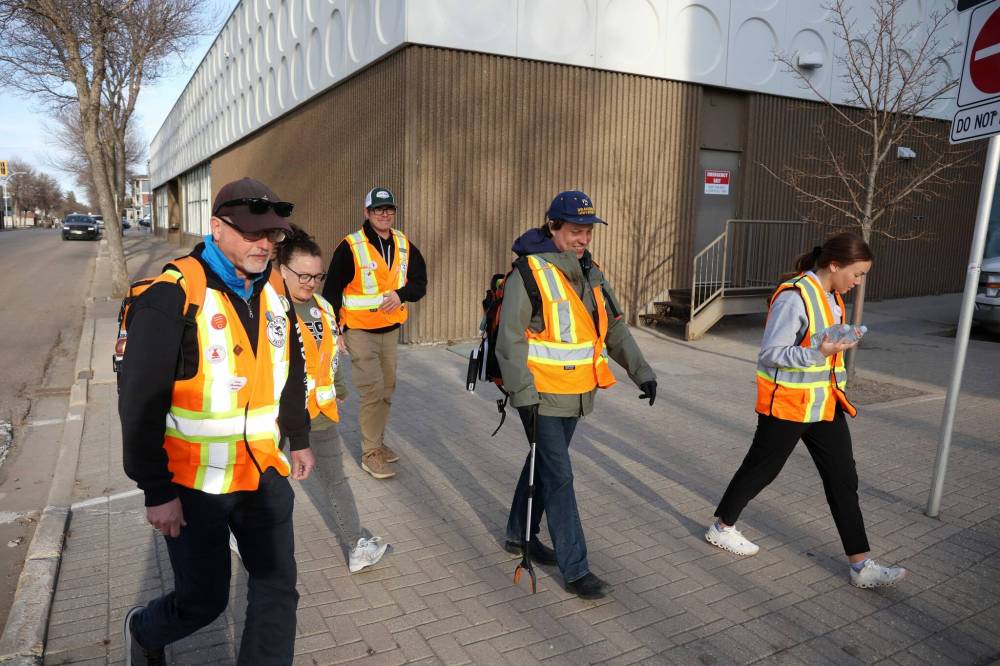
Brandon Bear Clan members patrol Princess Avenue in downtown Brandon on Thursday evening, handing out food, water and clothing and offering help to people in need in the downtown core. (Tim Smith/The Brandon Sun)
Manitoba continues to see some of the highest rates of human immunodeficiency virus in Canada as provincial numbers have “sharply risen” over the last few years, he said.
In 2024, Manitoba reported 19.5 cases per 100,000 people — more than three and a half times the national rate of 5.5 per 100,000 people, Roussin said.
Last year saw a total of 328 reported cases, up from 142 cases in 2021 and 90 in 2019.
While Roussin didn’t publicly release numbers for the first quarter of 2026, he said it’s similar to the number of cases during that same period in 2025.
The Prairie Mountain and Northern regional health authorities currently have the highest rates per capita and the Winnipeg region has the most cases overall.
“We know that Indigenous people are disproportionately affected by this, and we know that relates back to all the factors that come from the ongoing effects of colonization,” Roussin said.
It is the first time Manitoba has declared a public health emergency related to HIV. Doing so opens a “number of options” to increase awareness and access to treatment and prevention through non-traditional forms of testing, which includes point-of-care testing and self-testing, he said.
“We want to bring this level of urgency and awareness to all of our partners, to Manitobans.”
Responding to the conditions driving HIV transmission requires a co-ordinated approach with health authorities, Indigenous leadership, grassroots organizations and the federal government, Roussin said.
“We have, you know, really amazing work being done at the community level, at the ground level, but despite all this work, despite all the increased investment, we still see our numbers climbing,” he said.
Declaring a public health emergency was recommended by different levels of government, Indigenous leaders, community groups, health-care organizations and other experts during a meeting in December 2025 to discuss Manitoba’s response to HIV prevention, Roussin said.
The meeting also led to the launch of an HIV response steering committee that will be co-ordinated through public health.
“We want to raise that level of urgency, raise our co-ordination and really start to bring it all together because we all know these numbers are not acceptable,” he said.
The province plans to amplify work that’s already being done in communities because grassroots organizations know what messaging is effective to spread awareness that’s culturally safe.
Jade Gamblin, Brandon Bear Clan Patrol supervisor, said the province issuing a public health emergency was “bound to happen” because there’s a lack of harm reduction supports in Manitoba, including spaces for safe injection.
She said patrols have seen an increase of used needles on the ground since the snow has melted.
The group patrols daily and hands out clean needle usage kits, inhalation kits, safe sex supplies and papers with resources to ensure people know where to access more harm reduction supplies.
“We see a lot of our relatives are folks who are very aware. They do practise safe use, and they are pretty mindful of the people that they’re with,” Gamblin said.
Gaps in providing safe supplies throughout the weekends or evenings can lead to people sharing needles or using discarded ones on the ground, which puts people at increased risk, she said.
Education and awareness are of utmost importance when aiming to reduce HIV transmission, said Sioux Valley Dakota Nation Chief Jennifer Bone.
“People need access to accurate information, testing, prevention tools, the health-care supports, also in a way that’s respectful and free from that stigma,” Bone said.
“Because when the stigma exists, it can prevent people from seeking help or accessing services early.”
Bone said continued collaboration with Indigenous communities and long-term investments in culturally appropriate health-care services are essential in managing health crises.
“As First Nations and Indigenous communities, we know our realities best, and it’s important that governments work directly with the leadership and local health-care providers in developing those strategies and those programs,” Bone said.
She would also like to see more supports dedicated to mental health and addictions services in rural and Indigenous communities.
Since 2023, the Manitoba government has spent more than $8 million to fund increased access to care for HIV and other sexually transmitted and blood-borne infections, which includes HIV medication such as pre-exposure prophylaxis (PrEP) and post-exposure prophylaxis (PEP), the province said.
“HIV is preventable and it’s treatable,” Roussin said, adding that PrEP is underutilized by some of the most high-risk groups across the province.
More than 50 per cent of new HIV cases in Manitoba are in females who access “very little” of PrEP. There are also very few people who inject drugs accessing the medication, he said.
In 2024, about 70 per cent of HIV transmission was related to drug injection, Roussin said. Unprotected heterosexual sex was also a factor.
Females account for more than half of HIV cases in Manitoba, compared to the Canadian average of 32 per cent, the province said.
There was one case where an infant was born with HIV infection in 2024 and another in 2025. Prior to 2024, the last case of perinatal transmission was in 2021.
The majority of newly diagnosed females are under 40 years old, which increases the risk of more perinatal cases, the province said.
» tadamski@brandonsun.com