
BSD concerned about impact of clock policy
Advertisement
Read this article for free:
or
Already have an account? Log in here »
We need your support!
Local journalism needs your support!
As we navigate through unprecedented times, our journalists are working harder than ever to bring you the latest local updates to keep you safe and informed.
Now, more than ever, we need your support.
Starting at $15.99 plus taxes every four weeks you can access your Brandon Sun online and full access to all content as it appears on our website.
Subscribe Nowor call circulation directly at (204) 727-0527.
Your pledge helps to ensure we provide the news that matters most to your community!
To continue reading, please subscribe:
Add Brandon Sun access to your Free Press subscription for only an additional
$1 for the first 4 weeks*
- Enjoy unlimited reading on brandonsun.com
- Read the Brandon Sun E-Edition, our digital replica newspaper
*Your next Free Press subscription payment will increase by $1.00 and you will be charged $20.95 plus GST for four weeks. After four weeks, your payment will increase to $24.95 plus GST every four weeks.
Read unlimited articles for free today:
or
Already have an account? Log in here »
Brandon School Division’s senior administration is urging Manitoba to consider the impact of changing clocks two times a year on students and youth as the province seeks public feedback.
Supt. Mathew Gustafson, during the school board general meeting last week, presented an analysis of how permanent standard time, permanent daylight saving time, and the current biannual time change could affect students’ daily lives, mental health, safety and opportunities for physical activity.
“I’ve noticed that the rationale provided is consistent with studies,” Gustafson said. “However, the rationale does not appear to reflect the student perspective or the impact on youth and education.”
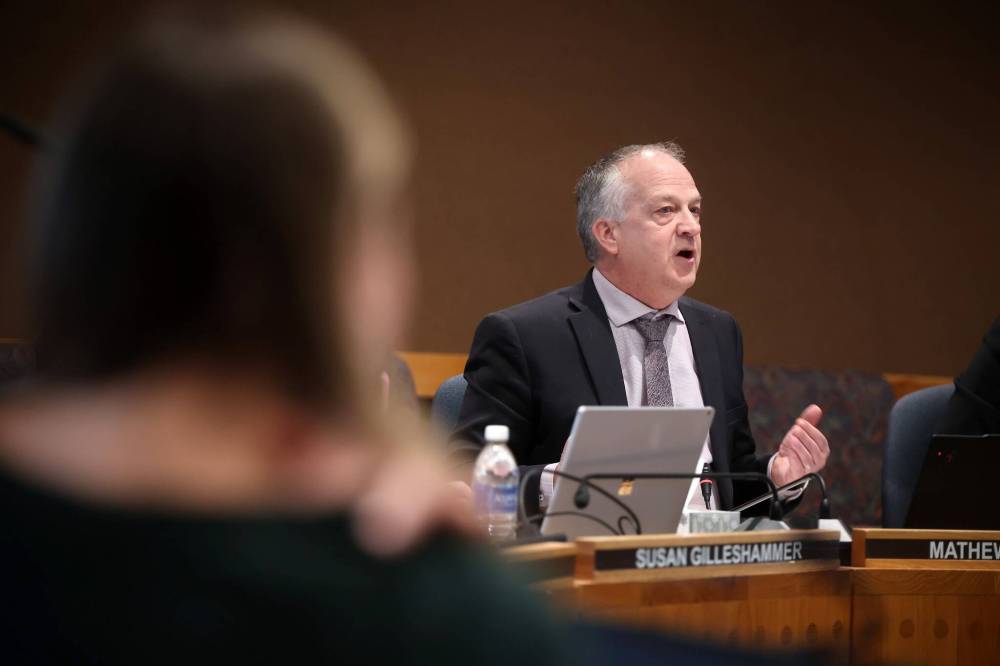
Brandon School Division Supt. Mathew Gustafson says the research and some of the resulting conclusions in the public discourse on time changes do not appear to weigh the behavioural, societal, and psychological variables, in addition to the biological variables. (Tim Smith/The Brandon Sun files)
He added that existing research often overlooks key factors affecting students in Manitoba’s northern latitude.
“The research and some of the resulting conclusions in the public discourse do not appear to weigh the behavioural, societal, and psychological variables, in addition to the biological variables,” he told the board.
Gustafson also pointed to how daylight patterns interact with students’ daily routines, noting that many analyses fail to consider when youth are actually awake.
“Students do not make use of the additional time in the morning, as their wake times tend to be later,” he said.
He said that while permanent standard time may increase morning daylight in winter, it reduces usable daylight after school.
“The one-hour earlier sunset reduces the amount of time for youth to engage in outdoor extracurricular or recreational activities during the spring and fall,” Gustafson said. “Youth from lower socioeconomic status backgrounds have fewer opportunities for club or fee sport activities and therefore rely on school activities.”
He warned that reduced evening daylight could have broader social impacts.
“The one lost hour during the waking hours means that youth have less time to access the playgrounds in the spring and fall in the evenings,” he said. “It seems that earlier sunset times may expose youth to additional antisocial behaviours.”
On permanent daylight saving time, Gustafson said the trade-off is different but still significant.
“The daylight saving time model provides the greatest amount of daylight during the waking hours during the time of year when it’s most enjoyable to be outside,” he said. “It means that during warmer weather, youth can be outside for longer in the daylight, creating a safer environment than being outside in the dark.”
However, he cautioned about winter conditions under that system.
“It would result in students walking to school in the dark for a quarter of the school year during the winter months,” Gustafson said. “The later daylight times mean colder walking experiences and an increased likelihood of indoor recesses in the morning.”
He said that neither permanent option fully solves the issue.
“It is acknowledged that neither permanent standard nor permanent daylight-saving times address all issues,” he said. “Each have their advantages and disadvantages from biological, psychological, behavioural, and societal perspectives.”
Trustees responded by reflecting on broader implications for student performance and well-being.
Chair Linda Ross said the discussion raised new considerations about school scheduling.
“There’s lots of data that shows, particularly for young teenagers, that if we started school later in the day, they would probably be more productive,” she said.
Ross encouraged public participation in the provincial consultation.
“If you want your voice to be heard, the survey is out there,” she said.
The Manitoba government is currently seeking input from residents as it considers whether to maintain or change the current system of switching between standard time and daylight-saving time.
» aodutola@brandonsun.com
» X: @AbiolaOdutola