
Dam operations blasted from both sides
Advertisement
Read this article for free:
or
Already have an account? Log in here »
We need your support!
Local journalism needs your support!
As we navigate through unprecedented times, our journalists are working harder than ever to bring you the latest local updates to keep you safe and informed.
Now, more than ever, we need your support.
Starting at $15.99 plus taxes every four weeks you can access your Brandon Sun online and full access to all content as it appears on our website.
Subscribe Nowor call circulation directly at (204) 727-0527.
Your pledge helps to ensure we provide the news that matters most to your community!
To continue reading, please subscribe:
Add Brandon Sun access to your Free Press subscription for only an additional
$1 for the first 4 weeks*
- Enjoy unlimited reading on brandonsun.com
- Read the Brandon Sun E-Edition, our digital replica newspaper
*Your next Free Press subscription payment will increase by $1.00 and you will be charged $20.95 plus GST for four weeks. After four weeks, your payment will increase to $24.95 plus GST every four weeks.
Read unlimited articles for free today:
or
Already have an account? Log in here »
Two farmers have joined a campground owner in decrying the province’s management of the Shellmouth Dam this spring.
Stan Cochrane, who farms north of Griswold near the Assiniboine River, said he is dealing with prolonged flooding on about 500 acres of farmland.
He said the dam should be operated differently to prevent this problem downstream.
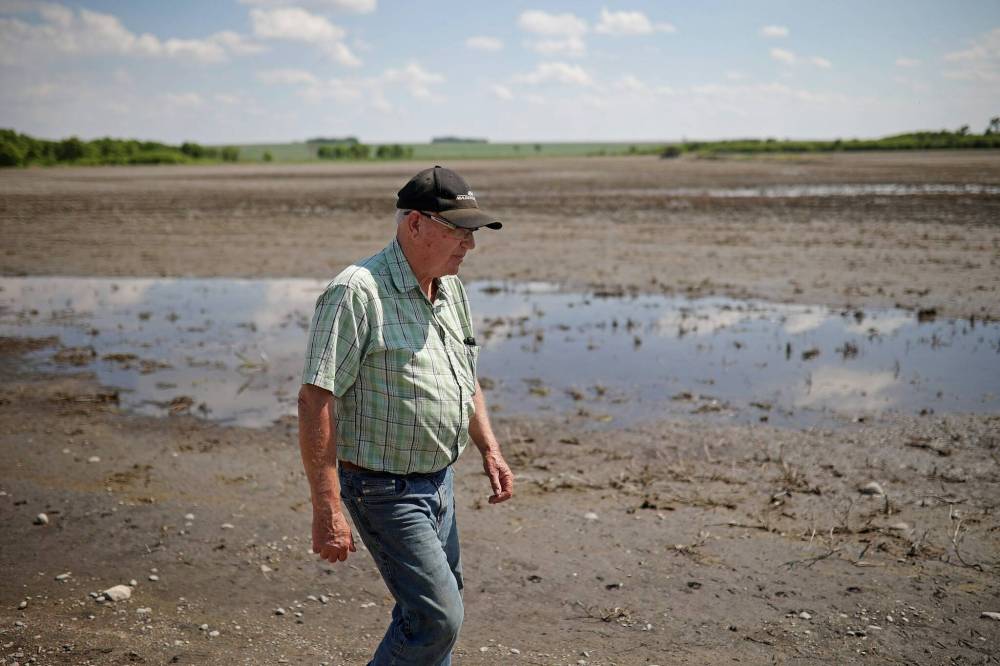
Lifelong farmer Stan Cochrane looks over one of his fields bordering the Assiniboine River east of Sioux Valley Dakota Nation on Friday afternoon. About 500 acres of Cochrane’s land is still wet with puddles after being flooded by the rise in the Assiniboine River caused when water was released from the Shellmouth reservoir. Cochrane needs the land to dry up enough so that he can finish seeding. (Tim Smith/The Brandon Sun)
The provincial guideline he takes issue with is keeping the reservoir at 1,386 feet above sea level ahead of the spring thaw. Cochrane said it should be lowered so that the dam has more room to store water when snow melts.
“We’re saying that they could lower it down to 1,380,” Cochrane told the Sun on Friday. “If they had let more water out in the spring, maybe they would be able to hold back enough water now, so that the water would be off our fields.”
The acres are meant for soybeans, but a deadline is approaching this month to have the land seeded and still be covered by crop insurance.
It’s too risky to seed crops once the deadline passes, and so his family farm will pivot and grow livestock feed for his cattle if the water does not dry up in the next few weeks, he said.
“It makes a big difference,” he said. “Every farmer from here to the dam is going to lose $100,000. And if your farm is big enough, you might lose (up to) $300,000.”
Cochrane said one of his biggest complaints is the importance given to fish at the dam. The province states on its website that “fish kill is a concern” should the water go below 1,386 feet in the winter.
“That seems to be one of the biggest problems we have, as far as releasing water in the spring,” Cochrane said. “What’s more important — the fishery at the lake or the thousands of acres of land between the lake and Brandon?”
He said crop production should take precedence for its value in growing food, adding that he has advocated for many years to have some sort of compensation, or changes at the dam, but to no avail.
“I’m over 70 years old. I’m almost sick of fighting them.”
The province told the Sun last week that it is dealing with one of the highest inflow volumes on record for the Shellmouth reservoir system due to the 2026 spring runoff. The water flowed in from Saskatchewan and the Assiniboine River Basin.
The province projected that the reservoir is expected to stay high at least until mid-June. Under wet conditions, the reservoir is projected to stay at the same level through the end of the month.
A provincial spokesperson noted that people who are affected can turn to agricultural insurance and business risk management or emergency support programs.
Keith Pearn, a farmer east of Virden, told the Sun on Friday that the floods are lasting “too long” due to the province’s practices. He believes higher volumes of water should be released from the dam early in the spring, because it would end the flood faster.
“I do expect to be flooded, but these floods are lasting too long, and it’s just not sustainable,” Pearn said. “We could be flooded into July, and I don’t think that’s right.”
Farmers are blocked from seeding their land by any amount of water on their fields — so it would be better to keep the floods shorter, even if they run higher while they last, he said.
“We are already flooded, so it doesn’t matter to us. You got water running over the land anyways. I mean, two inches or two feet, you can’t do nothing with that land,” he said.
He said he has asked for a review of the Shellmouth Dam guidelines, but that has not happened.
Pearn is a beef producer and farms canola, soybeans and wheat.
The farmers’ complaints echo concerns expressed by the owner of the Pyotts West Campground, located upstream of the dam, who said last week he expects to lose between $40,000 and $100,000 due to flooding at the campsites.
Owner Jason Digby said he wanted to see the province increase outflows of water during the spring as well.
“The way that it is now, they’re not helping anybody, because it’s still keeping the water level high below the dam, so they still can’t get on their fields,” he said.
The provincial government did not provide a response to the Sun when asked about the concerns raised by farmers on Friday.
» cmcdowell@brandonsun.com